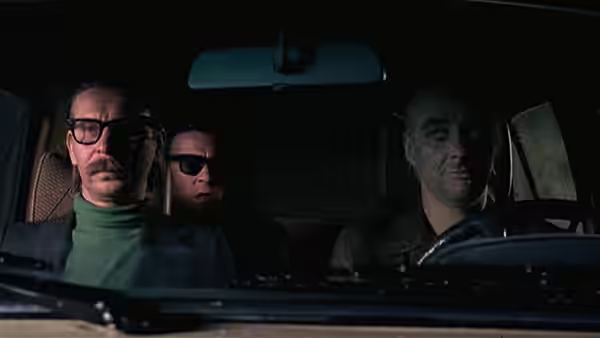
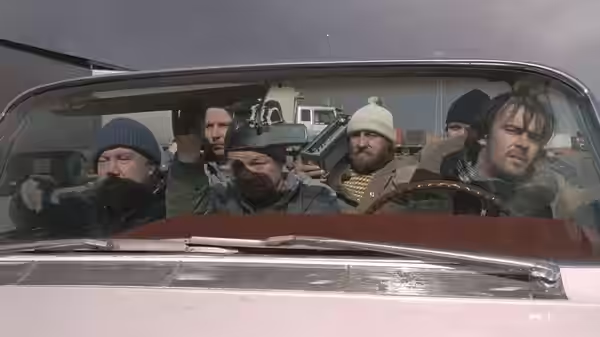
Three men sit inside a car, with one behind the wheel and two in the back
Film review

Ariel

1988 · Directed by Aki Kaurismäki · 1h 13m

In a sentenceA convertible with no roof, a winter with no end, and a hero who takes both the way you take the weather

Northern Finland, in winter. The mine where Taisto Kasurinen (Turo Pajala) works is closed, and the men are told over a loudspeaker to collect their pay. His father, a fellow miner (Erkki Pajala), sits him down in a café, hands him the keys to a white Cadillac convertible whose roof will not go up, tells him to try the south, and excuses himself to the lavatory. Taisto drives to Helsinki in an open car with his savings in his jacket. Soon after arriving he is robbed at knifepoint by a mugger (Matti Jaaranen) and left with the car and nothing else. He takes casual work at the harbour, sleeps in a night hostel, and is fined for parking by Irmeli Pihlaja (Susanna Haavisto), a traffic warden with a small son, Riku (Eetu Hilkamo). He asks her out. She agrees, without visible enthusiasm.

Fi1m review

Aki Kaurismäki follows a sacked miner south in a roofless Cadillac and is finished in 73 minutes. It is dry, plain and unexpectedly tender, and we would send almost anyone to it with one warning: its people show nothing, and you must meet them halfway.

Aki Kaurismäki’s Ariel begins with a mine closing in northern Finland and is over in 73 minutes, and it does not waste one of them. It is a film about Finns at the bottom of the pay scale who say little and are let down a great deal, and it is a good place to start with Kaurismäki. We would send almost anyone to it, with one warning we will come to.

Taisto Kasurinen (Turo Pajala) is told over a loudspeaker that the mine has shut. His father (Erkki Pajala) sits him down in a café, hands him the keys to a white Cadillac convertible, tells him to head south, and excuses himself to the lavatory, from which he does not return. The Cadillac’s roof will not go up, so Taisto drives the length of the country with snow on the seats, wearing the jacket he will wear for the rest of the film. We laughed at the roof, and we laughed at the father’s exit, which is staged as a man stepping out for a moment, and then we felt ashamed of ourselves. We suspect that is the intended order.

In Helsinki he is robbed of everything but the car by a mugger (Matti Jaaranen), takes casual work at the harbour, and is fined for parking by Irmeli Pihlaja (Susanna Haavisto), a traffic warden with a small son, Riku (Eetu Hilkamo). Their courtship takes about four lines of dialogue. He asks; she says yes; nobody smiles. It moved us far more than we were braced for, because Kaurismäki has cut away every gesture actors normally use to signal love, and what is left, two tired people deciding to try, is enough. Hilkamo plays the boy as a small, unimpressed adult, and he is funny.

Pajala has a long face that does almost nothing, and the film is built on it. He takes the sack, the robbery and the weather with the same faint nod, and by the half-hour mark that nod has become expressive; you can read a whole day’s disappointment in how slowly it arrives. Haavisto matches him. Matti Pellonpää, as Mikkonen, a man Taisto meets once his luck has properly gone, gives him a courtesy so weary it is almost tender.

Timo Salminen shoots it in hard, flat colour: grey streets, brown rooms, and then one red jacket or one blue door that carries the whole frame. He keeps the camera still and lets people walk into the shot and out of it, so that the empty room they leave behind is part of the scene. Risto Karhula furnishes rooms with a table, a bed and a radio and no more, and Tuula Hilkamo dresses everybody as if they own one outfit, which they do. Raija Talvio cuts each scene a beat before another editor would let it start, so that we are always arriving after the decision has been taken. The music is credited to Olavi Virta, Taisto Tammi and Pyotr Ilyich Tchaikovsky, among others, and it is warmer than any face on screen.

The warning. Kaurismäki’s people show almost nothing, and if you need a face to tell you what to feel you will find this cold and possibly smug. It is neither, but it does ask something of you. The crime plot that takes over in the second half is also thinner than the first half deserves. It is handled with a shrug, the way everything is handled, and a shrug is a less interesting response to a gun than to a parking ticket. There is a stretch of perhaps ten minutes where the deadpan runs on its own momentum.

Then it recovers, and the last movement is among the most quietly hopeful things Kaurismäki has made, in a way we will not describe. See it in a cinema if one is showing it, where the long stares have room. At home, keep your phone in another room. It does not repeat itself, and at 73 minutes there is nothing to skip.

Critical consensus AI synthesised

73
Positive
3
Mixed
1
Negative
0
Empire
1 January 2000 · Robyn Karney
75*

Karney recommends the film as interesting, entertaining and absorbing. She praises Kaurismäki’s cool, well-paced direction and tightly constructed storytelling.

Read the full review →
Los Angeles Times
7 November 1990 · Kevin Thomas
75*

Thomas praises Ariel as one of Kaurismäki’s best, finding dark humor and meaning in its spare portrayal of marginal lives. He singles out the film’s beautiful imagery and bleakly impersonal settings.

Read the full review →
Time Out
· TCh
64*

The available page identifies this as a review but reveals no critical verdict. No praise or complaint is available in the accessible text.

Read the full review →
Eye for Film
16 October 2007 · Anton Bitel
80*

The critic finds the film compelling, funny, and ultimately romantic despite its grim subject matter. They praise its beautifully shot minimalist style and the lively plot it conceals.

Read the full review →

Straight answers AI written, from our review

Is Ariel worth watching?
Ariel is worth watching for almost anyone who can meet a film halfway, and we scored it 80. Kaurismäki's sacked miner drives a roofless Cadillac south and is finished in 73 minutes that are dry, plain and unexpectedly tender. Its people show nothing on their faces, and if you need to be told what to feel you will find it cold.
How long is Ariel, and what is it rated?
Ariel runs 1h 13m. It is a drama and romance film.
Where can I watch Ariel in Vietnam?
Ariel is not on any streaming or rental service in Vietnam at the moment. It is available in 6 other countries; change your country at the top of the page to see where. Availability is checked daily.
How violent or frightening is Ariel, and is it suitable for children?
Ariel carries a UK 15 certificate and is a low-key drama rather than a frightening one. There is a mugging at knifepoint early on and a thinner crime plot in the second half, all of it handled with a shrug rather than dwelt on. It is not for young children, less because of what is shown than because its long silent stares ask for a patience they will not have.
How does Ariel compare to Stranger Than Paradise?
Ariel is the warmer and tighter of the two, and Stranger Than Paradise is the funnier. Both are deadpan road films about drifters who say little, but Kaurismäki gives his miner a courtship and a quiet hope, while Jarmusch's determined cool keeps his people at a distance. Start with Kaurismäki if you want to be moved, Jarmusch if you want to laugh.
What should I watch after Ariel?
After Ariel, try Stranger Than Paradise (1984, Fi1m 82): Jarmusch’s deadpan road film about drifters, the closest American cousin to Kaurismäki. Then Pickpocket (1959, Fi1m 84): Bresson’s blank-faced thief and the stillness Kaurismäki learned from.

Cast

If you liked this, try…

  1. The Match Factory Girl (1990) · not on Fi1m yetKaurismäki two years later, colder and even shorter, with a heroine who acts.

  2. Stranger Than Paradise (1984, Fi1m 82)Jarmusch’s deadpan road film about drifters, the closest American cousin to Kaurismäki.

  3. Pickpocket (1959, Fi1m 84)Bresson’s blank-faced thief and the stillness Kaurismäki learned from.

  4. They Live by Night (1948) · not on Fi1m yetNicholas Ray’s lovers on the run, tender and doomed and beautifully lit.

  5. Songs from the Second Floor (2000) · not on Fi1m yetRoy Andersson’s fixed-camera Swedish misery, funnier and stranger than it sounds.

Ariel (1988) review: deadpan, tender, over in 73 minutes (Vietnam) | Fi1m