Robert Bresson follows a donkey from foal to old age through the hands of a French village and never tells us what to feel. Hard going in places, drawn with a ruler in others, and among the most exact films we know.
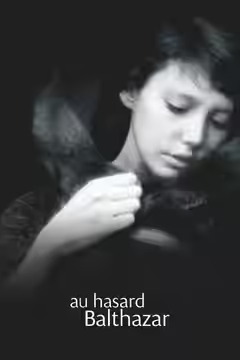
Robert Bresson wrote and directed Au Hasard Balthazar, and the title character is a donkey. He is born on a farm in the French countryside, baptised by children with salt and water, and loved for a summer by Marie (Anne Wiazemsky) and Jacques (Walter Green). Then Jacques’s family leaves, Marie’s father (Philippe Asselin) takes on the land, and Balthazar becomes a working animal. Over 96 minutes he passes from hand to hand: a farmer who beats him, a baker’s wife (Marie-Claire Fremont) and her delivery boy Gérard (François Lafarge), the village drunk Arnold (Jean-Claude Guilbert), a grain merchant (Pierre Klossowski). Marie grows up alongside him and does not do much better.
We would tell a stranger to see it, with a warning attached. Bresson works with non-professionals, has them speak flatly and keeps their faces still, so that nobody on screen tells us what to feel. In his earlier films this could look like a discipline imposed on actors. Here it is simply the condition of the lead, because a donkey cannot act, cannot be sentimental and cannot be lying. Everything human in the film is measured against an animal that only watches.
We were horrified, twice, and both times it was the framing that did it. Early on Gérard twists a sheet of newspaper round Balthazar’s tail and sets it alight, and Ghislain Cloquet does not show us a suffering face. He shows the tail, the hooves shifting on the road, the boy’s hands, and then Raymond Lamy cuts away before the animal has finished reacting. Later, worked past exhaustion, Balthazar lies down in a lane and the men stand over him with sticks. Bresson will not hold the shot, and that is exactly why we could not bear it.
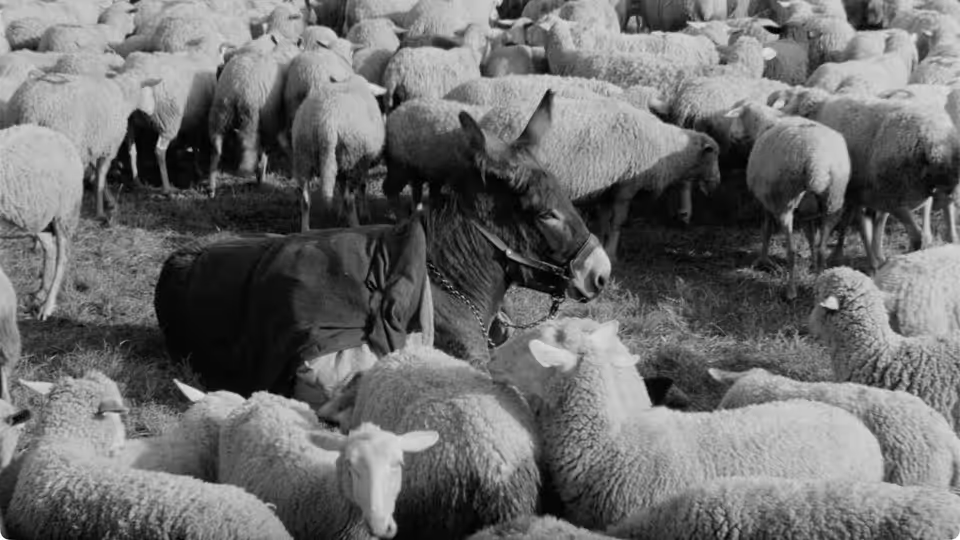
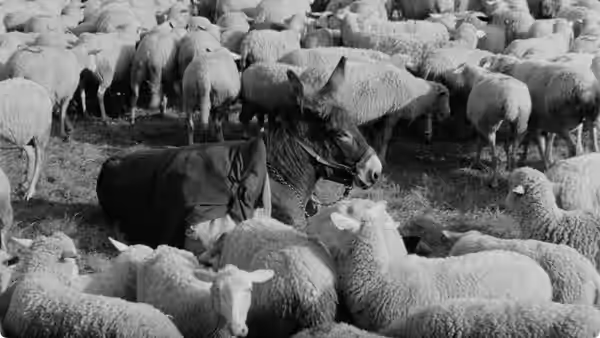
Cloquet shoots in black and white and low to the ground, near the height of a donkey’s eye, so that people arrive as boots and legs and hands before they are faces. Pierre Charbonnier’s rooms are bare: a barn, a bakery, a bench outside a café, a table with a bottle on it. Jean Wiener is credited with the music and his share is mostly the jukebox where Gérard and his friends gather; the rest is a Schubert piano sonata, played in short stretches and stopped before it can swell. Otherwise the soundtrack is hooves, bells and a cart on a road.
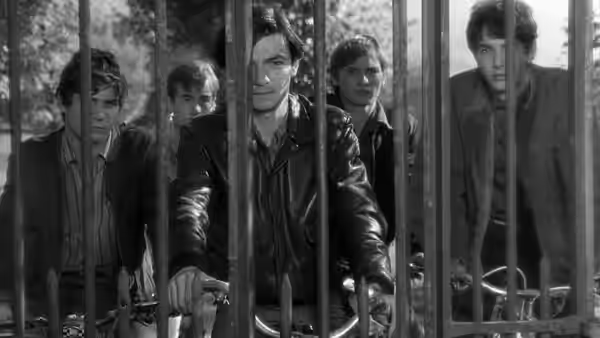
Not all of it holds. Gérard and his gang, with their leather jackets and mopeds and transistor radio, are the delinquents a film of 1966 imagined, and Lafarge is asked to be wicked in a way the rest of the cast are not asked to be anything. Klossowski’s merchant, counting coins and explaining why he gives nothing away, is a figure from a fable rather than a man. Bresson wants us to see Balthazar as a saint, which the film mostly earns by looking and occasionally insists on by arrangement. A couple of the parallels between the donkey’s life and Marie’s are drawn with a ruler.
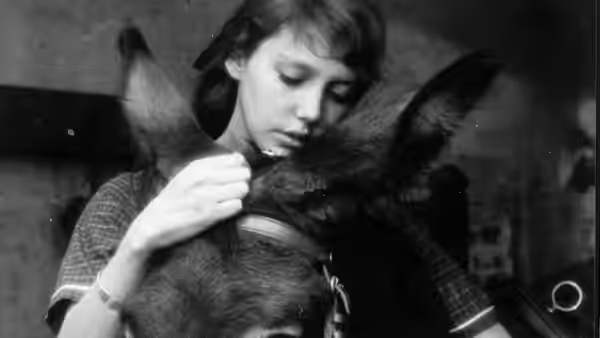
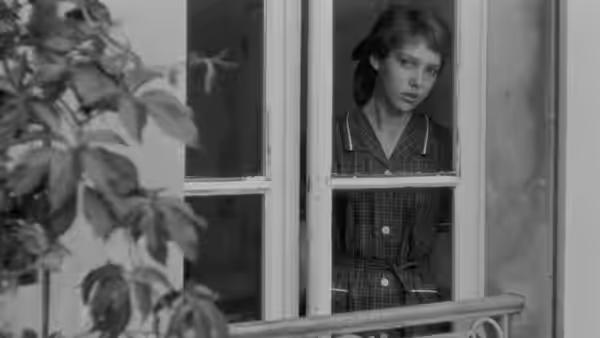
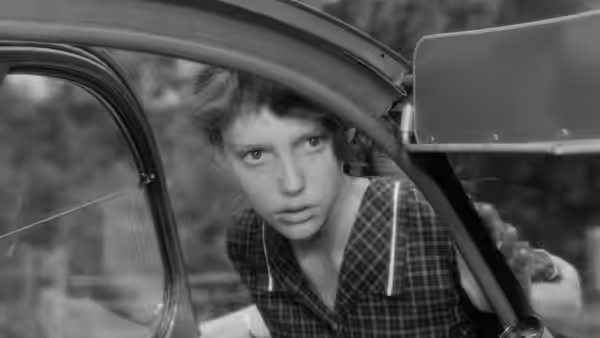
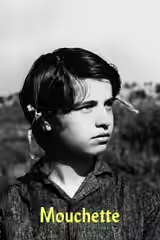
Wiazemsky’s Marie is the harder case. She goes to Gérard knowing what he is and stays, and Bresson gives us no inner life to explain it, only her walk, her hands on the donkey’s neck and a stare that goes past the camera. Some viewers find her a blank. We found her the most frightening thing in the film, because she is the one character with a choice and we could see her not making it.
Bresson’s earlier heroes had a task: a prisoner working at a door in A Man Escaped, a thief training his hands in Pickpocket. Balthazar wants nothing and plans nothing, and the film is braver for building itself round him. The second half takes him further than we will describe. Most critics rate it about where we do, and the one complaint that recurs, that the religious meaning is laid on thick, is fair for perhaps ten minutes of the 96.
It is not a film for children, and it is not a film to have on while you do something else. Look away and you lose the thread. Sit still for an hour and a half. The donkey manages considerably longer.