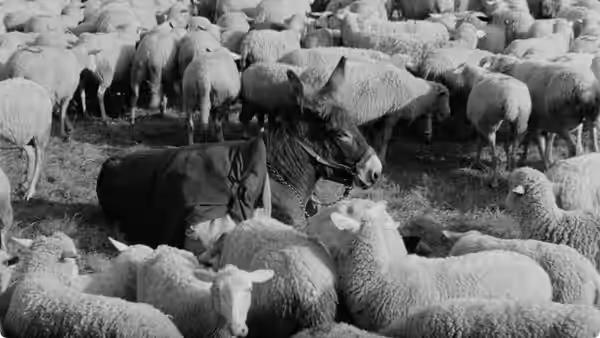
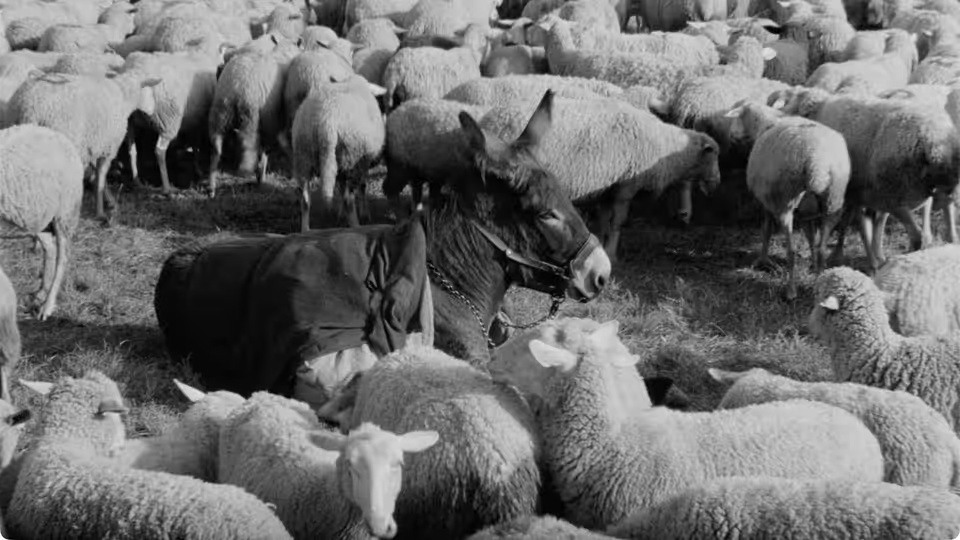
A donkey stands among a flock of sheep in a pasture
Film review

Au Hasard Balthazar

1966 · Directed by Robert Bresson · 1h 36m

In a sentenceEveryone in the village gets a turn with the stick, and the donkey keeps his opinions to himself

On a farm in the French countryside, children baptise a donkey foal with salt and water and name him Balthazar. Marie (Anne Wiazemsky) and Jacques (Walter Green), whose family owns the land, spend a summer with him before Jacques is taken away and Marie’s father (Philippe Asselin) is left to work the farm. Years pass. Balthazar is put to the cart, beaten, and passed to the village bakery, where the delivery boy Gérard (François Lafarge), who rides a moped and runs with a gang, uses the donkey for his rounds and for his temper. Marie, now grown, is drawn to Gérard in spite of everything she has watched him do. Around them are Arnold (Jean-Claude Guilbert), the local drunk, and a grain merchant (Pierre Klossowski), who will each have the donkey in their turn.

Fi1m review

Robert Bresson follows a donkey from foal to old age through the hands of a French village and never tells us what to feel. Hard going in places, drawn with a ruler in others, and among the most exact films we know.

Robert Bresson wrote and directed Au Hasard Balthazar, and the title character is a donkey. He is born on a farm in the French countryside, baptised by children with salt and water, and loved for a summer by Marie (Anne Wiazemsky) and Jacques (Walter Green). Then Jacques’s family leaves, Marie’s father (Philippe Asselin) takes on the land, and Balthazar becomes a working animal. Over 96 minutes he passes from hand to hand: a farmer who beats him, a baker’s wife (Marie-Claire Fremont) and her delivery boy Gérard (François Lafarge), the village drunk Arnold (Jean-Claude Guilbert), a grain merchant (Pierre Klossowski). Marie grows up alongside him and does not do much better.

We would tell a stranger to see it, with a warning attached. Bresson works with non-professionals, has them speak flatly and keeps their faces still, so that nobody on screen tells us what to feel. In his earlier films this could look like a discipline imposed on actors. Here it is simply the condition of the lead, because a donkey cannot act, cannot be sentimental and cannot be lying. Everything human in the film is measured against an animal that only watches.

We were horrified, twice, and both times it was the framing that did it. Early on Gérard twists a sheet of newspaper round Balthazar’s tail and sets it alight, and Ghislain Cloquet does not show us a suffering face. He shows the tail, the hooves shifting on the road, the boy’s hands, and then Raymond Lamy cuts away before the animal has finished reacting. Later, worked past exhaustion, Balthazar lies down in a lane and the men stand over him with sticks. Bresson will not hold the shot, and that is exactly why we could not bear it.

Cloquet shoots in black and white and low to the ground, near the height of a donkey’s eye, so that people arrive as boots and legs and hands before they are faces. Pierre Charbonnier’s rooms are bare: a barn, a bakery, a bench outside a café, a table with a bottle on it. Jean Wiener is credited with the music and his share is mostly the jukebox where Gérard and his friends gather; the rest is a Schubert piano sonata, played in short stretches and stopped before it can swell. Otherwise the soundtrack is hooves, bells and a cart on a road.

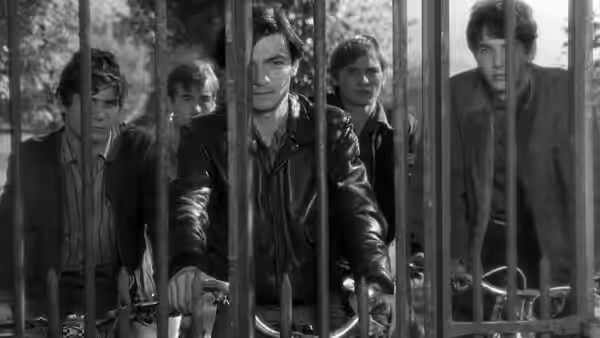
Not all of it holds. Gérard and his gang, with their leather jackets and mopeds and transistor radio, are the delinquents a film of 1966 imagined, and Lafarge is asked to be wicked in a way the rest of the cast are not asked to be anything. Klossowski’s merchant, counting coins and explaining why he gives nothing away, is a figure from a fable rather than a man. Bresson wants us to see Balthazar as a saint, which the film mostly earns by looking and occasionally insists on by arrangement. A couple of the parallels between the donkey’s life and Marie’s are drawn with a ruler.

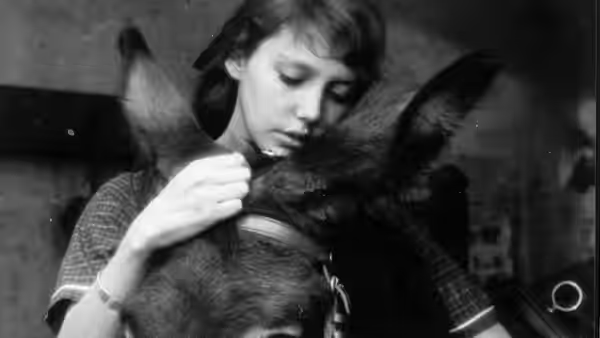
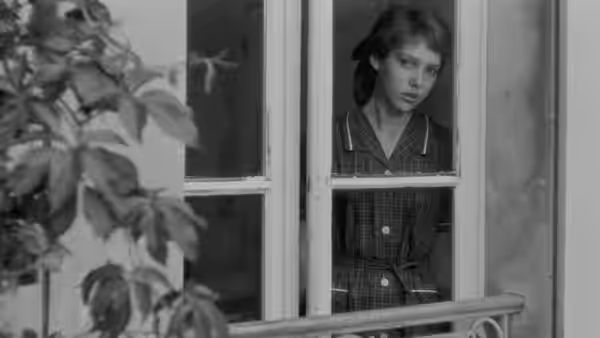
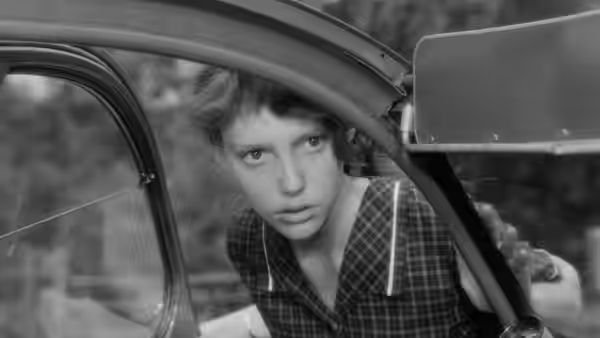
Wiazemsky’s Marie is the harder case. She goes to Gérard knowing what he is and stays, and Bresson gives us no inner life to explain it, only her walk, her hands on the donkey’s neck and a stare that goes past the camera. Some viewers find her a blank. We found her the most frightening thing in the film, because she is the one character with a choice and we could see her not making it.

Bresson’s earlier heroes had a task: a prisoner working at a door in A Man Escaped, a thief training his hands in Pickpocket. Balthazar wants nothing and plans nothing, and the film is braver for building itself round him. The second half takes him further than we will describe. Most critics rate it about where we do, and the one complaint that recurs, that the religious meaning is laid on thick, is fair for perhaps ten minutes of the 96.

It is not a film for children, and it is not a film to have on while you do something else. Look away and you lose the thread. Sit still for an hour and a half. The donkey manages considerably longer.
Critical consensus AI synthesised

87
Positive
8
Mixed
1
Negative
0

Most critics agree, and warmly. Eight of nine reviews are positive, and the praise clusters around Bresson’s austere direction: plain images and sounds that critics find building toward something they describe as profound, heartbreaking and sublime. The donkey is the other point of agreement. Reviewers single out its unhumanised perspective, and the film’s refusal to sentimentalise it, as the source of whatever the film has to say about people. Several read it as a religious parable, and most treat the sacred and the brutal as deliberately balanced rather than at odds.

The spread is narrow and the reservations mild. Empire finds the religious overtones heavy-handed while still calling the film intelligent and morally serious. Eye for Film and Total Film are approving rather than rapturous, praising the unsentimental treatment of cruelty and the stark meditation on existence without going further. One review could not be read in full. Nobody argues the film fails; the disagreement is only about how far to go.

Radio Times
★★★★★ · Adrian Turner
100

Turner calls the film a masterpiece and a clear religious parable. He praises its remarkable range, describing it as austere, warm, grim, surreal, shocking and heartbreaking.

Read the full review →
Slant Magazine
22 June 2005 · ★★★★/4 · Eric Henderson
100

Henderson sees the film as a rare spiritual work that makes saintliness ordinary rather than elevating its characters above humanity. He praises Bresson’s dispassionate balance of the sacred and profane, especially in the donkey’s final moments among the sheep.

Read the full review →
Time Out
★★★★★ · Alexandre Prouvèze
100

The page identifies this as a five-star review, indicating a strongly positive verdict. The review text is unavailable, so no specific praise or complaint can be reliably identified.

Read the full review →
Los Angeles Times
22 February 2018 · Justin Chang
95*

Chang regards the film as a masterpiece and a profound, heartbreaking achievement. He singles out Bresson’s poetic transformation of a donkey’s brutal life into a deeply human vision.

Read the full review →
The AV Club
22 November 2016 · Ignatiy Vishnevetsky
90*

The critic presents the film as an unconventional masterpiece, praising Bresson’s austere style for making simple images and sounds profoundly powerful. He especially singles out the donkey’s unhumanized perspective as a source of the film’s insight into human nature.

Read the full review →
Total Film
20 September 1999 · ★★★★ · Total Film
80

The review praises the film as a stark, profound meditation on existence. It singles out the way images and sounds build toward a sublime epiphany.

Read the full review →

Straight answers AI written, from our review

Is Au Hasard Balthazar worth watching?
Au Hasard Balthazar is worth watching for anyone prepared to sit still through 96 minutes of a donkey being passed from hand to hand in a French village, and we scored it 90. Robert Bresson never tells us what to feel, and two scenes of the animal's mistreatment horrified us. It is not for children, and not for a distracted evening.
How long is Au Hasard Balthazar, and what is it rated?
Au Hasard Balthazar runs 1h 36m. It is a drama film.
Where can I watch Au Hasard Balthazar in Ireland?
Au Hasard Balthazar is not on any streaming or rental service in Ireland at the moment. It is available in 36 other countries; change your country at the top of the page to see where. Availability is checked daily.
How does Au Hasard Balthazar compare to Umberto D.?
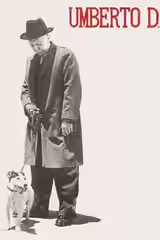
Au Hasard Balthazar and Umberto D. both set an animal beside a person the world has no use for, but Bresson keeps his distance where De Sica lets us in. The Italian film is the warmer and easier evening, carried by Carlo Battisti's proud, awkward old man. Bresson's is the more exacting, and the harder to shake off.
What should I watch after Au Hasard Balthazar?
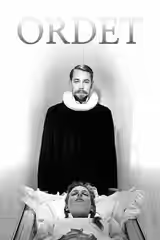
After Au Hasard Balthazar, try Umberto D. (1952, Fi1m 91): An old man, a small dog and a Rome that has no use for either. Then Ordet (1955, Fi1m 86): Dreyer’s farmhouse miracle, the other great film that takes faith at face value.

Cast

If you liked this, try…

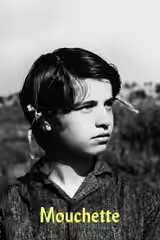
  1. Mouchette (1967) · not on Fi1m yetBresson’s next film, a village girl this time, just as plain and just as hard.

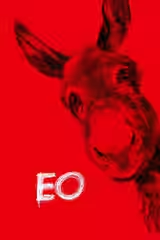
  2. EO (2022) · not on Fi1m yetA Polish donkey on the road, shot in colour and noise; the debt is open.

  3. Umberto D. (1952, Fi1m 91)An old man, a small dog and a Rome that has no use for either.

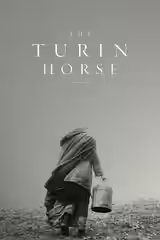
  4. The Turin Horse (2011) · not on Fi1m yetSix days, a horse that will not eat, and wind; Tarr at his sparest.

  5. Ordet (1955, Fi1m 86)Dreyer’s farmhouse miracle, the other great film that takes faith at face value.

Au Hasard Balthazar (1966) review: a hard, exact film about a donkey (Ireland) | Fi1m