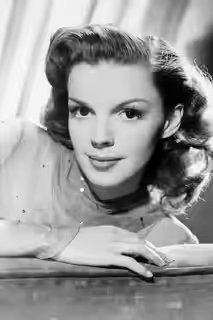
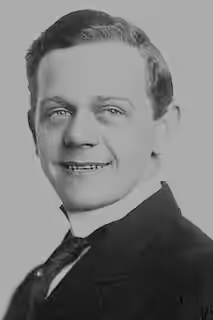
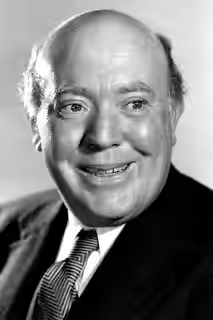
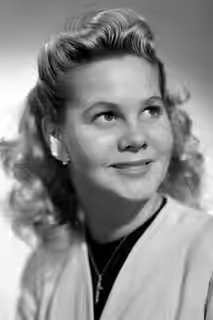
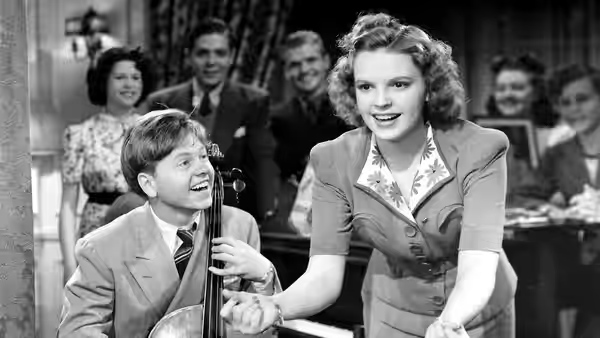
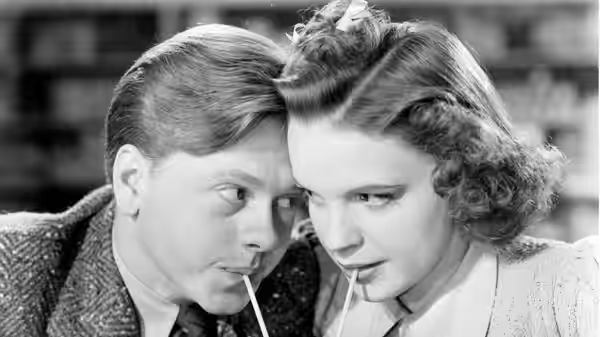
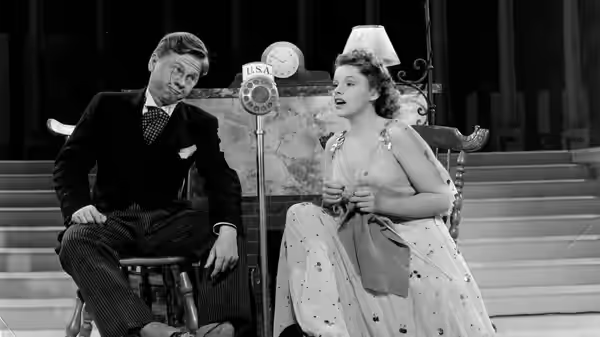
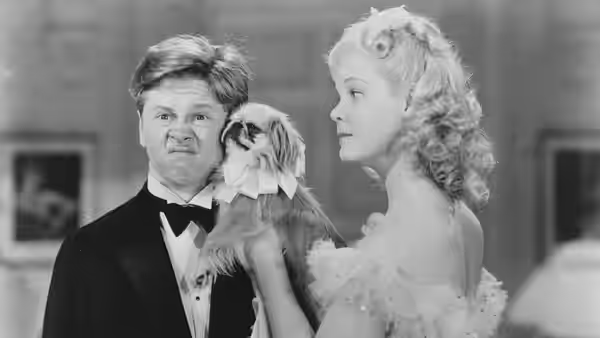
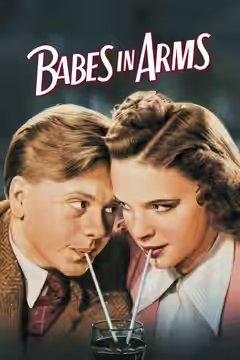
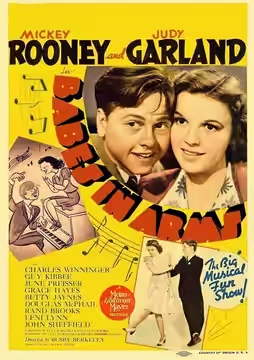
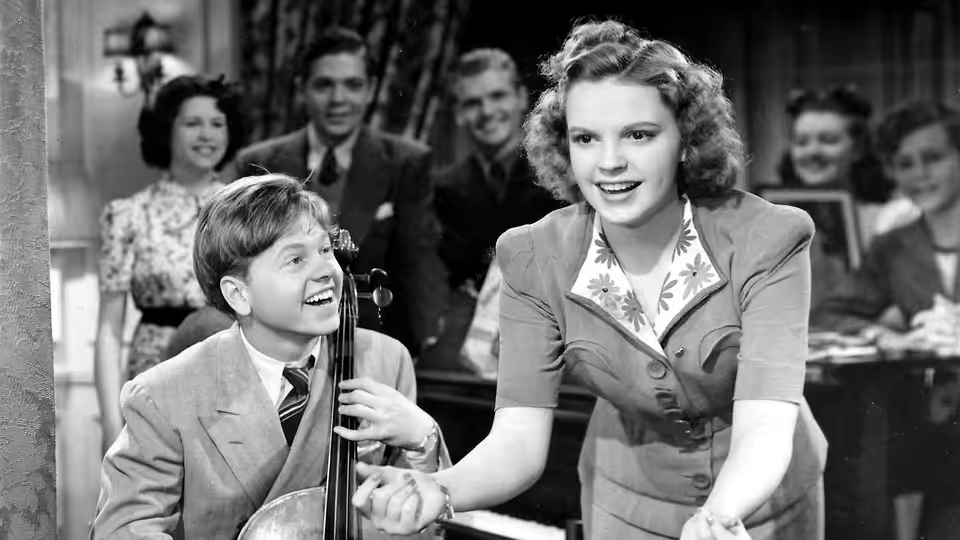
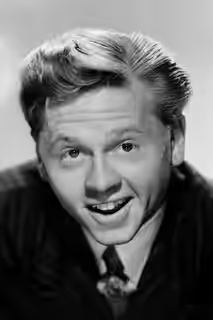
Mickey Moran (Mickey Rooney) sits with a cello as Patsy Barton (Judy Garland) leans forward beside him
Film review

Babes in Arms

1939 · Directed by Busby Berkeley · 1h 33m

In a sentenceMickey Rooney could entertain us during a scene change, which would spare us some of the screenplay

Babes in Arms follows Mickey Moran (Mickey Rooney) and Patsy Barton (Judy Garland), with Joe Moran (Charles Winninger), Judge Black (Guy Kibbee) and Rosalie Essex (June Preisser) among the surrounding characters. Martha Steele (Margaret Hamilton), Florrie Moran (Grace Hayes) and Molly Moran (Betty Jaynes) also feature. Busby Berkeley directs this 1939 musical comedy from a screenplay by Kay Van Riper and Jack McGowan. Running for 93 minutes, it brings its cast together through a story and a series of musical numbers.

Fi1m review

Mickey Rooney and Judy Garland make Babes in Arms worth considering despite its tired story. The musical numbers offer reliable pleasure, but the screenplay depends too heavily on the stars to keep things interesting.

We would recommend Babes in Arms chiefly to anyone who already enjoys Mickey Rooney and Judy Garland. Busby Berkeley’s musical comedy is agreeable when they have our attention, and much less persuasive when the story asks for it back. Its 93 minutes contain enough entertainment to justify an interested look, but not enough to make the familiar plotting disappear. The stars have quite a lot of compensating to do.

Mickey Rooney’s Mickey Moran is the main reason to persevere. His versatility gives the comedy a useful supply of surprises, even when the material itself offers few. We laughed at the precision of his comic timing. He makes the performance look worth attending to, which matters in a film where familiarity can so easily become an excuse to stop trying. That energy is welcome, though the screenplay relies on it too heavily.

Judy Garland’s Patsy Barton is an engaging partner for him, and their pairing is the film’s most dependable pleasure. She holds our attention without making every moment feel like a competition for it. That matters beside a performer as eager to entertain as Mickey Rooney. The temptation is to forgive the writing because we enjoy their company; after a while, however, the film asks for that favour once too often.

Kay Van Riper and Jack McGowan’s screenplay is the weakness. A musical does not need an unfamiliar story, but it does need enough purpose between numbers to stop us waiting for the next one. Here, the plotting feels like work undertaken to earn another helping of entertainment. Frank Sullivan’s editing cannot entirely disguise that wait, and the pace feels less assured whenever the performers have fewer chances to hold us.

Ray June’s cinematography does not give us a stronger reason to stay than the cast does. The visual presentation is serviceable, but we seldom find ourselves attending to it for its own sake. For a musical, that is a limitation. A little more visual wit might have made the stretches without a number feel less like something we had to get through. A familiar story can survive if the images offer enough invention; here, the pleasure remains concentrated in the people performing, and the film feels smaller whenever their appeal has to carry everything.

The music, credited to Georgie Stoll and George Bassman, fares better. The numbers give the film its clearest sense of pleasure, and they provide relief from the dutiful feeling of the plot. We wanted the writing around them to be as engaging, particularly when it had such willing performers available. This is a musical for those happy to accept a thin story in exchange for good company; anyone seeking equal satisfaction from both should lower their expectations.
Critical consensus AI synthesised

67
Positive
2
Mixed
2
Negative
0
Radio Times
★★★★ · Tony Sloman
80

Sloman says the film’s reduced Rodgers and Hart score matters little because its stars draw audiences in. He singles out Mickey Rooney as magnificent and an ideal foil for Judy Garland.

Read the full review →
Variety
31 December 1938 · Variety Staff
75*

The review finds the adaptation greatly enhanced and entertaining. It singles out Mickey Rooney’s versatile performance and comic timing for praise.

Read the full review →
The New Yorker
28 October 1939 · John C. Mosher
64*

The issue lists a review of Babes in Arms, but the review’s verdict is not available on this page. It provides no praise or complaint about the film.

Read the full review →
Time Out
· TM
50*

The review suggests a mixed verdict, noting that the story is tired. It singles out the musical numbers as dressing up the familiar plot.

Read the full review →

Straight answers AI written, from our review

Is Babes in Arms worth watching?
Babes in Arms is worth considering chiefly for Mickey Rooney and Judy Garland admirers; we score it 66 out of 100. Rooney’s comic timing, Garland’s engaging presence and the musical numbers provide enough pleasure for an interested look, but the thin, familiar story leaves the stars doing too much of the work.
How long is Babes in Arms, and what is it rated?
Babes in Arms runs 1h 33m. It is a comedy and music film.
Where can I watch Babes in Arms in Portugal?
Babes in Arms is not on any streaming or rental service in Portugal at the moment. It is available in 2 other countries; change your country at the top of the page to see where. Availability is checked daily.
How does Babes in Arms compare to Footlight Parade?
Babes in Arms is more dependent on its stars than Footlight Parade, which we favour for its musical invention and backstage bustle. Neither offers consistently strong plotting: Footlight Parade has a dragging first hour but a water ballet worth waiting for, while Babes in Arms chiefly suits those content to spend time with Rooney and Garland.

Cast

Awards

Academy Awards, 1940

Nominated
Best Actor
Nominated
Best Score, Adaptation or Treatment

If you liked this, try…

  1. Footlight Parade (1933, Fi1m 70)Backstage bustle and musical invention, with less patience for the ordinary.

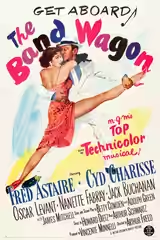
  2. The Band Wagon (1953) · not on Fi1m yetFor performers whose professional pride makes the backstage squabbling worth enduring.

  3. The Young Girls of Rochefort (1967) · not on Fi1m yetTry this for musical pleasure spread across an entire French town.

  4. Sing Street (2016) · not on Fi1m yetAnother makeshift musical venture, with teenage yearning given more room to matter.

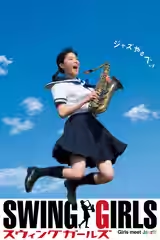
  5. Swing Girls (2004) · not on Fi1m yetAmateur musicians learn that enthusiasm becomes more useful after a little practice.