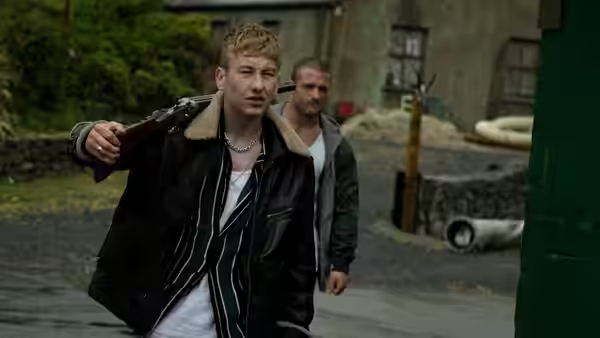
Dympna (Barry Keoghan) walks ahead of Arm (Cosmo Jarvis) through a rural yard
Film review

Calm with Horses

2020 · Directed by Nick Rowland · 1h 40m

In a sentenceCosmo Jarvis looks as though asking for help would hurt more than being hit

In a rural town, Arm (Cosmo Jarvis) works as an enforcer for a criminal gang while trying to be a good father. His work depends on his willingness to hurt people, and the gang’s claims on him keep competing with his responsibilities as a parent. Dympna (Barry Keoghan) and Ursula (Niamh Algar) are part of the life he struggles to hold together. Arm wants to meet the demands of fatherhood without abandoning his criminal loyalties, but his readiness to do what others require makes that difficult. The gang keeps finding uses for him.

Plays from YouTube when you press play; nothing loads from them until then.

Fi1m review

Cosmo Jarvis gives Calm with Horses a bruised tenderness that makes its familiar crime story worth following. Nick Rowland’s drama is strongest when it lets us watch Arm struggle, without the music insisting on the difficulty.

Nick Rowland’s Calm with Horses earns our attention through Cosmo Jarvis, playing a man whose usefulness to a gang leaves him little freedom to be a father. It is a good, sometimes moving crime drama, held back by a familiar plot and a score that too often presses the point. Joseph Murtagh’s script makes Arm’s divided loyalties immediately understandable. We spend much of the film hoping he can find a way to stop being useful to the wrong people.

Cosmo Jarvis gives Arm a physical weight that makes his violence credible, then allows uncertainty to spoil any impression of command. The wish to be a good father does not feel like a convenient excuse for what he does; it feels like a task he has no idea how to begin. We were moved by Arm’s awkward attempts at tenderness, because the performance makes them seem so much less practised than his aggression. Our sympathy remains uneasy, especially when his wish to do better runs up against his willingness to obey.

Barry Keoghan, as Dympna, brings a different kind of unease: his presence is chilling without making the performance a competition in menace. The contrast with Arm gives their scenes a tension the plot cannot always supply. Niamh Algar gives Ursula enough force and feeling to suggest a life that deserves more of the film’s attention. The writing is less generous to the women than to Arm, and her work makes that imbalance harder to overlook.

Piers McGrail’s cinematography gives the rural landscapes a starkness that suits the story’s limited opportunities for escape. Open country offers little relief from the pressure of the gang, and the scenery never feels like a consolation. Damien Creagh’s production design contributes to that sense of a small, constricting world; nothing about these surroundings makes gang life look worth the trouble. The setting feels persuasive enough that Arm’s limited choices are understandable before the script starts spelling them out.

Benjamin John Power’s music is less restrained, and its insistence becomes a problem when the performances have already made the distress clear. We do not need another warning that this is a hard life. The editing, credited to Andonis Trattos, Nicolas Chaudeurge and Matthew Tabern, handles the movement between violence and quieter character scenes capably. But the gentler passages have an interest that the gangster business cannot consistently match, and the changes of pace sometimes make that difference more apparent.

The difficulty is familiar to crime dramas built around a violent man with some tenderness left in him: the violence can become more predictable than the tenderness. The direction gives Arm enough attention for us to care, but the criminal story follows a route that offers fewer surprises than the performance. Its simplicity is not fatal, and the film remains involving whenever Arm has room to register the strain. Still, we would have welcomed more of that patient attention for Ursula, rather than another reminder of how trapped Arm is. Choose it for the acting, with fair warning that the criminal plot is the part least likely to surprise.


Critical consensus AI synthesised

69
Positive
12
Mixed
9
Negative
0

Most critics find Calm with Horses an affecting crime drama, with praise centred on Cosmo Jarvis’s performance as an enforcer caught between criminal loyalty and fatherhood. The reviews repeatedly credit him with making the character’s violence, vulnerability and tenderness convincing. Barry Keoghan and Niamh Algar also draw praise, while the rural setting and tense atmosphere give the familiar material a strong sense of place. The positive notices value the quieter character scenes as much as the threat of violence.

Reservations cluster around the crime story, which several critics find conventional, thin or poorly balanced with the family drama. IndieWire also objects to the limited roles given to women. The spread runs from enthusiasm to substantial reservations, though even the less persuaded reviews tend to admire Jarvis. The Hollywood Reporter finds the drama sluggish and its stakes low, making it a notable dissent from the broader praise for the film’s tension.

The i Paper
12 March 2020 · ★★★★ · Saskia Baron
80

Baron finds the film excellent and says it sustains sympathy for Arm despite his being manipulated into terrible acts. She praises Barry Keoghan’s chilling performance and the stark landscapes, while faulting the direction’s overuse of dramatic music.

Read the full review →
Time Out
9 March 2020 · ★★★★ · Helen O’Hara
80

O’Hara praises the film as an inspired, layered crime drama. She singles out its claustrophobic portrayal of the limited horizons of rural towns and criminal gangs.

Read the full review →
Total Film
11 March 2020 · ★★★★ · James Mottram
80

The critic finds the film tightly scripted, forcefully directed, and invigorating despite its familiar plot. Cosmo Jarvis’s magnetic performance as a damaged man torn between family and criminal loyalty is singled out for praise.

Read the full review →
IndieWire
31 July 2020 · B · Ryan Lattanzio
77

The critic calls it a moving, confidently directed crime fable, though its criminal plot is simple and its women are mostly disposable. Cosmo Jarvis’s anguished lead performance is the film’s standout strength.

Read the full review →
Sight and Sound
16 March 2020
70*

The critic finds the film engaging despite its basic dramatic construction. They single out Cosmo Jarvis’s performance and the gentler, poetic scenes for praise.

Read the full review →
Variety
11 September 2019 · festival review · Dennis Harvey
68*

Harvey finds the crime drama engrossing, though its story becomes more conventional as it moves toward revenge-thriller territory. He particularly praises the vivid characters and milieu, alongside Cosmo Jarvis’s sympathetic performance.

Read the full review →

Straight answers AI written, from our review

Is Calm with Horses worth watching?
Calm with Horses is worth watching for Cosmo Jarvis’s moving performance as a gang enforcer struggling to be a father, and we score it 74 out of 100. We recommend it to those who favour character-led crime drama, with reservations about the familiar criminal plot and music that presses emotions the acting already makes clear.
How long is Calm with Horses, and what is it rated?
Calm with Horses runs 1h 40m. It is a crime and drama film.
Where can I watch Calm with Horses in Canada?
Calm with Horses is streaming on Tubi and Amazon Prime Video in Canada, and it is also available to rent from Apple TV from CA$4.99. It leaves Tubi on 1 October. Availability is checked daily; the links above go straight to each service.
How violent or frightening is Calm with Horses, and is it suitable for children?
Calm with Horses is an adult crime drama with violence and a chilling sense of gang pressure; it carries a US R certificate, with no UK certificate supplied. We would not recommend it for children: Arm’s work involves hurting people, and his attempts at tenderness sit alongside credible aggression rather than softening the film into reassuring family drama.
How does Calm with Horses compare to A Prophet?
Calm with Horses is the more intimate fatherhood drama, while we recommend A Prophet as the stronger choice for a gripping account of criminal education and power. Both centre on constrained choices and persuasive lead performances, but Arm’s awkward tenderness is more compelling than his familiar gangster story; A Prophet makes the workings of crime itself absorbing, despite some tidy plotting.
What should I watch after Calm with Horses?
After Calm with Horses, try A Prophet (2009, Fi1m 86): Criminal apprenticeship, constricted choices and a lead performance that makes every compromise register. Then Animal Kingdom (2010, Fi1m 84): A criminal family makes loyalty feel compulsory, with affection offering little protection; and The Quiet Girl (2022, Fi1m 84): An Irish drama that gives neglected childhood the patient attention Arm struggles to manage.

Cast

If you liked this, try…

  1. The Drop (2014) · not reviewed yetAnother watchful crime drama about a quiet man whose gentleness invites dangerous assumptions.

  2. A Prophet (2009, Fi1m 86)Criminal apprenticeship, constricted choices and a lead performance that makes every compromise register.

  3. Animal Kingdom (2010, Fi1m 84)A criminal family makes loyalty feel compulsory, with affection offering little protection.

  4. The Quiet Girl (2022, Fi1m 84)An Irish drama that gives neglected childhood the patient attention Arm struggles to manage.

  5. The Long Good Friday (1980, Fi1m 88)A different kind of criminal authority, equally ill-equipped to recognise its own vulnerability.