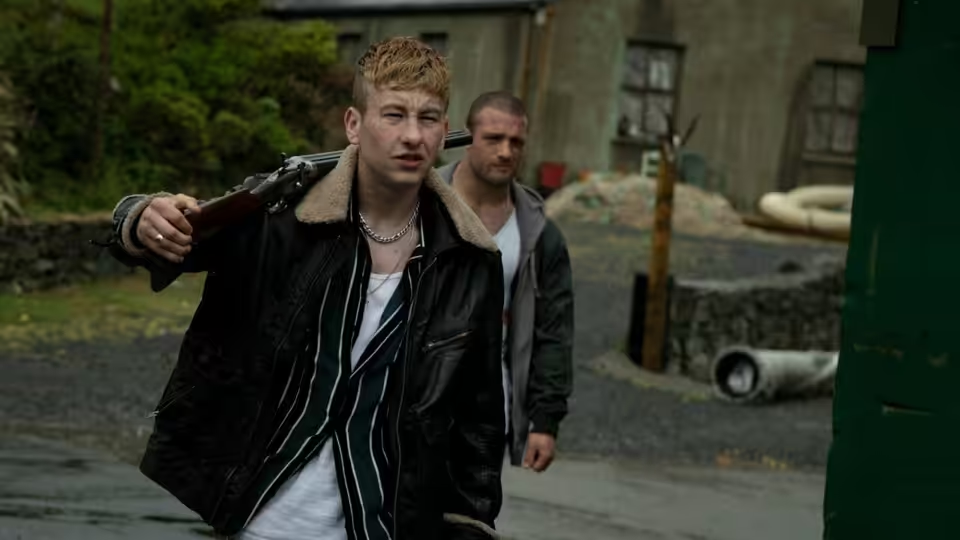
Cosmo Jarvis gives Calm with Horses a bruised tenderness that makes its familiar crime story worth following. Nick Rowland’s drama is strongest when it lets us watch Arm struggle, without the music insisting on the difficulty.
Nick Rowland’s Calm with Horses earns our attention through Cosmo Jarvis, playing a man whose usefulness to a gang leaves him little freedom to be a father. It is a good, sometimes moving crime drama, held back by a familiar plot and a score that too often presses the point. Joseph Murtagh’s script makes Arm’s divided loyalties immediately understandable. We spend much of the film hoping he can find a way to stop being useful to the wrong people.
Cosmo Jarvis gives Arm a physical weight that makes his violence credible, then allows uncertainty to spoil any impression of command. The wish to be a good father does not feel like a convenient excuse for what he does; it feels like a task he has no idea how to begin. We were moved by Arm’s awkward attempts at tenderness, because the performance makes them seem so much less practised than his aggression. Our sympathy remains uneasy, especially when his wish to do better runs up against his willingness to obey.
Barry Keoghan, as Dympna, brings a different kind of unease: his presence is chilling without making the performance a competition in menace. The contrast with Arm gives their scenes a tension the plot cannot always supply. Niamh Algar gives Ursula enough force and feeling to suggest a life that deserves more of the film’s attention. The writing is less generous to the women than to Arm, and her work makes that imbalance harder to overlook.
Piers McGrail’s cinematography gives the rural landscapes a starkness that suits the story’s limited opportunities for escape. Open country offers little relief from the pressure of the gang, and the scenery never feels like a consolation. Damien Creagh’s production design contributes to that sense of a small, constricting world; nothing about these surroundings makes gang life look worth the trouble. The setting feels persuasive enough that Arm’s limited choices are understandable before the script starts spelling them out.
Benjamin John Power’s music is less restrained, and its insistence becomes a problem when the performances have already made the distress clear. We do not need another warning that this is a hard life. The editing, credited to Andonis Trattos, Nicolas Chaudeurge and Matthew Tabern, handles the movement between violence and quieter character scenes capably. But the gentler passages have an interest that the gangster business cannot consistently match, and the changes of pace sometimes make that difference more apparent.
The difficulty is familiar to crime dramas built around a violent man with some tenderness left in him: the violence can become more predictable than the tenderness. The direction gives Arm enough attention for us to care, but the criminal story follows a route that offers fewer surprises than the performance. Its simplicity is not fatal, and the film remains involving whenever Arm has room to register the strain. Still, we would have welcomed more of that patient attention for Ursula, rather than another reminder of how trapped Arm is. Choose it for the acting, with fair warning that the criminal plot is the part least likely to surprise.