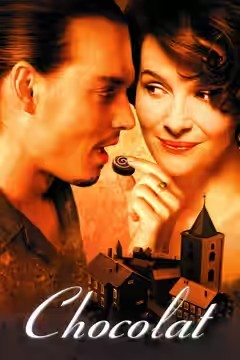
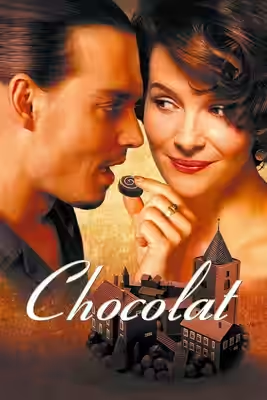
Vianne Rocher (Juliette Binoche) dancing closely with Roux (Johnny Depp) in a cafe
Film review

Chocolat

2000 · Directed by Lasse Hallström · 2h 01m

In a sentenceEvery ailment in the village has a truffle for it, and every truffle works

Lansquenet, a walled French village, in the Lent of 1959. Vianne Rocher (Juliette Binoche) arrives on the north wind with her daughter Anouk (Victoire Thivisol), rents a derelict shop from the sharp-tongued landlady Armande Voizin (Judi Dench) and opens a chocolaterie opposite the church, six weeks before Easter. Count Paul de Reynaud (Alfred Molina), the mayor, writes the young Father Henri’s (Hugh O’Conor) sermons, expects the village to fast, and sets out to close her down. Vianne guesses each customer’s favourite from a spinning plate: the widower Guillaume Blerot (John Wood), who pines for Mrs. Audel (Leslie Caron), and Josephine Muscat (Lena Olin), who steals from the counter and goes home to a husband, Serge (Peter Stormare), who hits her. Armande, meanwhile, is forbidden by her daughter Caroline Clairmont (Carrie-Anne Moss) from seeing her grandson Luc.

Plays from YouTube when you press play; nothing loads from them until then.

Fi1m review

Lasse Hallström’s village fable is handsomely made and warmly acted, with Alfred Molina and Judi Dench doing far better work than the script requires. It argues that pleasure is good and self-denial bad, to an audience that arrived already agreeing.

Lasse Hallström, working from Joanne Harris’s novel in a screenplay by Robert Nelson Jacobs, has made a fable and says so at the start: a narrator, an old story, a village where nothing has changed for a long time. A woman opens a chocolate shop during Lent and the village, having been told for centuries that wanting things is a sin, begins to want things. That is the whole argument, and the film has made it inside twenty minutes. The remaining hundred are spent confirming it, one customer at a time.

Alfred Molina is the reason to watch. His Reynaud is not a villain but a man who has decided that starving himself is a form of love, and Molina plays the starving: the tightened jaw at the shop window, the meals he does not eat, the sermons he writes for the boyish Father Henri (Hugh O’Conor) and then sits through from the front pew. The film wants us to laugh at him and Molina declines to make that easy. Whenever he is on screen the fable has an opponent worth the name.

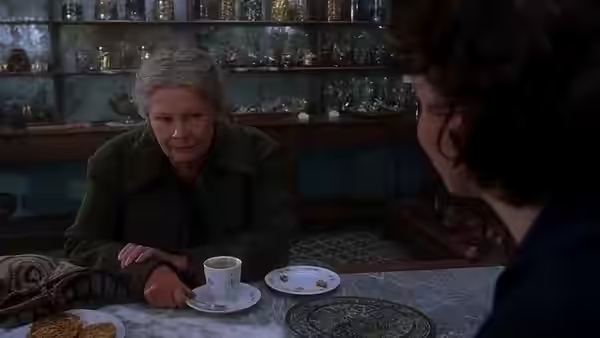
Judi Dench does what she does with a grouchy old woman and a bottle, which is to make her the most alive person on screen. Armande’s quarrel with her daughter Caroline Clairmont (Carrie-Anne Moss) over the grandson she is not allowed to see is one of two strands with any weight. The other is Lena Olin’s Josephine, married to Peter Stormare’s Serge, who drinks and hits her. We were more moved than we had any intention of being by Olin: the way Josephine holds her handbag with both hands as if someone might take it, and the moment she first laughs in the shop and looks round to see who heard. Nothing in the script asks for that. Olin brings it anyway.

Juliette Binoche is serene and lovely and, as written, a saint with a spatula. Vianne has a trick with a spinning plate that tells her what each customer secretly craves, and she is right every time, which is a problem for a story. Nobody she helps is made worse by it. Johnny Depp arrives as Roux, the river traveller, with a guitar and an accent from somewhere a long way west of the village, and the film tells us the two of them are in love and then does little to show it. They stand near each other in firelight and the matter is considered settled.

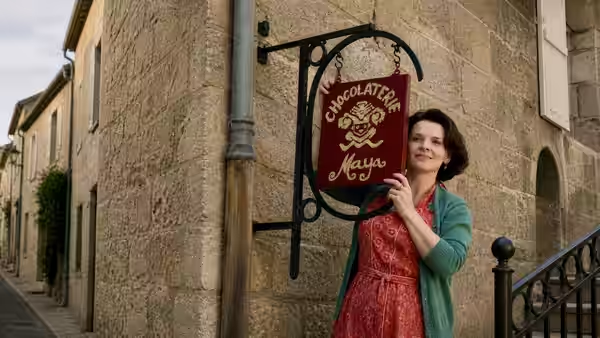
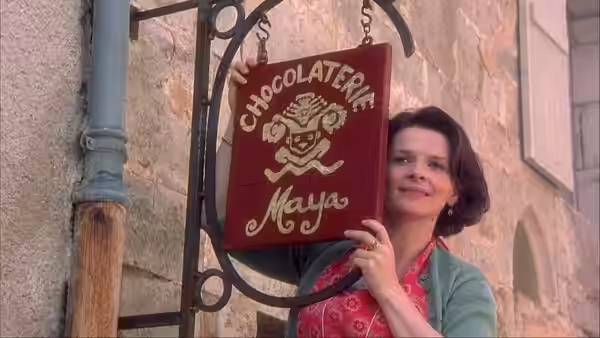
It is beautifully done. Roger Pratt shoots the village in slate greys and browns and lets the shop glow amber against them, so the chocolaterie looks like the one lit window on a cold street. David Gropman’s shop is a real place, copper pans and cocoa dust and a counter you could lean on; his village, though, is a picture book, with no mud, no poverty and a 1959 that seems never to have heard of a war. Renee Ehrlich Kalfus puts Vianne in colours the rest of the cast has been denied, in case we had missed the point. Rachel Portman’s score is pretty and never stops; every tender moment gets the same rising strings, so that by the hour mark we knew what we were meant to feel a bar before the picture told us. Andrew Mondshein cuts the eating in close-ups of mouths and melting, which is effective the first six times.

The trouble is that the film has no doubt. Jacobs’s script has decided that nobody in Lansquenet is wicked, only mistaken, and that a mistake is cured by a good ganache. Every problem in the village turns out to have a confection that fits it. A fable is allowed to be simple, but Babette’s Feast was simple and still let its Lutherans keep their dignity to the end. Here the case for pleasure is put to people who have bought a ticket to a film called Chocolat, and it is not a hard case to win.

At 121 minutes it is a long dessert, and it carries a 12. Watch it on a cold evening with someone who will not want to argue about it afterwards, and it will do what it sets out to do, which is to make you feel kindly for two hours and then hungry. Ask it anything harder and only Molina seems to have heard the question.


Critical consensus AI synthesised

61
Positive
5
Mixed
2
Negative
3

Most critics find Chocolat an agreeable fable, and half of them like it a good deal more than that. The praise clusters on the cast. Juliette Binoche is named in most reviews as the film’s calm centre, Alfred Molina’s mayor is repeatedly singled out, and Judi Dench’s landlady draws notice too. Lasse Hallström’s direction is described as light and assured, and the warmer reviews credit him with making something more substantial than the sugary premise suggests.

The spread is wide. The reservations all point the same way: it is too soft, too sweet and too eager to please, with little real conflict and a feel-good ending that some find patronising. The Guardian is the harshest, arguing that not even Binoche can save it, and the Evening Standard says the film blunts the sharper edges of the novel. Time Out adds that the period setting seals the story off from any present-day bite.

Los Angeles Times
15 December 2000 · Kevin Thomas
90*

The critic hails it as a delectable yet spiritually nourishing humanist fable with wide appeal. Hallström's subtle direction and the cast's glowing performances, especially Binoche and Molina, are singled out for praise.

Read the full review →
Variety
7 December 2000 · Lael Loewenstein
85*

The review describes it as a richly textured comic fable blending Old World wisdom with timely commentary on moral superiority. It praises Hallström's observations on the human spirit and the exquisite production values.

Read the full review →
Empire
1 January 2000 · Kim Newman
80*

Lasse Hallström brings a delicate touch to this blend of comedy, soap, romance and magic that feels like a souffle but turns out more substantial. It is a treat and a rare showcase for Binoche, though with the minor cavil of players speaking English with slight French accents.

Read the full review →
RogerEbert.com
22 December 2000 · Roger Ebert
80*

The critic sees the film as a charming fable pitting pagan sensuality against rigid Christianity, with chocolate as the winning force. Binoche is singled out as a serene, wise presence who embodies the story's life-affirming spirit.

Read the full review →
The New York Times
15 December 2000 · Elvis Mitchell
60*

The review calls it a crowd-pleasing but manipulative confection, an art-house film for those who dislike art-house films. It praises the assured direction and strong ensemble performances, especially Molina and Depp.

Read the full review →
Time Out
10 September 2012 · WH
55*

Hallström's soft adaptation constructs a feminist parable about courage, support and pleasure in personal transformation, with excellent performances. However, their relevance is diminished by the historical bubble in which they are situated, with the period cinematography preserving the whole in aspic.

Read the full review →

Straight answers AI written, from our review

Is Chocolat worth watching?
Chocolat is worth watching for anyone who wants a handsome, warmly acted fable about pleasure winning over self-denial, and we scored it 60. Alfred Molina, Judi Dench and Lena Olin do far better work than the script asks of them; the film itself has no doubt about its argument and spends a hundred minutes confirming it. Watch it on a cold evening with someone who will not want to argue afterwards.
How long is Chocolat, and what is it rated?
Chocolat runs 2h 01m. It is a comedy and drama film.
Where can I watch Chocolat in the Philippines?
Chocolat is streaming on HBO Max in the Philippines. Availability is checked daily; the links above go straight to each service.
How violent or frightening is Chocolat, and is it suitable for children?
Chocolat carries a UK 12 and is gentle for most of its length, with little to frighten anyone. The one hard strand is Josephine's marriage to Serge, who drinks and hits her, which the film treats seriously rather than graphically. Younger children may find it slow and the domestic violence upsetting; teenagers and adults will be fine.
How does Chocolat compare to Amélie?
Chocolat is the calmer and plainer of the two, a slow village fable; Amélie is the funnier and the better looking, with sharper jokes and colour that does more than tell you who to like. Both are about a kindly meddler in a storybook France. We prefer Amélie, though it works too hard to charm; Chocolat suits a viewer who wants less visual business and more time with Molina and Dench.
Is Chocolat based on a true story or a book?
Chocolat is based on the novel by Joanne Harris, adapted by Robert Nelson Jacobs, and is not a true story. The film announces itself as a fable from the start, with a narrator and a village where nothing has changed for a long time. You need not know the book to follow it; the argument is made inside twenty minutes.
What should I watch after Chocolat?
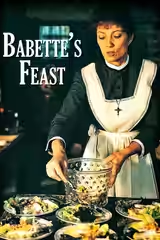
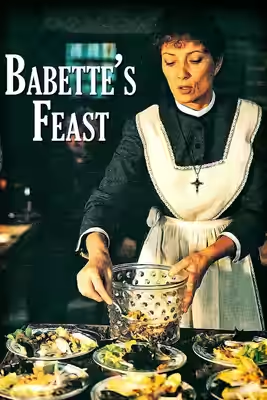
After Chocolat, try Babette's Feast (1987, Fi1m 86): One dinner, a Danish village of Lutherans, and pleasure argued with far more patience. Then Tampopo (1985, Fi1m 84): A Japanese comedy about noodles that takes eating more seriously than most dramas; and Amélie (2001, Fi1m 82): Another kindly meddler in a storybook France, with sharper jokes and better colour.

Cast

Awards

Academy Awards, 2001

Nominated
Best Actress
Nominated
Best Original Score
Nominated
Best Picture
Nominated
Best Supporting Actress
Nominated
Best Writing, Adapted Screenplay

European Film Award - People's Choice Award for Best Director, 2001

Nominated
European Film Award - People's Choice Award for Best Director

Jameson People's Choice Award for Best Actress, 2001

Won
Jameson People's Choice Award for Best Actress

If you liked this, try…

  1. Babette's Feast (1987, Fi1m 86)One dinner, a Danish village of Lutherans, and pleasure argued with far more patience.

  2. Like Water for Chocolate (1992) · not reviewed yetMexican magic realism where the cooking carries real grief, not just comfort.

  3. Tampopo (1985, Fi1m 84)A Japanese comedy about noodles that takes eating more seriously than most dramas.

  4. Amélie (2001, Fi1m 82)Another kindly meddler in a storybook France, with sharper jokes and better colour.

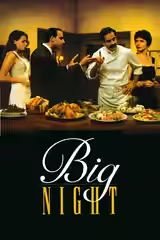
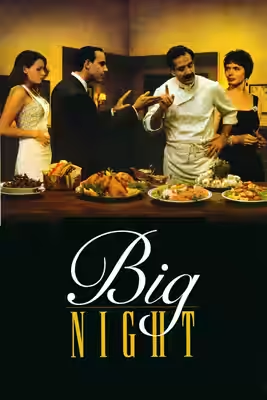
  5. Big Night (1996, Fi1m 84)Two brothers, one restaurant, one meal; food as pride rather than medicine.

Free account

Know what to watch tonight

Two lists that know where things are streaming, collections you can share, your own score beside ours, and Discover that remembers what you have seen.

  • Want to see, sorted by what is streaming now
  • Seen, with your score out of ten
  • No adverts, ever