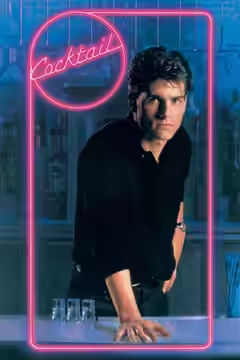
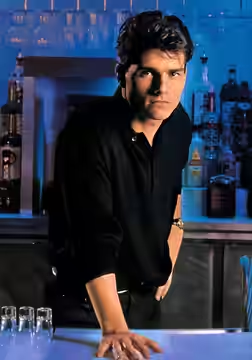
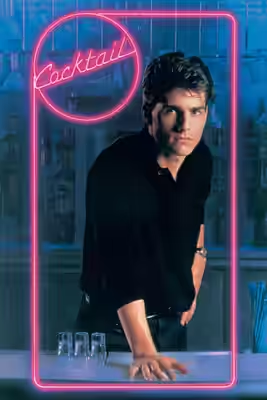
Brian Flanagan juggles a bottle behind a tiki bar as Doug Coughlin and a woman sit nearby
Film review

Cocktail

1988 · Directed by Roger Donaldson · 1h 44m

In a sentenceTom Cruise puts more work into serving the drinks than the screenplay puts into anyone drinking them

Brian Flanagan (Tom Cruise) makes a performance of bartending, juggling bottles and putting his charm to work as he serves drinks. Douglas “Doug” Coughlin (Bryan Brown) and Jordan Mooney (Elisabeth Shue) feature in his working and romantic life. The story takes in bars and a Caribbean romance, following Brian beyond the counter and into relationships that require more than an ability to entertain. Getting attention comes readily to him; deciding what to do with it, and what he wants from other people, proves less straightforward.

Fi1m review

Tom Cruise’s bottle-juggling and Bryan Brown’s presence provide the few pleasures in a poor romance. Roger Donaldson keeps the glamour coming, but the shallow characters make its life lessons hard to take.

Roger Donaldson’s Cocktail is a poor romantic drama with an entertaining demonstration of bartending inside it. It wants the pleasure of watching an attractive man do a job impressively, then asks us to take his education in life and love seriously. Those aims could coexist, but the writing gives the people too little substance for the second to matter. At 104 minutes, it has room to establish more than charm, flirtation and a set of lessons we can see coming.

Tom Cruise, playing Brian Flanagan, does the bottle-juggling with enough assurance to make the work entertaining on its own terms. We enjoyed watching him handle the bottles, because the skill is visible and the film briefly stops asking charm to do every job. There is real effort here, and an appeal that does not depend on believing a word of the screenplay. Roger Donaldson keeps returning to his leading man’s attractiveness, though, until our interest in the performance begins to wear thin.

Bryan Brown, as Douglas “Doug” Coughlin, supplies another reason to keep watching: he can hold our attention when the characterisation will not. Elisabeth Shue, playing Jordan Mooney, gets less help from a romantic story that does too little to make her wants matter. Heywood Gould’s screenplay treats the women chiefly in relation to the man’s progress, and its lessons about relationships suffer accordingly. The sexism matters because we are being asked to accept the film as an account of growing up.

Dean Semler’s cinematography makes a spectacle of the bar work and gives Tom Cruise plenty of admiring attention. Mel Bourne’s production design supplies bars suited to these performances, though the glossy surroundings cannot make the people more interesting. There is nothing wrong with making this job look attractive, and the film is easy enough to look at. The Caribbean romance offers a change of setting without much improvement in how the relationships are written.

Neil Travis’s editing has an easier job with the bartending routines, where there is something definite to watch, than with the increasingly strained melodrama. The drama asks for feelings that the shallow characterisation has done little to earn. J. Peter Robinson’s music supports the shifts in mood, but cannot make them feel less forced. By the time the film is pressing its life lessons upon us, the screenplay has given us little reason to trust its judgement.

A glossy romance need not offer much wisdom, but it does need people whose attractions and disappointments we can believe. Here, the predictable writing and the increasingly overworked drama make that difficult, even with these performers. Most critics have little patience for the film, and we share their objection to the thin characters rather than begrudging anyone the pleasure of the bar routines. If convincing romance matters tonight, choose something else.


Critical consensus AI synthesised

32
Positive
0
Mixed
1
Negative
6

Most critics take a negative view of Cocktail, finding little substance beneath its glossy presentation. The limited praise centres on the performers rather than the story: Tom Cruise’s charm provides some distraction from material repeatedly described as predictable or thin. Radio Times credits his bottle-juggling and bartending technique, while the Los Angeles Times singles out Bryan Brown’s charisma. Slick presentation and decorative entertainment value earn scattered acknowledgement, but neither amounts to much of a defence.

The differences concern which failing matters most. Some reviews focus on shallow characterisation and unconvincing life lessons; others object to the increasingly absurd melodrama. Time Out identifies sexism as the defining problem. The accessible verdicts range from mildly dismissive to sharply hostile, with no positive recommendation. The New York Times entry cannot establish a dissenting position: its review text is inaccessible, so the available information supports no account of its praise or reservations.

The New York Times
29 July 1988 · Janet Maslin
64*

The review text was inaccessible, so its verdict cannot be established. The available page information does not identify what the critic praised or complained about.

Read the full review →
Radio Times
★★ · Adrian Turner
40

Turner describes the film as a bland concoction despite its box-office success. He praises Cruise’s bottle-juggling and bartending technique, but finds the story’s life lessons unconvincing.

Read the full review →
RogerEbert.com
29 July 1988 · ★½/4 · Roger Ebert
38

Ebert’s review is negative about the film. It criticizes the shallow characterization and lack of substance beneath the glamour.

Read the full review →
Variety
31 December 1987 · Variety Staff
35*

The review finds the story predictable, despite its slick presentation. It singles out the film’s sustained focus on Tom Cruise’s charm and attractiveness.

Read the full review →
Empire
1 January 2000 · Lola Borg
20*

The critic finds the film irritating and predictable, with little to recommend beyond its decorative entertainment value. Tom Cruise’s charisma is singled out as its saving grace, while the bar-acrobatics and Caribbean romance fail to make a convincing mix.

Read the full review →
Time Out
· RS
20*

The review takes a sharply negative view of the film. It singles out the film’s sexism as its defining flaw.

Read the full review →

Straight answers AI written, from our review

Is Cocktail worth watching?
Cocktail is hard to recommend as a romance, and we score it 38 out of 100. We enjoy Tom Cruise’s bottle-juggling and Bryan Brown’s presence, but the thin characters, sexism and strained melodrama leave little beyond those pleasures; it suits an interest in the performers better than an evening built around convincing romance.
How long is Cocktail, and what is it rated?
Cocktail runs 1h 44m. It is a romance and drama film.
Where can I watch Cocktail in Ecuador?
Cocktail is streaming on Disney+ in Ecuador. Availability is checked daily; the links above go straight to each service.
How violent or frightening is Cocktail, and is it suitable for children?
Cocktail carries a UK 15 certificate, so it is not suitable for children under 15. The certificate indicates material intended for older teenagers and adults, but we cannot give a more specific account of violence or frightening content from the details available; our review’s concerns are sexism and strained romantic melodrama.
How does Cocktail compare to The Color of Money?
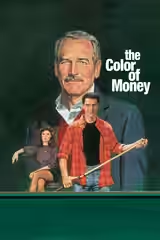
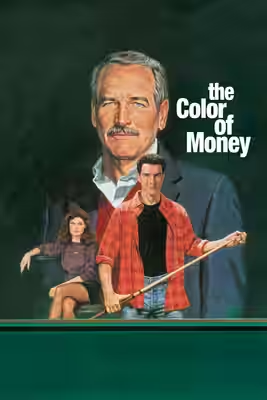
Cocktail is the weaker choice beside The Color of Money, which we recommend for its sharper script about talent, vanity and an older mentor. Both offer Tom Cruise’s appeal, but the pool-hall rivalry gives him more to work with than the bartending romance, even if its heavier confrontations also strain what the writing earns.
What should I watch after Cocktail?
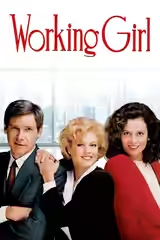
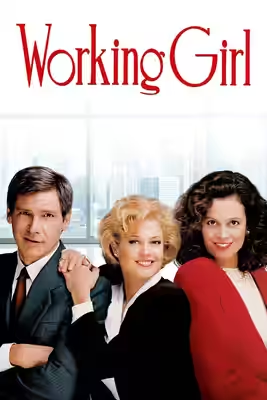
After Cocktail, try The Color of Money (1986, Fi1m 80): Tom Cruise gets a sharper script about talent, vanity and an older mentor. Then Working Girl (1988, Fi1m 80): Ambition and romance share the screen, with clearer stakes and better jokes; and The Lunchbox (2013, Fi1m 75): Food and work lead towards a quieter romance with room for both people.

Cast

Awards

Golden Raspberry Award for Worst Actor, 1989

Nominated
Golden Raspberry Award for Worst Actor

Golden Raspberry Award for Worst Director, 1989

Nominated
Golden Raspberry Award for Worst Director

Golden Raspberry Award for Worst Picture, 1989

Won
Golden Raspberry Award for Worst Picture

Golden Raspberry Award for Worst Screenplay, 1989

Won
Golden Raspberry Award for Worst Screenplay

If you liked this, try…

  1. The Color of Money (1986, Fi1m 80)Tom Cruise gets a sharper script about talent, vanity and an older mentor.

  2. Working Girl (1988, Fi1m 80)Ambition and romance share the screen, with clearer stakes and better jokes.

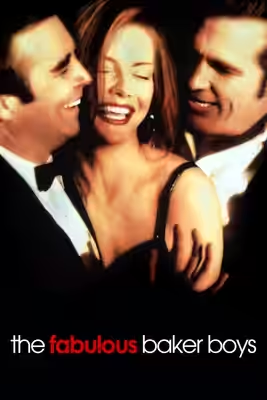
  3. The Fabulous Baker Boys (1989) · not reviewed yetFor nightclub work, adult disappointment and performers who make the routine persuasive.

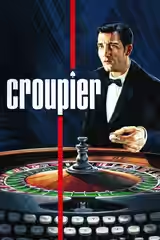
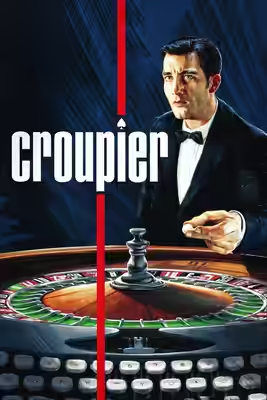
  4. Croupier (1998) · not reviewed yetAnother man behind a counter, with less sunshine and considerably more suspicion.

  5. The Lunchbox (2013, Fi1m 75)Food and work lead towards a quieter romance with room for both people.

Free account

Know what to watch tonight

Two lists that know where things are streaming, collections you can share, your own score beside ours, and Discover that remembers what you have seen.

  • Want to see, sorted by what is streaming now
  • Seen, with your score out of ten
  • No adverts, ever