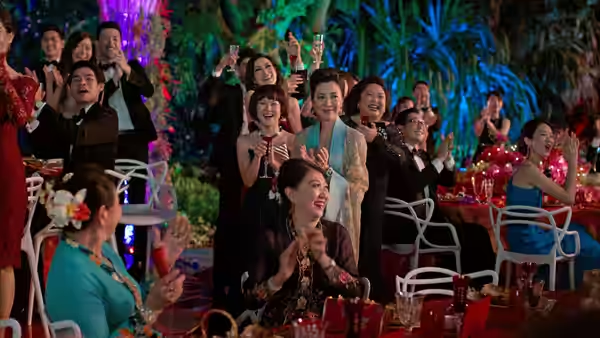
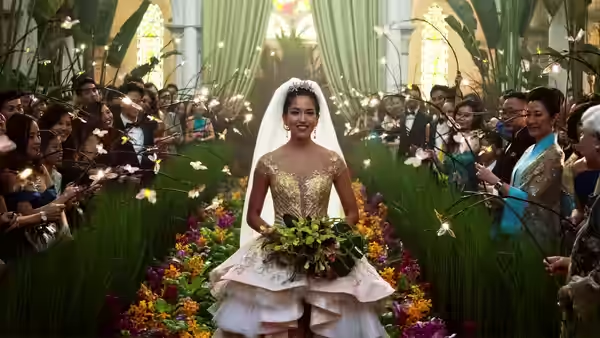
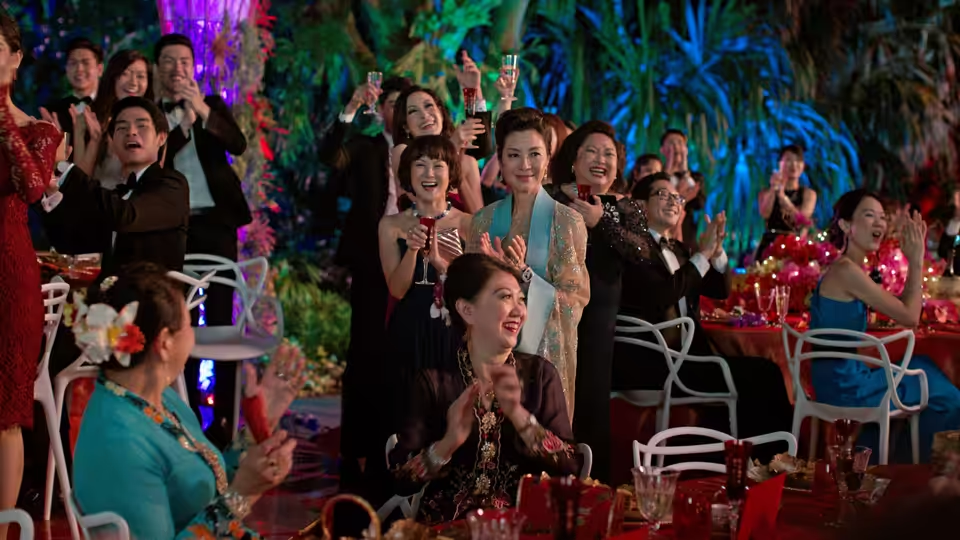
Guests cheer and applaud at an outdoor banquet beneath colorful lights
Film review

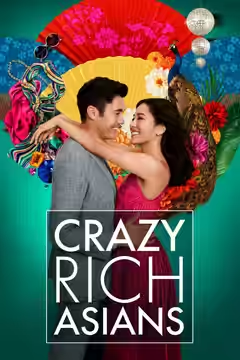
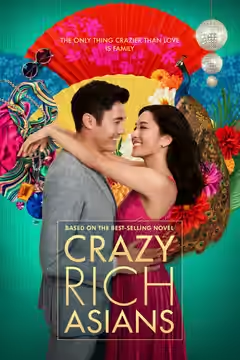
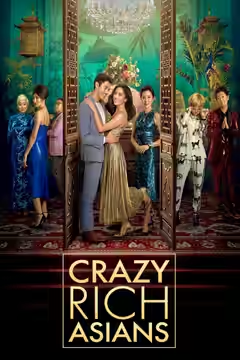
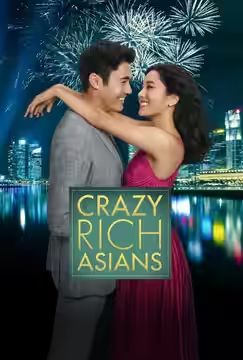
Crazy Rich Asians

2018 · Directed by Jon M. Chu · 2h 01m

In a sentenceMeet the parents, except the parents own half of Singapore and the mother has met your type before

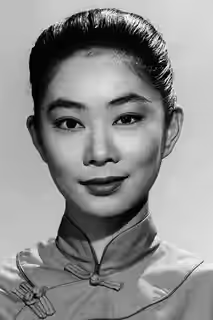
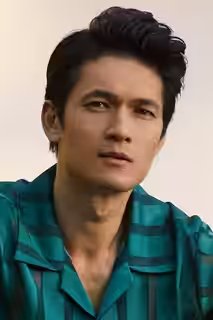
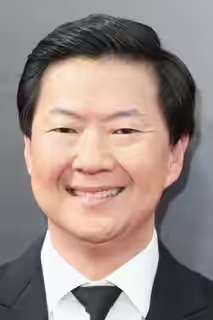
Rachel Chu (Constance Wu), an economics professor in New York, has been seeing Nick Young (Henry Golding) for a year without learning much about his family. He invites her to Singapore for the wedding of his best friend Colin Khoo (Chris Pang) to Araminta Lee (Sonoya Mizuno), and she finds herself in a first-class cabin wondering who is paying. Nick, it turns out, comes from one of the richest families in Asia. In Singapore Rachel stays with her old college friend Peik Lin Goh (Awkwafina) and her father Wye Mun Goh (Ken Jeong), eats at the hawker stalls, and is driven to the Young mansion for a party. There Nick’s mother Eleanor (Michelle Yeoh) receives her with perfect manners and no warmth, his grandmother Ah Ma (Lisa Lu) presides, and his cousin Astrid (Gemma Chan) has troubles of her own.

Plays from YouTube when you press play; nothing loads from them until then.

Fi1m review

Jon M. Chu’s romantic comedy is warm, well dressed and funnier than its premise needs, with Michelle Yeoh doing the hard work. It also wants us to see through its money and cannot stop admiring it, and the ending is softer than it should be.

Jon M. Chu has made an old kind of film. The outsider is brought home to meet the family, the family has money, and the mother does not approve. Kevin Kwan’s novel supplied the money; Adele Lim and Peter Chiarelli’s script keeps the shape. What is new is where it happens and who is in it. Rachel Chu (Constance Wu), an economics professor in New York, flies to Singapore with Nick Young (Henry Golding) for his best friend’s wedding and starts to work out on the plane that he is heir to one of the richest families in Asia. It is a good-natured, well-made, often funny film that looks at enormous wealth and finds it mostly lovely. We enjoyed it, we recommend it, and we did not believe its lesson for a minute.

Myron Kerstein’s editing does its best work in the first ten minutes. Nick and Rachel are photographed in a New York restaurant and the news crosses the world in a chain of texts and calls, cut as fast as thumbs can move, so we know what the Youngs are before we have met one. Vanja Černjul then shoots Singapore the way a tourist board would if it had taste: hawker stalls under strip lights and steam, the Marina Bay towers lit across the water, and Nelson Coates’s Young mansion, a colonial pile with lanterns strung over the lawn. Mary E. Vogt dresses Michelle Yeoh’s Eleanor in silk and jade and never once lets her look surprised by a room.

Wu gives the film its centre. Rachel is clever, unimpressed and out of her depth, and Wu plays all three at once. Yeoh’s Eleanor is the performance, though. At their first meeting, at a party on the lawn, Eleanor asks about Rachel’s mother, hears that she came from China alone and raised a daughter to follow her passion, and says, “how American.” Yeoh makes two words do a page of work. There is a kitchen scene later, which we will not describe, where Eleanor explains what the family cost her, and Yeoh does not soften it or ask to be liked. We had come in ready to dislike her and for several minutes we were on her side. It was how little she does with her face that did it: the eyes go flat and she trusts us to fill in the rest.

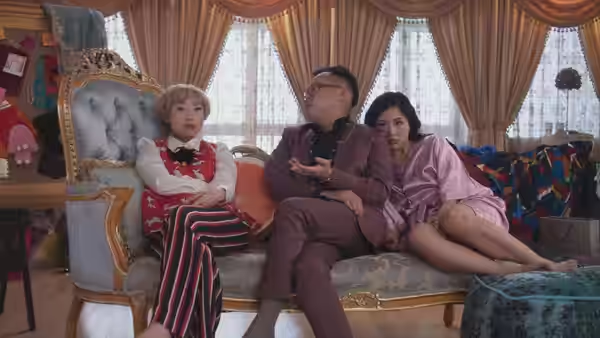
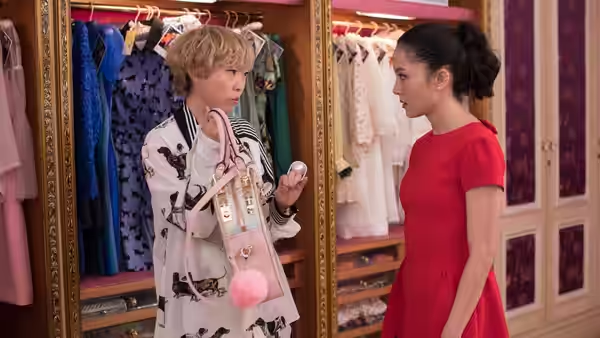
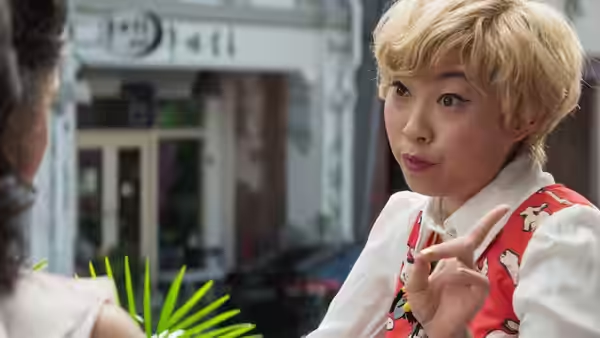
The supporting cast carry the comedy. Awkwafina’s Peik Lin, Rachel’s college friend, lives in a house that is gold from the floor up, and Ken Jeong, as her father, gets his laughs by being the most embarrassing man at his own dinner table. Ronny Chieng and Jimmy O. Yang play relations who exist to be awful, and are. Henry Golding is handsome, pleasant and slightly blank; Nick is the man everything happens around, and Golding does not find much to do with him except look sorry, which he does well.

The trouble is the money. The script opens with Rachel teaching game theory, and then Chu films every jet, yacht and party as though he had been asked to sell them. The film means to say that the wealth is empty and the people inside it unhappy, and it says so, out loud, more than once. Černjul’s camera does not agree; it lingers on the shoes. Gemma Chan’s Astrid has the one storyline that takes the point seriously, a marriage going wrong in an expensive flat, and the film keeps leaving her for another party. We felt our attention go every time it came back to her, not because Chan is dull, she is not, but because Lim and Chiarelli never give her a scene that lands. Brian Tyler’s score swoons on cue, and the last twenty minutes swoon with it. The ending is sweeter than anything that came before it.

Against the genre it sits above most studio romantic comedies of its decade, which is not saying a great deal, and below the comedies of manners it borrows from. Most critics have been a little warmer than we are, and we can see why: a Hollywood romantic comedy led entirely by Asian actors was rare enough that the fact of it was news, and the film carries that lightly and well. That is a fact about the industry, though, not about the script.

It runs 121 minutes and contains a wedding, a stag weekend, a hen weekend and a great many dumplings. You will want to book a flight before the credits, and we suspect that was at least half the point.

Critical consensus AI synthesised

77
Positive
19
Mixed
6
Negative
0

The reviews lean clearly positive, with nineteen of twenty-five in favour and none against. Most critics find it a charming, energetic romantic comedy that does the familiar thing well, and many treat it as a milestone for an Asian-led cast. The praise gathers around the women: Constance Wu’s grounded, intelligent Rachel, Michelle Yeoh’s disapproving mother, and Awkwafina’s comic turns. The mahjong confrontation between Rachel and Eleanor is repeatedly singled out as the film’s sharpest scene.

The reservations are consistent. Several call the script uneven and the story conventional, say Astrid’s subplot is thin, and find the ending sweeter than it needs to be. The commonest complaint is that the film admires the wealth it might have questioned; Vulture argues it undercuts its sharper ideas by returning to the spectacle of money. The spread is narrow, with the coolest voice at The Ringer, which grants the film its cultural significance but finds it neither revolutionary nor formally ambitious.

Time Out
9 September 2018 · ★★★★★ · Danny Yu
100

The review is strongly positive, describing the film as full of attitude and heart. It praises the film’s energetic take on an Asian-centric romantic comedy.

Read the full review →
Empire
29 August 2018 · Olly Richards
90*

Richards calls it a romcom milestone and one of the decade’s best, praising its charm and deftly balanced ensemble. He singles out Awkwafina’s performance and the film’s lively portrayal of cultural change.

Read the full review →
The Hollywood Reporter
8 August 2018 · David Rooney
90*

Rooney finds the film a captivating, uplifting romantic comedy that makes its extravagant setting serve a heartfelt story. He praises Constance Wu’s grounded performance and the chemistry she shares with Henry Golding.

Read the full review →
Variety
8 August 2018 · Critic's Pick · Peter Debruge
85*

Debruge praises the film as a broadly appealing, sparkling romance that balances extravagant wealth with a grounded heroine. He particularly singles out Constance Wu’s intelligent, self-reliant Rachel and her integrity in the mahjong scene.

Read the full review →
The AV Club
13 August 2018 · B+ · Caroline Siede
83

Siede finds the film a stylish, emotionally grounded rom-com whose familiar story is elevated by its perspective and exuberance. She especially praises Michelle Yeoh’s layered performance and the film’s sumptuous visual spectacle.

Read the full review →
Evening Standard
14 September 2018 · ★★★★ · Charlotte O'Sullivan
80

O’Sullivan finds the film less funny than Bridesmaids but leaves it with an unexpectedly pleased grin. She praises the gripping, moving women’s performances and the mother-daughter relationship that refreshes the rom-com formula.

Read the full review →

Straight answers AI written, from our review

Is Crazy Rich Asians worth watching?
Crazy Rich Asians is worth watching for anyone who wants a warm, well-dressed romantic comedy with a better cast than the genre usually gets, and we scored it 74. Michelle Yeoh gives the performance, Constance Wu holds the centre, and the jokes land. Its lesson about money rings false, and the ending is softer than it should be.
How long is Crazy Rich Asians, and what is it rated?
Crazy Rich Asians runs 2h 01m. It is a comedy and romance film.
Where can I watch Crazy Rich Asians in South Africa?
Crazy Rich Asians is streaming on Netflix in South Africa, and it is also available to rent from Apple TV from R34.99. Availability is checked daily; the links above go straight to each service.
How violent or frightening is Crazy Rich Asians, and is it suitable for children?
Crazy Rich Asians is a UK 12 romantic comedy with no violence to speak of and nothing frightening in it. The certificate reflects adult humour around a stag weekend and a hen weekend, and a marriage going wrong, rather than anything alarming. Teenagers will be fine; younger children are more likely to be bored by the family politics than upset by them.
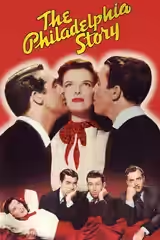
How does Crazy Rich Asians compare to The Philadelphia Story?
Crazy Rich Asians tells the same joke as The Philadelphia Story, a rich family, a wedding weekend and an outsider taking notes, and the older film tells it more sharply. Cukor's comedy is the better of the two for wit and for its three leads, though its treatment of Tracy Lord dates it. Chu's film is warmer, easier and more forgiving of its money.
Is Crazy Rich Asians based on a true story or a book?
Crazy Rich Asians is based on Kevin Kwan's novel of the same name, not on a true story. Adele Lim and Peter Chiarelli's script keeps the book's shape, the outsider brought home to a disapproving family, and adds nothing you need to know beforehand. Newcomers to the novel will follow every scene without help.
What should I watch after Crazy Rich Asians?
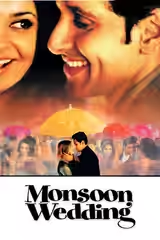
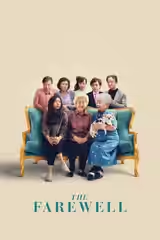
After Crazy Rich Asians, try The Philadelphia Story (1940, Fi1m 84): Rich family, wedding weekend, an outsider with a notebook; the same joke, sharper. Then Monsoon Wedding (2001, Fi1m 80): Mira Nair’s Delhi wedding, where the money is smaller and the family is louder; and The Farewell (2019, Fi1m 84): Awkwafina again, in a quieter film about what a family decides not to say.

Cast

If you liked this, try…

  1. The Philadelphia Story (1940, Fi1m 84)Rich family, wedding weekend, an outsider with a notebook; the same joke, sharper.

  2. Monsoon Wedding (2001, Fi1m 80)Mira Nair’s Delhi wedding, where the money is smaller and the family is louder.

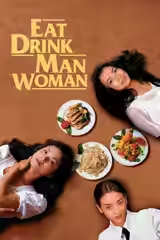
  3. Eat Drink Man Woman (1994) · not on Fi1m yetAng Lee’s Taipei chef and his daughters; the food scenes this film is chasing.

  4. The Farewell (2019, Fi1m 84)Awkwafina again, in a quieter film about what a family decides not to say.

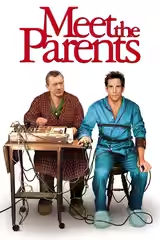
  5. Meet the Parents (2000, Fi1m 78)The disapproving in-law as horror comedy, with Robert De Niro instead of Michelle Yeoh.