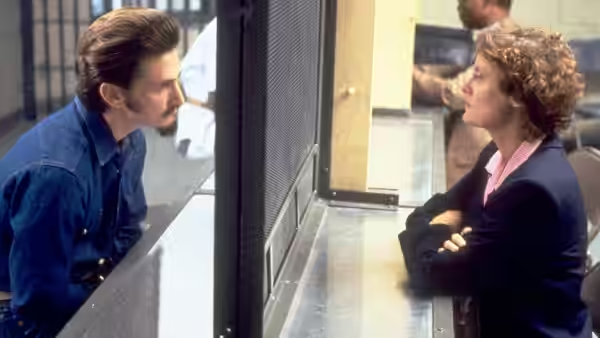
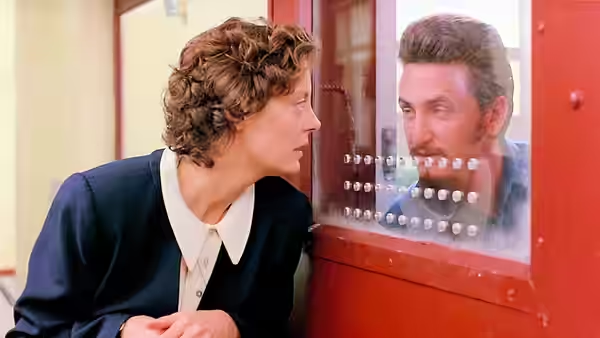
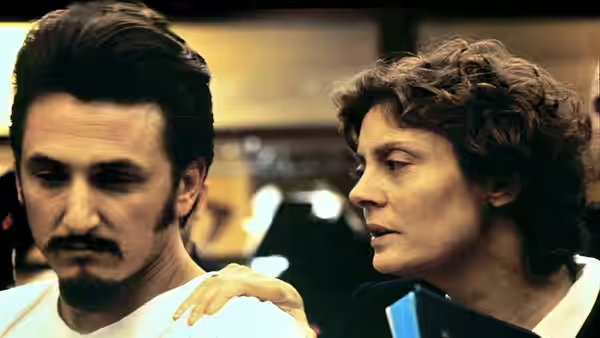
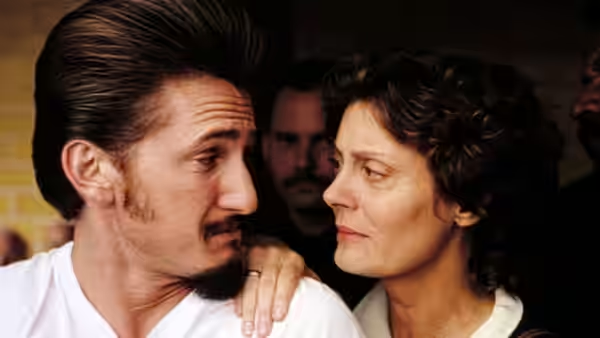
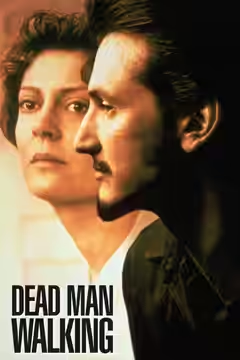
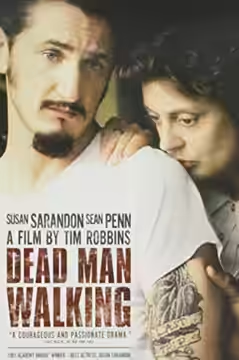
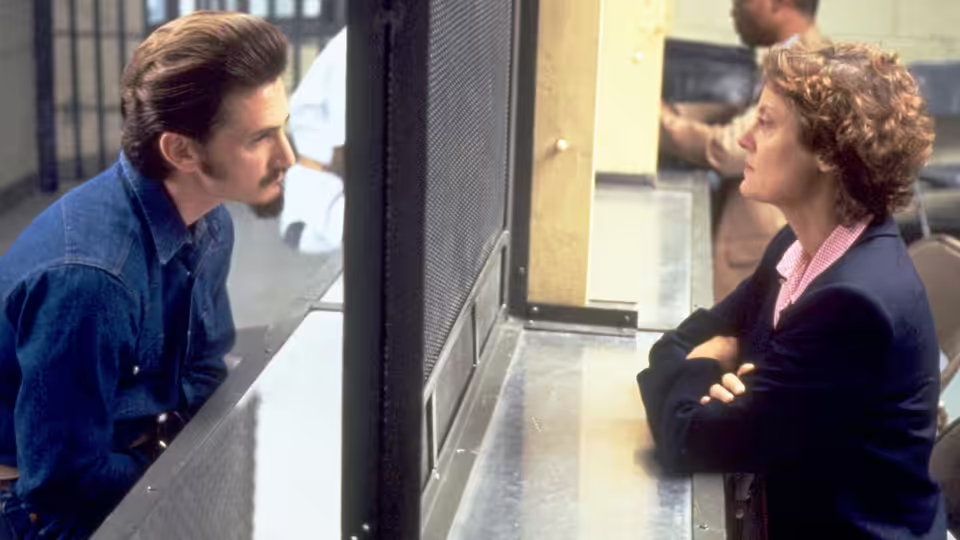
Matthew Poncelet (Sean Penn) and Sister Helen Prejean (Susan Sarandon) talking through a prison partition
Film review

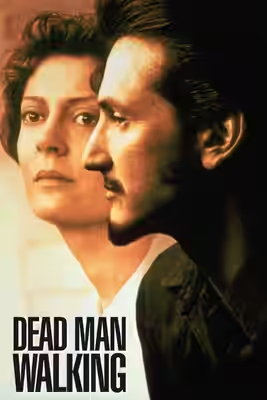
Dead Man Walking

1995 · Directed by Tim Robbins · 2h 02m

In a sentenceSean Penn makes compassion look like hard work

Sister Helen Prejean (Susan Sarandon) meets Matthew Poncelet (Sean Penn), a prisoner facing the death penalty. Their encounters draw the nun into questions of punishment, responsibility and what she owes a man whose behaviour makes compassion difficult. Away from the prisoner, she also meets the victim’s parents, bringing her concern for him into contact with those affected by his crime. Tim Robbins writes and directs a drama about capital punishment and redemption, with Raymond J. Barry as Earl Delacroix, R. Lee Ermey as Clyde Percy and Celia Weston as Mary Beth Percy.

Plays from YouTube when you press play; nothing loads from them until then.

Fi1m review

Tim Robbins’s capital-punishment drama earns its emotion through Susan Sarandon and Sean Penn’s difficult encounters. The debate occasionally feels too carefully arranged, but the performances make this a film we warmly recommend.

Dead Man Walking is a moving, serious drama that earns the attention it asks for, even when its debate about capital punishment feels too carefully arranged. Writer-director Tim Robbins places Susan Sarandon’s Sister Helen Prejean opposite Sean Penn’s Matthew Poncelet and makes their encounters difficult for both of them. We are asked to stay with a man who gives us little encouragement to care. Robbins understands how much that asks of an audience, and Penn does not soften the task.

Penn is crucial because he makes Poncelet unpleasant without turning him into a collection of villainous habits we can comfortably dismiss. His resistance to easy sympathy gives Sarandon something substantial to work against. She makes Helen’s willingness to listen seem effortful, and their scenes have the awkwardness of people who cannot simply agree to get along. We believe in the work involved in these meetings, even when we can see where the writing wants to take us.

The visit to the victim’s parents makes that work harder to feel comfortable about. We felt painfully uneasy watching Helen in their company, because her concern for Poncelet now has to contend with the people affected by his crime. Robbins gives their suffering a claim on our attention that her religious commitment cannot settle. The film is particularly persuasive here, allowing us to understand why someone trying to help might be unwelcome.

Roger Deakins’s cinematography serves these encounters without making the people look grander than they are. His concentration on the performers lets us watch Penn’s intransigence and Sarandon’s attentiveness without feeling that every exchange has been arranged to demonstrate their acting. Richard Hoover’s production design feels appropriately impersonal, keeping the settings from overwhelming the encounters. We are never tempted to spend these meetings admiring the surroundings, which seems the right order of priorities.

Editors Ray Hubley and Lisa Zeno Churgin give the exchanges time to become uncomfortable, and their patience is essential to the film’s effect. There are passages where the deliberateness begins to feel dutiful, as though each position must receive its allotted hearing before we can proceed. David Robbins’s music helps sustain the gravity without providing the main reason to feel anything. That comes from the strain of watching Helen continue to listen when Poncelet gives her so little reassurance.

The weakness belongs chiefly to Tim Robbins’s screenplay, which can make opposing views seem tidier than the people expressing them. We do not come away convinced that every assumption has been tested, however earnestly each has been heard. For a drama about punishment and redemption, it sometimes settles too readily for the force of a feeling. Yet the intimate scenes escape the solemn neatness that can make this kind of film feel like a classroom exercise, largely because Sarandon and Penn remain such difficult company.

Those performances are reason enough to forgive the passages where Robbins seems anxious to prove how seriously he takes his subject. At 122 minutes, the film asks for sustained attention, and we think the encounters between Helen and Poncelet repay it. Choose it for an evening when neither of you needs cheering up, and leave time to talk afterwards.

Critical consensus AI synthesised

84
Positive
7
Mixed
1
Negative
0

The reviews are almost uniformly warm. Most critics take the film as a fair, even-handed treatment of capital punishment that refuses to argue one side, and they credit Tim Robbins, as writer and director, with a clear step up in maturity and craft from his earlier work. The praise settles on the two central performances: Susan Sarandon’s nun and, most often, Sean Penn’s condemned man, whom several reviews single out for making a repellent character human without asking us to forgive him.

The reservations are few and the spread is narrow. Some critics find the film austere to the point of coolness, and others note that its power is emotional rather than argued. The one real dissent comes from The Independent, which calls it hollow and self-conscious, well acted in its intimate scenes but more likely to confirm what viewers already think than to unsettle it.

RogerEbert.com
12 January 1996 · ★★★★/4 · Roger Ebert
100

The film confronts capital punishment fairly from all sides without shortcuts or manipulation, while also being absorbing and technically superb. It stands out as a rare spiritual drama centered on the performances of Susan Sarandon and Sean Penn.

Read the full review →
The New York Times
29 December 1995 · NYT Critic’s Pick · Janet Maslin
90*

The critic highlights the film's courageous and hard look at capital punishment issues through exceptional casting and performances. It singles out Sean Penn's unrepentant portrayal of the convict and the nun's eye-opening experiences for praise.

Read the full review →
Variety
17 December 1995 · Emanuel Levy
90*

The critic calls it a quantum leap for Robbins as writer-director and a mature, well-crafted intimate drama. It singles out the superb acting by Sarandon and Penn and the balanced, multi-perspective approach to the material for praise.

Read the full review →
Empire
1 January 2000 · Angie Errigo
85*

The review highlights the film's even-handed exploration of the death penalty debate through strong performances by Sarandon and especially Penn, who humanizes a repulsive character. Robbins' direction is praised for forcing viewers to confront moral questions without easy answers or polemic.

Read the full review →
Los Angeles Times
29 December 1995 · Kenneth Turan
80*

The critic describes the film as an exploratory and dispassionate examination of capital punishment with austere gravity. It singles out the strong, non-theatrical acting by Penn and Sarandon for praise.

Read the full review →
The New Yorker
1 January 1996 · Terrence Rafferty
80*

The movie explores the realities of capital punishment through a mix of drama and polemic drawn from Sister Helen Prejean's experiences. Its power rests on Sean Penn's performance revealing a salvageable soul in the condemned man.

Read the full review →

Straight answers AI written, from our review

Is Dead Man Walking worth watching?
Dead Man Walking is worth watching for anyone prepared for a serious, uncomfortable drama about capital punishment, and we scored it 84. Sean Penn and Susan Sarandon make their encounters difficult and convincing, though Tim Robbins's screenplay sometimes arranges the debate too tidily. Choose it for an evening when neither of you needs cheering up.
How long is Dead Man Walking, and what is it rated?
Dead Man Walking runs 2h 02m. It is a drama film.
Where can I watch Dead Man Walking in Romania?
Dead Man Walking is streaming on Amazon Prime Video in Romania, and it is also available to rent from Amazon Prime Video from lei 10.00. Availability is checked daily; the links above go straight to each service.
How violent or frightening is Dead Man Walking, and is it suitable for children?
Dead Man Walking carries a UK 15 certificate and is not suitable for children. The subject is a man facing execution and the crime that put him there, and the film asks the audience to sit with his unpleasantness and with the grief of the victim's parents. It is distressing rather than frightening, and best kept for older teenagers and adults.
What should I watch after Dead Man Walking?
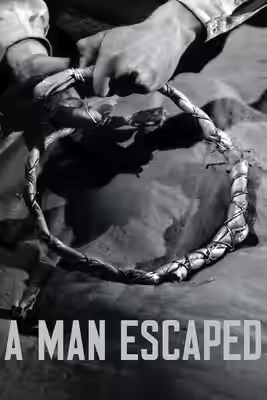
After Dead Man Walking, try Clemency (2019, Fi1m 81): The same punishment viewed through the people employed to carry it out. Then A Man Escaped (1956, Fi1m 90): For the patient attention to confinement, small gestures and spiritual endurance.

Cast

Awards

Academy Awards, 1996

Nominated
Best Actor
Nominated
Best Director
Won
Best Actress

If you liked this, try…

  1. A Short Film About Killing (1988) · not reviewed yetAn austere treatment of killing and punishment, with little comfort offered.

  2. Clemency (2019, Fi1m 81)The same punishment viewed through the people employed to carry it out.

  3. A Man Escaped (1956, Fi1m 90)For the patient attention to confinement, small gestures and spiritual endurance.

  4. The Woodsman (2004) · not reviewed yetA difficult central performance tests how far compassion can stretch.

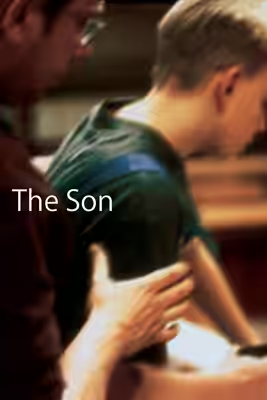
  5. The Son (2002) · not reviewed yetA similarly difficult test of compassion, conducted through close attention to behaviour.

Free account

Know what to watch tonight

Two lists that know where things are streaming, collections you can share, your own score beside ours, and Discover that remembers what you have seen.

  • Want to see, sorted by what is streaming now
  • Seen, with your score out of ten
  • No adverts, ever