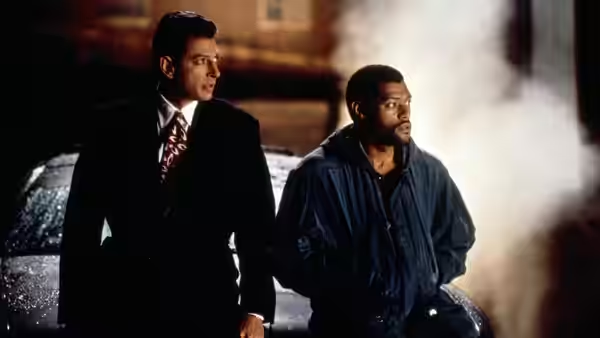
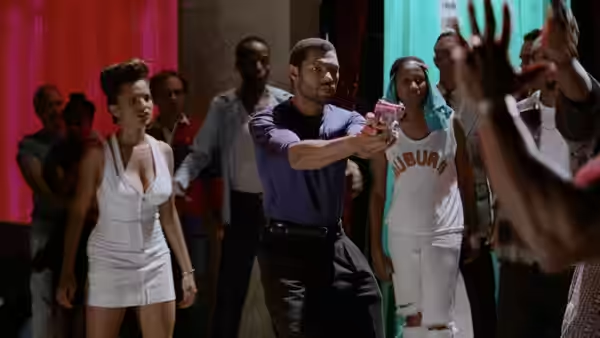
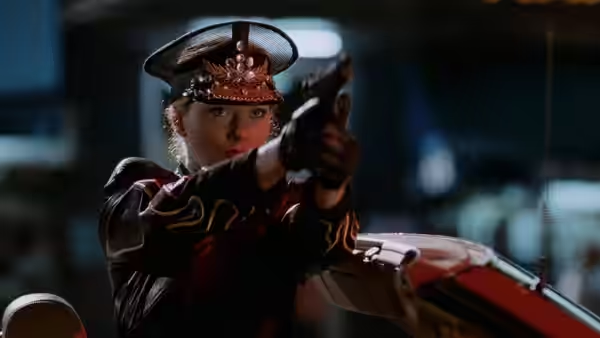
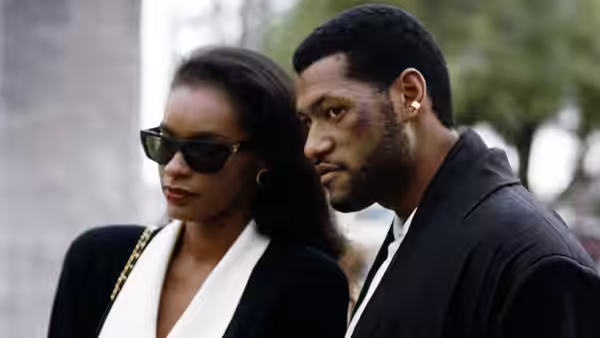
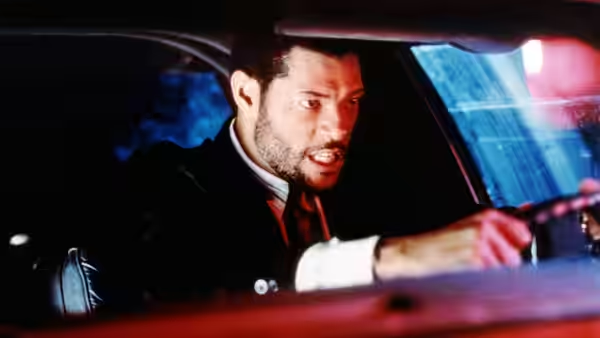
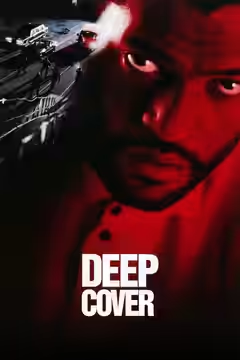
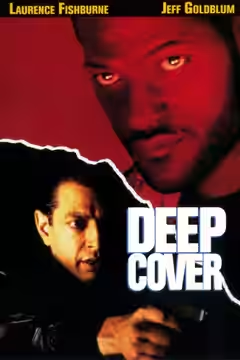
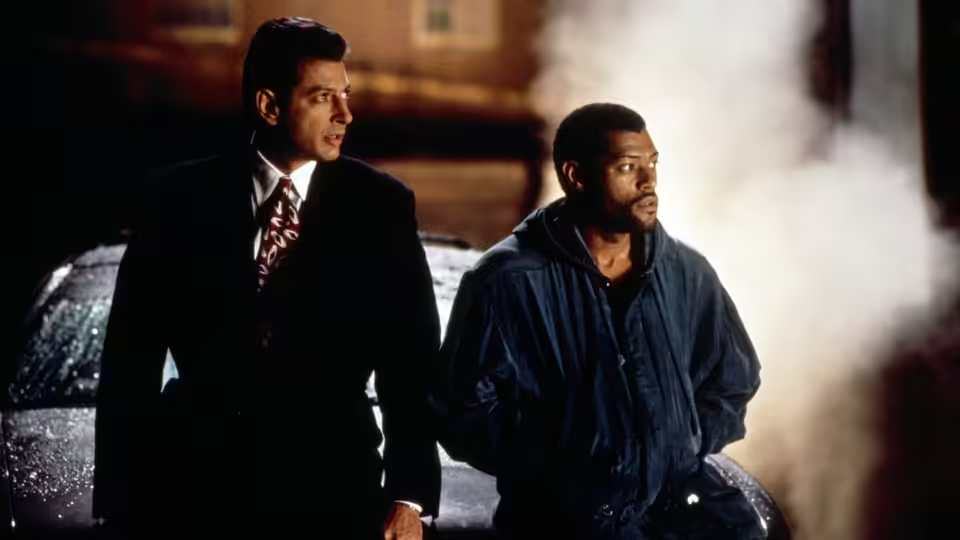
Russell Stevens Jr. (Laurence Fishburne) and David Jason (Jeff Goldblum) stand beside a car
Film review

Deep Cover

1992 · Directed by Bill Duke · 1h 48m

In a sentenceJeff Goldblum makes us want a solicitor present before the conversation has even started

Russell Stevens Jr. / John Hull (Laurence Fishburne) is at the centre of a police thriller about catching a criminal without becoming one. David Jason (Jeff Goldblum) and Betty McCutcheon (Victoria Dillard) figure in the same crime story, alongside Felix Barbosa (Gregory Sierra) and Taft (Clarence Williams III). Law enforcement comes with questions about the conduct it permits and the people carrying it out. Bill Duke directs, from a screenplay by Michael Tolkin and Henry Bean, with the boundary between criminality and policing under examination.

Fi1m review

Bill Duke’s police thriller is worth seeing for Laurence Fishburne, Jeff Goldblum and its persistent unease. The plotting needs untangling, and its political questions deserve more attention than the screenplay gives them.

Deep Cover is a good crime thriller whose actors are more convincing than some of the writing. Bill Duke wants the danger to extend beyond the prospect of getting caught: catching criminals can also change the person doing it. That gives Michael Tolkin and Henry Bean’s screenplay a worthwhile problem to work through. It does not work through it cleanly, but the performances keep the film interesting when the plotting becomes difficult to follow.

Laurence Fishburne gives Russell Stevens Jr. / John Hull a reserve that sometimes risks looking inert. Mostly it works, because his firmness suggests someone making an effort to stay in control, and that effort is worth watching. We do not need every doubt announced for the possibility of doubt to matter. There are passages where the performance becomes too fixed, though, and the writing does not always give that stillness enough to do beyond holding our attention until the next exchange.

Jeff Goldblum, as David Jason, is the more immediately unsettling presence. We felt uneasy watching him because his unpredictable delivery makes a conversation seem capable of going wrong without warning. His performance gives Laurence Fishburne’s restraint something useful to contend with, and their contrasting approaches keep the film alert. Jeff Goldblum can suggest that someone is enjoying himself without making that enjoyment reassuring. He is also sufficiently interesting to expose how little attention some of the other characters receive.

The sinister atmosphere is another substantial pleasure. Bojan Bazelli’s cinematography gives the film a threatening quality, with Pamela B. Warner’s production design helping make its surroundings feel inhospitable. Both contributions support the performances without competing with them for attention. That is the right emphasis for a thriller whose strongest attraction is the chance to study these people, particularly when the script gives us more complications than we can usefully keep in mind.

John Carter’s editing has the less enviable job of getting us through that script. Some connections between its complications need more care, and the cutting cannot always make the writing easier to follow. Michel Colombier’s moody score is more dependable, sustaining the unease when the story becomes less persuasive. It helps maintain our interest, although there are stretches where we would gladly exchange some of that carefully sustained tension for a clearer understanding of what matters.

The larger disappointment is how unevenly the film develops its political concerns. Michael Tolkin and Henry Bean raise questions about the conduct permitted in the pursuit of criminals, but give themselves more to examine than they adequately explain. Bill Duke treats those questions seriously enough that their incomplete development feels like a missed opportunity. Against the ordinary demands of a police thriller, the film offers welcome ambition; judged by the expectations that ambition creates, it needs sharper writing and fewer distractions from its central problem.

At 108 minutes, it asks for a reasonable amount of patience, though patience will not resolve every complication. Anyone looking for a tightly explained police thriller should look elsewhere. For a crime film carried by two actors we keep wanting to watch, it is worth an evening.

Critical consensus AI synthesised

61
Positive
2
Mixed
2
Negative
1
Slant Magazine
3 August 2021 · ★★★★ · Chuck Bowen
80

Bowen praises Deep Cover as a richly textured, politically incisive American thriller. He singles out the film’s volatile style and Laurence Fishburne’s extraordinary performance.

Read the full review →
Time Out
· SGr
70*

The available description suggests a positive assessment of the film. It singles out Laurence Fishburne as sensational in his first starring role.

Read the full review →
The New York Times
15 April 1992 · Janet Maslin
64*

The review frames the film as a police thriller with broader issues in play. The article text was inaccessible, so its verdict and specific praise or criticism cannot be verified.

Read the full review →
Los Angeles Times
15 April 1992 · Peter Rainer
55*

Rainer finds the film uneven but says its sinister atmosphere and Goldblum’s performance lift it above its genre. He praises Goldblum’s unsettling, unpredictable portrayal while criticizing Fishburne’s rigid performance and the script’s underdeveloped ideas.

Read the full review →
Variety
31 December 1991 · Variety Staff
35*

The review finds the film convoluted and mostly unconvincing, though it retains some resonance. It praises Larry Fishburne’s heavyweight performance and singles out Michel Colombier’s moody score.

Read the full review →

Straight answers AI written, from our review

Is Deep Cover worth watching?
Deep Cover is worth watching for crime-thriller fans drawn to unsettling performances, and we score it 72 out of 100. Laurence Fishburne’s restraint and Jeff Goldblum’s unpredictable delivery sustain the tension, but we find the plotting difficult to untangle and the questions about police conduct insufficiently explored.
How long is Deep Cover, and what is it rated?
Deep Cover runs 1h 48m. It is an action and thriller film.
Where can I watch Deep Cover in Hong Kong?
Deep Cover is not on any streaming or rental service in Hong Kong at the moment. It is available in 3 other countries; change your country at the top of the page to see where. Availability is checked daily.
How violent or frightening is Deep Cover, and is it suitable for children?
Deep Cover carries a UK 18 certificate and is intended for adults, not children. We find Jeff Goldblum’s unpredictable delivery unsettling, while the threatening surroundings and moody music sustain the unease. The certificate signals adult material, but it does not by itself establish how graphic the violence is, so we cannot offer reassurance to squeamish viewers.
How does Deep Cover compare to The Long Good Friday?
Deep Cover and The Long Good Friday are worthwhile crime thrillers whose leading performances make negotiations uneasy, though both require patience with their plotting. We recommend The Long Good Friday for its mixture of humour, fear and attention to ambition and money; Deep Cover suits those drawn to Fishburne and Goldblum’s contrasting performances, despite its underdeveloped questions about policing.
What should I watch after Deep Cover?
After Deep Cover, try The Long Good Friday (1980, Fi1m 88): Another crime thriller where the leading performance makes every negotiation uneasy. Then Infernal Affairs (2002, Fi1m 87): Undercover work becomes harder when neither side can trust its own men; and A Prophet (2009, Fi1m 86): A young man’s criminal education makes every apparent advance feel dangerous.

Cast

If you liked this, try…

  1. The Friends of Eddie Coyle (1973) · not reviewed yetCriminal loyalties look fragile when survival becomes everybody’s first concern.

  2. The Long Good Friday (1980, Fi1m 88)Another crime thriller where the leading performance makes every negotiation uneasy.

  3. Infernal Affairs (2002, Fi1m 87)Undercover work becomes harder when neither side can trust its own men.

  4. A Prophet (2009, Fi1m 86)A young man’s criminal education makes every apparent advance feel dangerous.

  5. The Glass Shield (1994) · not reviewed yetPolice loyalty and racial prejudice receive a more directly institutional examination.