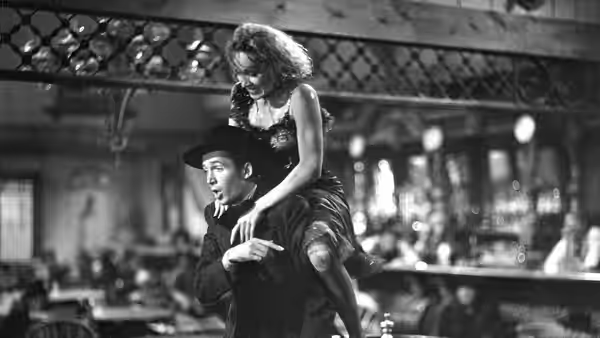
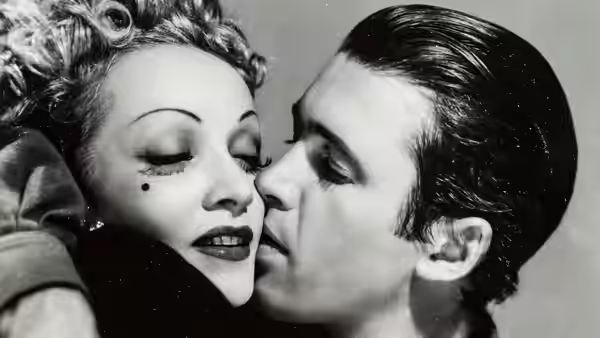
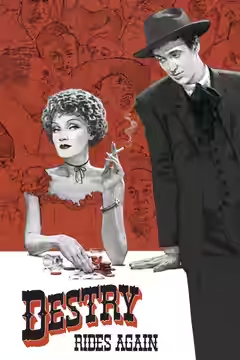
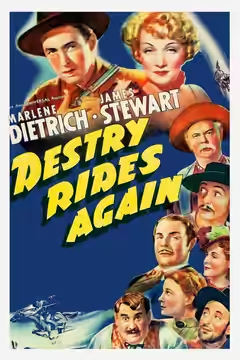
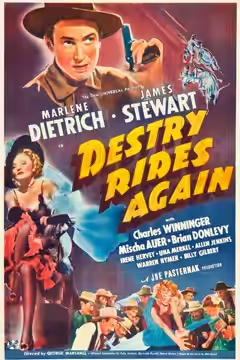
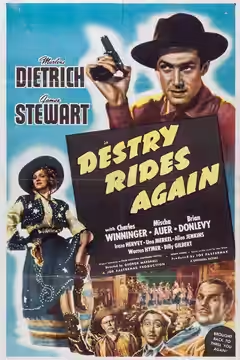
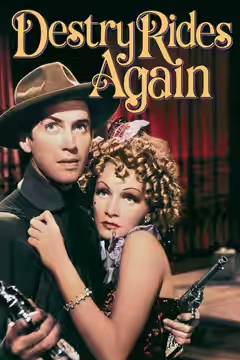
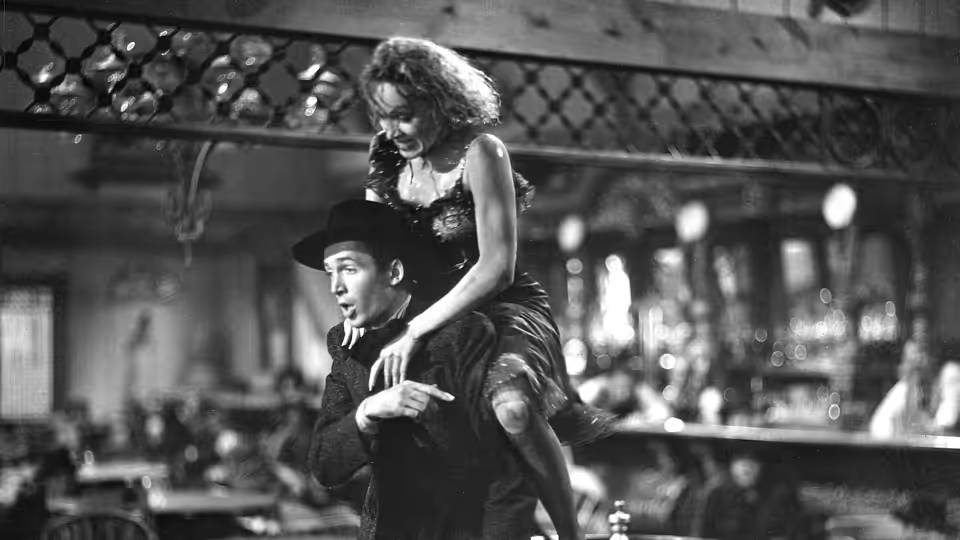
Frenchy (Marlene Dietrich) sits astride Tom Destry Jr. (James Stewart) in the saloon
Film review

Destry Rides Again

1939 · Directed by George Marshall · 1h 34m

In a sentenceJames Stewart brings manners to a saloon that has managed perfectly badly without them

Tom Destry Jr. (James Stewart) sets out to bring order to a lawless Western town without relying on a gun. He prefers words and jokes, which puts him at odds with the town’s ideas about how a lawman ought to behave. Frenchy (Marlene Dietrich) and Washington Dimsdale (Charles Winninger) are among the people he encounters. The saloon brings the town together, with songs and slapstick sharing space with the business of keeping the peace. Destry has to persuade people to listen in a place where a quiet approach does not command much respect.

Fi1m review

George Marshall’s comedy Western gives James Stewart and Marlene Dietrich room to be funny, difficult and persuasive. The broad slapstick occasionally wears thin, but the saloon bustle and the leads’ chemistry make this easy to recommend.

Destry Rides Again is a funny, warm Western with enough seriousness about violence to make its jokes matter. George Marshall takes the familiar business of restoring order to a lawless town and gives it to a man who would rather talk. Tom Destry Jr., played by James Stewart, makes patience look like a practical skill. The film enjoys the disruption this causes without treating decency as a joke. It is good company, with a small warning attached to the broader comedy.

James Stewart is particularly good at making Destry’s mildness feel deliberate. His conversational manner holds our attention through the commotion, and the jokes never quite erase the sense that he is working something out. We laughed at the contrast between his patient delivery and the fuss in the saloon. It is a pleasure to watch a Western lawman whose efforts to calm people down are allowed to be entertaining in themselves, without the actor having to wink at us.

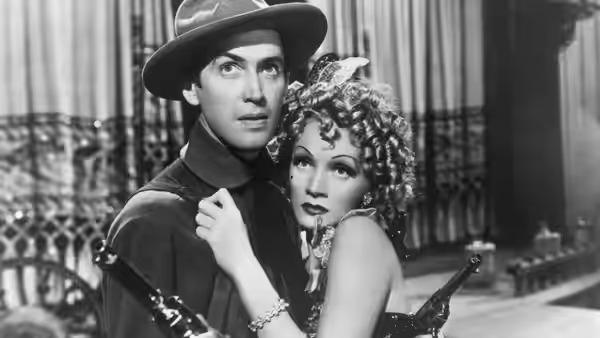
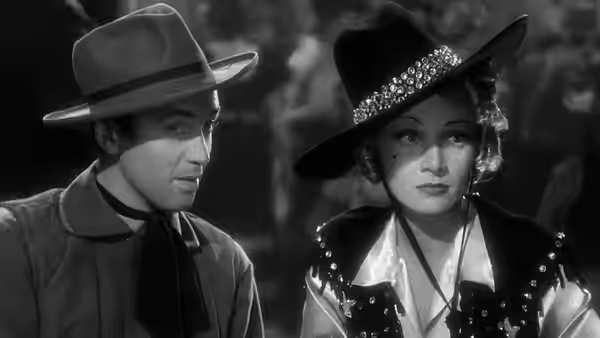
Marlene Dietrich makes Frenchy a convincing match for him, with a comic force that gives their scenes some friction. Their chemistry benefits from the sense that each finds the other difficult to account for; neither performance settles into easy admiration. The film has room for a woman’s impatience with masculine self-importance, and her performance keeps that impatience personal. It helps that neither lead appears to be politely waiting for the other to finish being charming.

George Marshall’s saloon staging gives the film much of its energy. Hal Mohr’s cinematography makes that busy space readable, so that the crowd remains interesting while the leads keep our attention. The setting matters because a man trying to keep the peace has an audience, and everyone else can see how he goes about it. The comedy benefits from having all those witnesses, with the saloon giving the actors somewhere to establish themselves through their behaviour towards one another.

Milton Carruth’s editing has a demanding mixture to manage: slapstick, wisecracks, songs and melodrama all want their turn. The changes of pace mostly work, allowing the film to become serious without making its earlier good humour seem misplaced. Frank Skinner’s music contributes to that amiability without removing the sense of trouble beneath it. The songs are part of the pleasure, giving the saloon more to do than provide a convenient place for men to quarrel.

The screenplay by Felix Jackson, Henry Myers and Gertrude Purcell is strongest when Destry’s manner unsettles the town’s expectations of a lawman. Some of the slapstick is less discriminating, inviting a broad laugh where the central performances have taught us to enjoy a smaller one. That is a modest but recurring irritation, particularly when the physical fuss delays another exchange between the leads. The supporting comedy is sometimes allowed to run beyond the point at which we have got the joke.

For a comedy Western, this has a satisfying seriousness about how men are expected to behave. Destry’s preference for persuasion keeps testing the assumption that authority has to announce itself through force, and the humour makes the question worth attending to. At 94 minutes, the film has space for both the saloon entertainment and the unease underneath it. Choose it for the two leads, and forgive the occasional joke that takes too long.
Critical consensus AI synthesised

83
Positive
7
Mixed
0
Negative
0

The reviews are uniformly positive about Destry Rides Again, with praise gathering around its comedy and its leading performances. Dietrich receives particular attention, while Stewart’s pacifist marshal is admired for tackling a lawless town with words and jokes. Radio Times singles out the chemistry between the two stars. The mix of slapstick, wisecracks, songs and melodrama also earns approval, with several accounts treating the film chiefly as lively, satisfying entertainment.

The differences concern emphasis rather than objections, though enthusiasm ranges from solid approval to considerable admiration. Slant Magazine makes the strongest case for looking beyond the comedy, finding a sombre western with thematic depth and praising Marshall’s saloon staging and the challenge to masculine mythology. No substantive criticism of the film emerges from the supplied accounts, although some are only partial descriptions, so the apparent agreement is clearer on strengths than on possible weaknesses.

Radio Times
★★★★★ · Tony Sloman
100

The review says the comedy western has universal appeal. It praises Dietrich’s performance and the chemistry she shares with Stewart.

Read the full review →
Slant Magazine
23 April 2020 · ★★★★½ · Chuck Bowen
90

Bowen sees the film as more than a spoof: a beautiful, somber western with substantial thematic depth. He especially praises Marshall’s staging of the saloon and the climactic revolt, highlighting the women’s challenge to the town’s mythology of manliness.

Read the full review →
Time Out
· GA
85*

The available description presents it as a marvellous comedy Western. It singles out Stewart’s pacifist marshal, who tames the lawless town with words and jokes.

Read the full review →
Variety
31 December 1938 · Variety Staff
75*

The review calls the film plain, good entertainment, elevated beyond an ordinary western. It singles out Marlene Dietrich’s performance as the element that makes it a class item.

Read the full review →
Empire
31 March 2006 · David Parkinson
70*

Parkinson presents the film as an entertaining Western that playfully subverts James Stewart’s clean-cut image. He singles out its mix of slapstick, wisecracks, songs and melodrama.

Read the full review →
The New York Times
30 November 1939
70*

The headline indicates a positive verdict, highlighting Marlene Dietrich’s performance in the western. The blocked article text prevents identifying any further praise or criticism.

Read the full review →

Straight answers AI written, from our review

Is Destry Rides Again worth watching?
Destry Rides Again is easy to recommend for its warm comedy and James Stewart–Marlene Dietrich chemistry, and we score it 84 out of 100. We particularly enjoy Stewart’s patient lawman amid the saloon commotion, though some broad slapstick runs too long; it suits anyone who likes a Western with more conversation than swagger.
How long is Destry Rides Again, and what is it rated?
Destry Rides Again runs 1h 34m. It is a western and comedy film.
Where can I watch Destry Rides Again in South Korea?
Destry Rides Again is not on any streaming or rental service in South Korea at the moment. It is available in 6 other countries; change your country at the top of the page to see where. Availability is checked daily.
How does Destry Rides Again compare to The Guard?
Destry Rides Again is the warmer, more satisfying comedy beside The Guard, whose Irish lawman has a much sharper tongue. We recommend The Guard for Brendan Gleeson and Don Cheadle’s rude, pointed exchanges, despite an investigation that needs more urgency; choose Destry Rides Again for its gentler humour, songs and persuasive central pairing.

Cast

If you liked this, try…

  1. The Sheepman (1958) · not on Fi1m yetAnother amiable Western where being underestimated becomes a useful professional advantage.

  2. The Man Who Shot Liberty Valance (1962) · not on Fi1m yetFor a sterner look at persuasion, violence and the making of authority.

  3. Way Out West (1937) · not on Fi1m yetFor more Western comedy that lets physical foolishness coexist with considerable warmth.

  4. Tampopo (1985) · not on Fi1m yetAnother playful borrowing of Western manners, with food taking priority over gunfire.

  5. The Guard (2011, Fi1m 78)An Irish lawman supplies the awkward manners and a much sharper tongue.