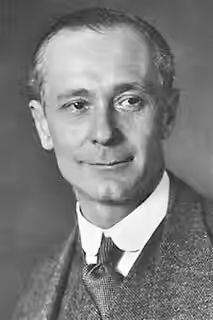
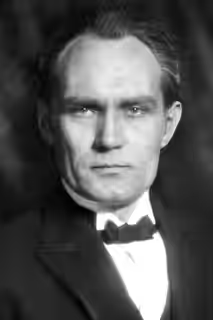
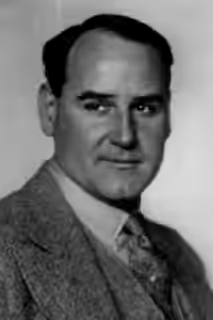
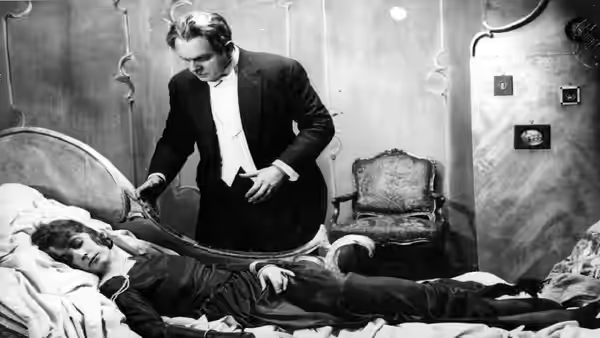
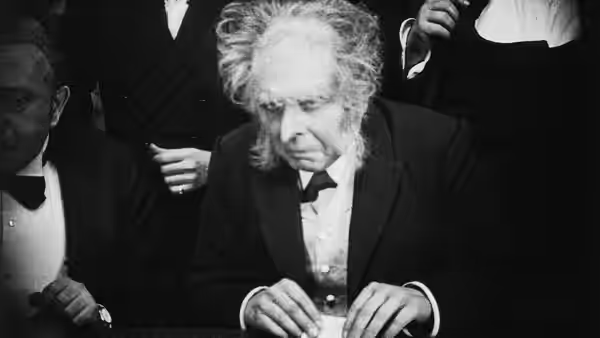
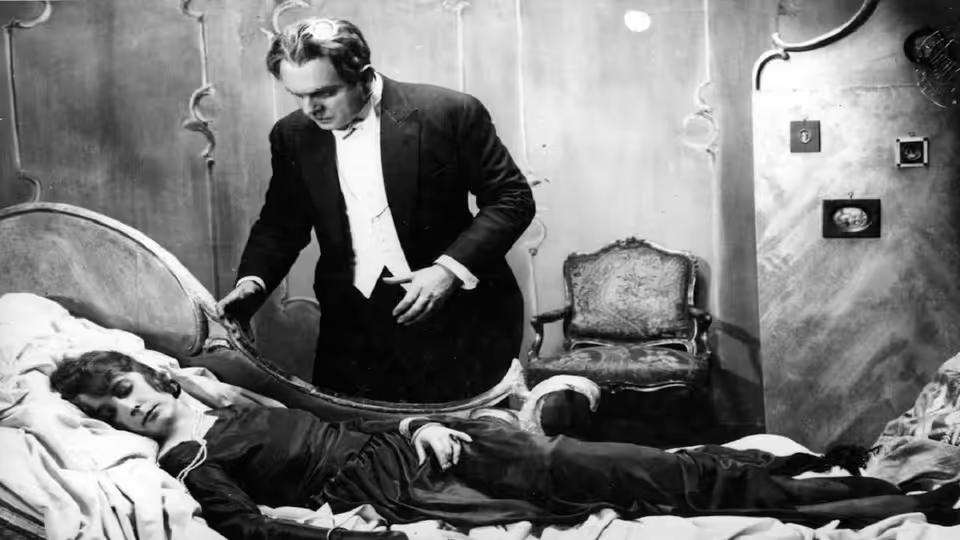
A suited man stands beside a bed where another man lies unconscious
Film review

Dr. Mabuse, the Gambler

1922 · Directed by Fritz Lang · 4h 31m

In a sentenceFour and a half hours is a generous amount of time to spend with a man we would cross the street to avoid

Dr. Mabuse (Rudolf Klein-Rogge) spreads disruption through Germany with a series of criminal schemes. Prosecutor von Wenk (Bernhard Goetzke) stands on the other side of the law, with the task of stopping him. Around them are Cara Carozza (Aud Egede-Nissen), Countess Dusy Told (Gertrude Welcker) and Count Told (Alfred Abel). The investigation shares the story with romantic pursuit, while sumptuous interiors provide the setting for a struggle between criminal ambition and the authorities. Mabuse wants to continue his schemes without interference; the prosecutor represents the obstacle in his path.

Fi1m review

Fritz Lang’s crime thriller rewards patience with Rudolf Klein-Rogge’s unsettling villain and oppressive interiors. The pursuit drags, and 271 minutes is more than the story can comfortably sustain, but the menace makes it worth the effort.

Fritz Lang’s Dr. Mabuse, the Gambler is a good crime thriller that asks for more patience than it consistently rewards. Its 271 minutes make room for an imposing villain, a brooding atmosphere and passages that could use a firmer hand. Lang wants Mabuse’s criminal schemes to suggest something wrong with the society around him. The film is most persuasive when it lets Rudolf Klein-Rogge carry that suggestion. It becomes less compelling when it settles into the work of pursuit.

Klein-Rogge’s Dr. Mabuse is the main reason to stay. The performance makes his decadence ugly, with little invitation to mistake it for sophistication, and gives the criminal schemes a personal nastiness. Such a dominant villain can leave a film struggling to hold our interest whenever he is absent. That is a problem here, although Klein-Rogge earns the attention: we remain interested in him after the business of tracking him has begun to wear thin.

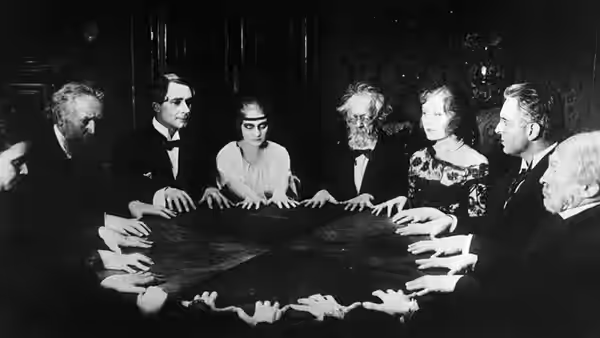
Carl Hoffmann’s cinematography is strongest in the interiors, where the lighting makes luxury feel oppressive. The rooms are sumptuous, but they do not look restful; their richness helps explain the attraction of the society Mabuse disrupts. Multiple exposures add to the disquiet without making the film’s effect depend entirely on visual tricks. Lang gives the décor enough attention for us to register it, and the brooding atmosphere survives even when the plot slows.

Bernhard Goetzke gives Prosecutor von Wenk a welcome firmness amid all this criminal excess. Aud Egede-Nissen, as Cara Carozza, and Gertrude Welcker, as Countess Dusy Told, also deserve attention for performances that hold their own beside Klein-Rogge. They help the film feel populated by people with separate concerns, even when the pursuit threatens to take over. The actors remain engaging through stretches of plotting that keep supplying business after we have understood the central conflict.

Thea von Harbou, Fritz Lang and Norbert Jacques share the screenplay credit, and the writing too often seems anxious to explain what the images have already made interesting. The wordy captions interrupt our attention to faces and rooms. We grew restless during the procedural passages, because the explanations keep delaying an investigation we want to see advance. The romantic pursuit also weakens the pressure, and at this length such diversions matter.

The music credited to Konrad Elfers and Osmán Pérez Freire supports the brooding tone, but it cannot hurry the more laborious passages. Those need fewer explanations and a shorter route through the investigation. As a thriller, the film gives us plenty to look at while leaving too much time to wonder when the pursuit will advance. Its precise direction makes that uneven pace more frustrating, since Lang plainly knows how to command attention.

A crime thriller needs its pursuers to interest us once the villain has left the screen. Lang does not always manage that, despite Goetzke’s efforts, and the long investigation exposes the weakness. Yet the oppressive interiors and Klein-Rogge’s performance give us good reasons to put up with the delays. Allow an evening for it, provided a sinister criminal and some carefully lit rooms can sustain your interest when the police are taking their time.
Critical consensus AI synthesised

76
Positive
4
Mixed
1
Negative
0
Time Out
15 March 2012
90*

Time Out presents Lang’s film as a masterpiece. It singles out Rudolf Klein-Rogge’s memorably decadent performance and Mabuse’s symbolic havoc across Germany.

Read the full review →
The New Yorker
23 July 2006 · Richard Brody
85*

Brody gives the film a strongly positive assessment, calling its direction ironic and precise. He singles out how Lang’s direction makes Mabuse’s schemes feel prophetically timely.

Read the full review →
Empire
31 March 2006 · David Parkinson
75*

The critic finds it an assured, epic thriller, though some passages drag. He praises its brooding atmosphere and masterful use of lighting, décor and multiple exposures.

Read the full review →
Slant Magazine
18 July 2006 · ★★★/4 · Keith Uhlich
75

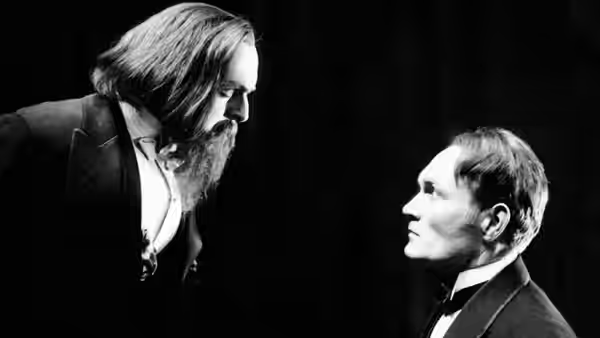
Uhlich gives the film a mixed verdict, finding its police procedural and romantic pursuit weaken the experience. He praises the striking final image as memorable black-and-white portraiture.

Read the full review →
Variety
31 December 1921 · Variety Staff
55*

The critic finds it an average but lively thriller, somewhat confused yet generally fast-moving. The sumptuous interiors and the performances of Goetzke, Egede-Nissen, and Welcker earn praise, while Klein-Rogge’s casting and Lang’s wordy captions draw criticism.

Read the full review →

Straight answers AI written, from our review

How long is Dr. Mabuse, the Gambler, and what is it rated?
Dr. Mabuse, the Gambler runs 4h 31m. It is a crime and thriller film.
Where can I watch Dr. Mabuse, the Gambler in Chile?
Dr. Mabuse, the Gambler is not on any streaming or rental service in Chile at the moment. It is available in 2 other countries; change your country at the top of the page to see where. Availability is checked daily.
What should I watch after Dr. Mabuse, the Gambler?
After Dr. Mabuse, the Gambler, try M (1931, Fi1m 94): Lang tightens the pursuit, making the people hunting a criminal equally troubling. Then Les Vampires (1915, Fi1m 82): Another sprawling criminal conspiracy, with Paris providing the rooms, rooftops and unease; and The Third Man (1949, Fi1m 92): A city’s corruption takes shape in shadows, doorways and one magnetic criminal.

Cast

If you liked this, try…

  1. M (1931, Fi1m 94)Lang tightens the pursuit, making the people hunting a criminal equally troubling.

  2. Les Vampires (1915, Fi1m 82)Another sprawling criminal conspiracy, with Paris providing the rooms, rooftops and unease.

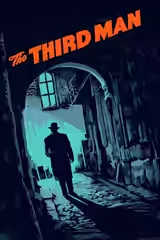
  3. The Third Man (1949, Fi1m 92)A city’s corruption takes shape in shadows, doorways and one magnetic criminal.

  4. Cure (1997) · not on Fi1m yetA police investigation grows steadily more troubling through quiet encounters and unexplained violence.

  5. House of Games (1987) · not on Fi1m yetFor the pleasure of watching careful schemes make apparently sensible people foolish.

Dr. Mabuse, the Gambler (1922) review: Good but it runs too long (Chile) | Fi1m