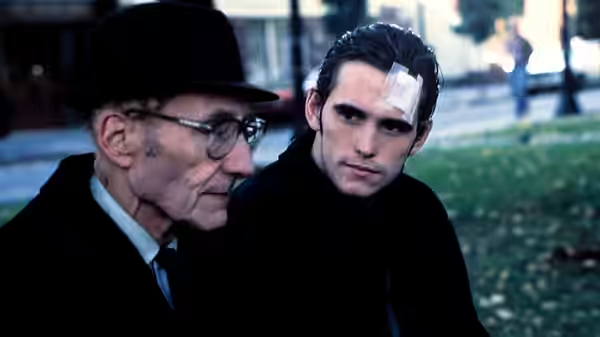
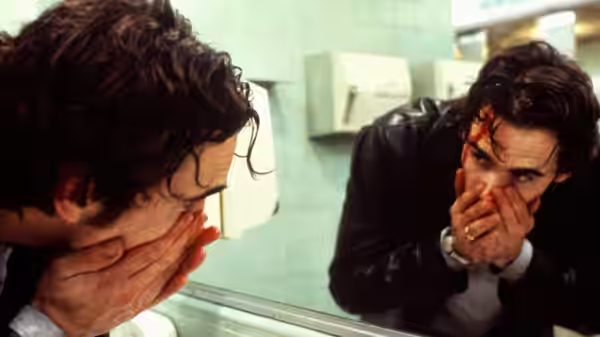
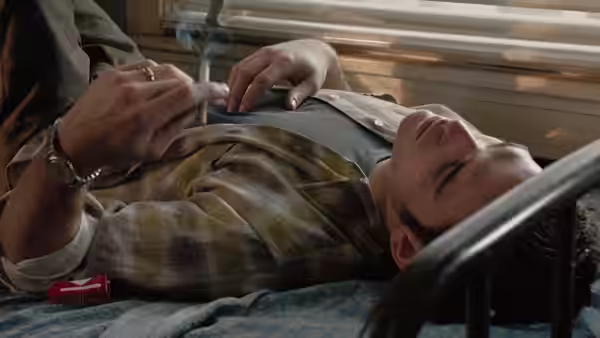
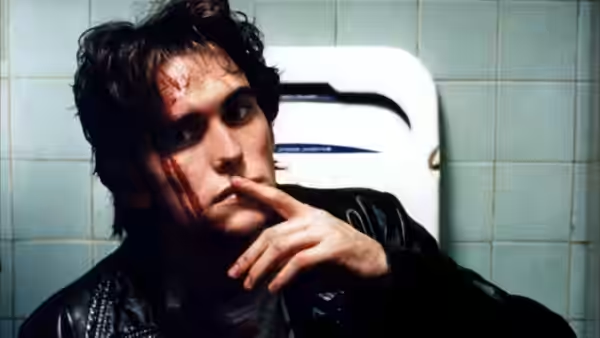
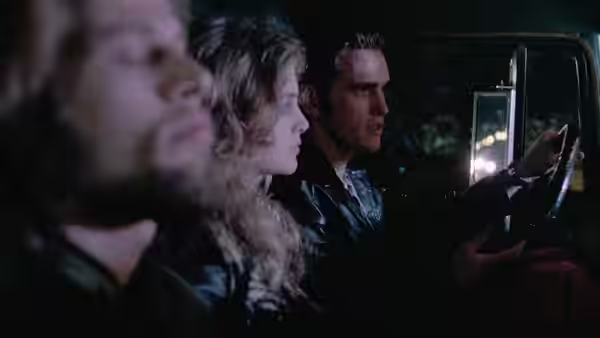
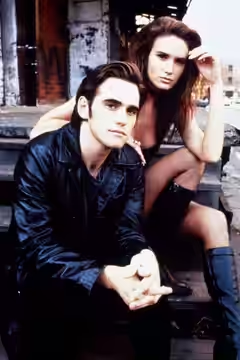
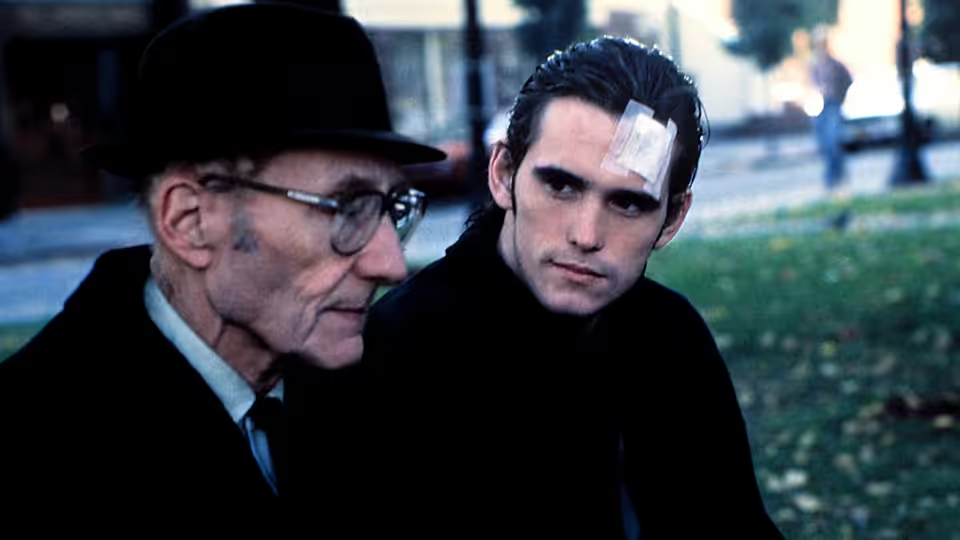
Tom the Priest (William S. Burroughs) sits beside Bob (Matt Dillon), who has a bandage on his forehead
Film review

Drugstore Cowboy

1989 · Directed by Gus Van Sant · 1h 42m

In a sentenceFour junkies rob chemists in Oregon and the most frightening thing in the film is a hat on a bed

Portland, Oregon, 1971. Bob (Matt Dillon) leads a crew who rob pharmacies for whatever is in the locked cabinet: his wife Dianne (Kelly Lynch), his friend Rick (James LeGros) and Rick’s girlfriend Nadine (Heather Graham). The method never varies. Nadine fakes a fit on the shop floor, the druggist runs to help, and Bob empties the shelves behind the counter. Between jobs they move from one rented house to the next, sort the pills on the carpet and shoot up in the living room, while Gentry (James Remar), a detective, tears their house apart looking for drugs. Bob lives by rules: no dogs, never look at the back of a mirror, never a hat on a bed. His mother (Grace Zabriskie) will not let him through her door.

Fi1m review

Gus Van Sant’s second feature follows four addicts robbing pharmacies in 1971 Oregon, and it is funny, exact and almost entirely free of lecturing. Matt Dillon and Kelly Lynch are exactly right for it, and the second half slackens; we recommend it all the same.

Portland, Oregon, 1971. Bob (Matt Dillon) runs a crew of four who rob pharmacies for whatever is in the locked cabinet, and Gus Van Sant’s film, written with Daniel Yost from James Fogle’s novel, watches them the way a film about carpenters would watch carpentry. Nadine (Heather Graham) throws a fit on the shop floor, the druggist (Eric Hull) runs to help, and Bob steps behind the counter and fills his pockets. Then everyone goes home, sorts the pills into piles on the carpet and gets high. It is the most honest film about drug use we know that is also, for most of its length, a pleasure to sit through, and we recommend it.

Van Sant does not lecture. Nobody explains why Bob uses; he uses because it is what he does, and because he is good at the part that comes before it. Dillon narrates in a flat, pleased-with-himself drawl, a small-time man who believes he has worked the whole thing out, and the film lets him be wrong without pointing at him. He has rules: no dogs, no talk of dogs, never look at the back of a mirror, and never, under any roof he sleeps in, a hat on a bed. When Nadine puts one there, we tensed more than we have at most gunfights, because Dillon plays the superstition as the one thing holding his world up.

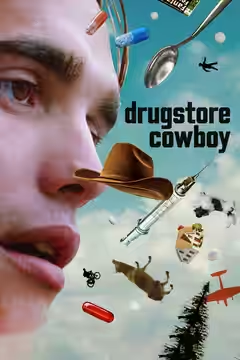
Robert Yeoman shoots Oregon in weak overcast light: rain on windscreens, brown carpet, wood-panelled rooms that David Brisbin has furnished with what a junkie could carry out of a rented house at short notice. When Bob shoots up, Van Sant floats things over his face against a moving sky, spoons, a cow, a hat, a small wooden house, like cut-outs from a children’s book. Editors Mary Bauer and Curtiss Clayton let them hang a beat longer than fashion allowed, so they read as what a man might see rather than as decoration. Elliot Goldenthal’s score is early work, spare and woozy, a few strings and something like a music box, and it mostly knows when to leave.

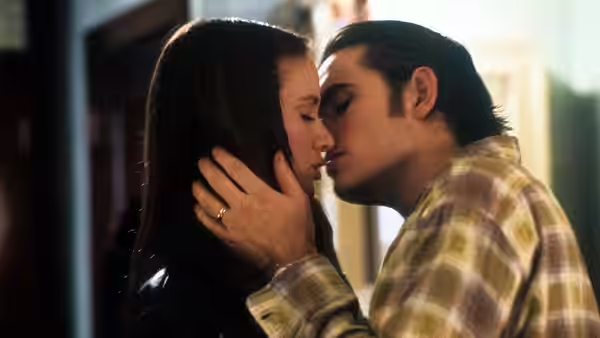
Kelly Lynch is the reason to see it twice. Dianne is Bob’s wife, drives the car, carries the gun she is told not to carry, and is angry for reasons she states plainly: he will not sleep with her any more, because the drugs have seen to that, and she always has to drive. We laughed out loud at the line and then noticed how unhappy she was. James LeGros gives Rick a slow, agreeable dimness that gets funnier the longer you look at it, and Graham makes Nadine’s neediness about her place in the gang rather than about the drugs. James Remar’s Gentry is not a villain. He is a tired detective who has made Bob his project, and their conversation outside the house, two men in the same trade, is among the best scenes in the film.

What moved us more than we expected was Grace Zabriskie as Bob’s mother, refusing to open her door to her son. She talks to him through the screen, lists what he has stolen from her, and will not let him past the step. Zabriskie never raises her voice, and Dillon, for once, has nothing to say.

The second half moves Bob into a different building and a different tempo, and we will not say why. It is quieter and more talkative, and the film loses the drive the robberies gave it. Dianne and Rick thin out into visitors. Bob’s superstitions, which were character, start doing the work of plot. Several critics have grumbled about the ending, some because it is too tidy and some because it stops short; we think it is both and did not mind much. William S. Burroughs turns up in this stretch as Tom the Priest, an old junkie in a dressing gown prophesying about narcotics and the police in a voice like a door that needs oiling. He says his lines as if he had lived every one of them, which he had.

Van Sant made stranger films after this and more famous ones. He did not make one where the people were this easy to spend time with and this hard to excuse. It is an 18 certificate and 102 minutes, and it does not stint on the needles. Watch it with someone who thinks films about drugs are all the same. The hat will get them.
Critical consensus AI synthesised

77
Positive
5
Mixed
2
Negative
0

Most critics like Drugstore Cowboy, and the praise lands in the same place: Matt Dillon. Nearly every review that gives a verdict singles out his performance as Bob, the thieving addict who narrates the film, and more than one credits him with holding the man’s charm and his physical decline in the same frame. Beyond Dillon, the reviews agree that Gus Van Sant treats drug use honestly, without either romance or sermon, and that the film is funny and easy to watch for something so bleak. Kelly Lynch draws a mention from Variety.

The reservations are few and mostly about the ending. Empire finds it abrupt; The Guardian finds it conventionally upbeat for a film otherwise so clear-eyed. Nobody dislikes it. Two of the seven reviews, from The New York Times and Time Out, are on record but their verdicts are not readable, so the spread among the rest is narrow, running from warm to warmer.

Los Angeles Times
11 October 1989 · SHEILA BENSON
90*

Benson finds the film electrifying, funny, and compulsively watchable without romanticizing its characters’ drug-bound lives. She especially praises the haunting performances, particularly Matt Dillon’s narration as Bob.

Read the full review →
Variety
31 December 1988 · Variety Staff
90*

The review praises the film as unusually honest and original in its portrayal of drug use. It singles out Kelly Lynch’s performance and calls Matt Dillon’s performance truly great.

Read the full review →
Slant Magazine
27 February 2025 · ★★★★ · Jake Cole
80

Cole praises the film’s tough, empathetic tone and unromantic depiction of addiction. He singles out Matt Dillon’s performance for balancing Bob’s roguish charm with the physical and mental toll of his lifestyle.

Read the full review →
Empire
1 January 2000 · Barry Mcllheney
78*

The review calls it a cult classic worth seeking out, despite criticizing the abruptness of its ending. It particularly praises Matt Dillon’s performance and the film’s convincing, everyday realism.

Read the full review →
The Guardian
7 December 1989 · Derek Malcolm
75*

Malcolm finds the film worth seeing for its unusually mature, clear-eyed treatment of drug use, despite an orthodoxly upbeat ending. He particularly praises Van Sant’s fresh direction and truthful approach to the characters.

Read the full review →
The New York Times
6 October 1989 · Janet Maslin
65*

The page identifies a review of the film, but its text is inaccessible. The critic’s verdict and specific praise or complaints cannot be verified.

Read the full review →

Straight answers AI written, from our review

Is Drugstore Cowboy worth watching?
Drugstore Cowboy is worth watching for anyone who can sit through a frank, funny, unlectured film about heroin addicts, and we scored it 83. Matt Dillon and Kelly Lynch are exactly right as the couple leading the crew, and Gus Van Sant never explains or excuses them. The second half slackens once the robberies stop, but we recommend it all the same.
How long is Drugstore Cowboy, and what is it rated?
Drugstore Cowboy runs 1h 42m. It is a drama and crime film.
Where can I watch Drugstore Cowboy in Austria?
Drugstore Cowboy is streaming on Amazon Prime Video in Austria, and it is also available to rent from Amazon Prime Video from €2.99. Availability is checked daily; the links above go straight to each service.
How violent or frightening is Drugstore Cowboy, and is it suitable for children?
Drugstore Cowboy is an 18 certificate and not for children or younger teenagers. There is little violence in the usual sense, but it does not stint on the needles: the characters shoot up in living rooms and the film watches them do it plainly. Anyone squeamish about drug use shown close and without judgement should think twice.
How does Drugstore Cowboy compare to My Own Private Idaho?
Drugstore Cowboy is the tighter and more purely enjoyable of Gus Van Sant’s two Portland films, and My Own Private Idaho is the more ambitious and uneven. The earlier film has thieves, a clear method and a dry, exact humour; the later has hustlers, a road structure and Shakespearean passages that can feel laboured. Start with Drugstore Cowboy; go on to Idaho for River Phoenix.
Is Drugstore Cowboy based on a true story or a book?
Drugstore Cowboy is based on a novel by James Fogle, adapted by Gus Van Sant and Daniel Yost. It is not presented as a true story, though the film treats the crew’s method and daily routine with the exactness of something observed rather than invented. You need not know the book to follow or enjoy it.
What should I watch after Drugstore Cowboy?
After Drugstore Cowboy, try My Own Private Idaho (1991, Fi1m 82): Van Sant back in Portland with hustlers instead of thieves, and Shakespeare. Then Trainspotting (1996, Fi1m 88): Edinburgh, louder and faster, with the same refusal to pretend the drugs aren’t fun.

Cast

If you liked this, try…

  1. The Panic in Needle Park (1971) · not on Fi1m yetNew York junkies in the same year Bob is robbing chemists, without the jokes.

  2. Christiane F. (1981) · not on Fi1m yetWest Berlin teenagers, Bowie on the soundtrack, and no hallucinatory cows to soften it.

  3. My Own Private Idaho (1991, Fi1m 82)Van Sant back in Portland with hustlers instead of thieves, and Shakespeare.

  4. Trainspotting (1996, Fi1m 88)Edinburgh, louder and faster, with the same refusal to pretend the drugs aren’t fun.

  5. Jesus' Son (1999) · not on Fi1m yetBilly Crudup drifts through Denis Johnson’s stories with a narrator as unreliable as Bob.