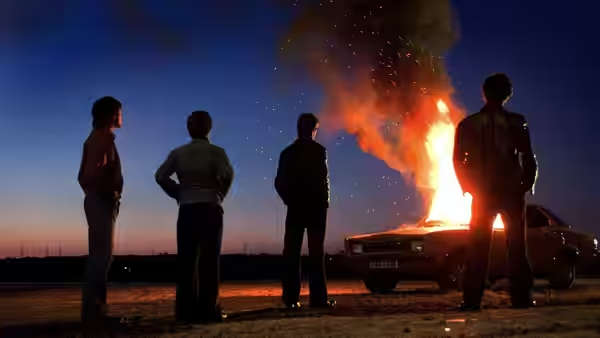
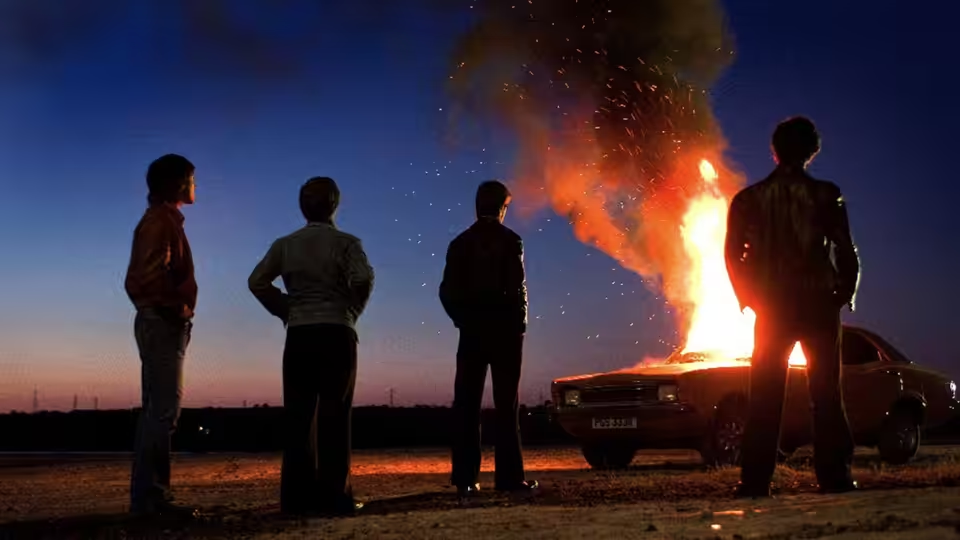
Four young men watch a car burn beside a rural road at dusk
Film review

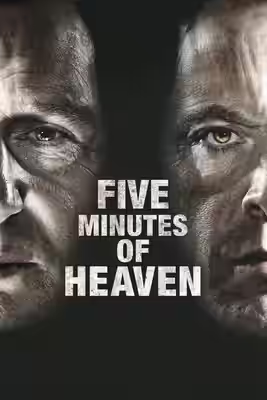
Five Minutes of Heaven

2009 · Directed by Oliver Hirschbiegel · 1h 29m

In a sentenceLiam Neeson has forgiven himself and James Nesbitt would like a word

Lurgan, Northern Ireland, 1975. Alistair Little (Mark Ryder), seventeen and newly sworn into a loyalist gang, is driven to a Catholic street with a gun and shoots Jim Griffin (Gerard Jordan) through the front window of his own home. Jim’s eleven-year-old brother Joe is standing on the pavement outside and sees it done. Thirty-three years later a television company brings the two men together for a reconciliation programme at a country house. Alistair (Liam Neeson), long out of prison, now gives talks about his past. Joe (James Nesbitt) sits in the back of a chauffeured car, chain-smoking and rehearsing what he will say. Vika (Anamaria Marinca), a runner on the crew, is the only person who speaks to him as if he were not a guest.

Fi1m review

Oliver Hirschbiegel’s small, hard drama about a killer and the boy who watched him is gripping for an hour and finely acted throughout. Then it stages a confrontation that lets everyone, including the film, off more lightly than what came before had promised.

Oliver Hirschbiegel, who made Downfall (2004), and the screenwriter Guy Hibbert have built a film out of a meeting that never happened. Alistair Little and Joe Griffin are real men, and the captions say so. In 1975 the seventeen-year-old Alistair shot Joe’s brother Jim through a front window in Lurgan while Joe, aged eleven, stood on the pavement. The film imagines a television company bringing the two of them, decades on, to a country house to shake hands for the cameras. Everything that follows is about whether they can get through the door.

The 1975 section is the best stretch of the film and it lasts perhaps twenty minutes. Ruairí O’Brien shoots it handheld and grainy, close on faces, so the terraced streets feel both small and very public. Mark Lowry’s rooms are brown and cramped, and Maggie Donnelly puts the boys in the flares and denim of the time without ever drawing attention to it. Mark Ryder plays the young Alistair as a boy who wants his friends to see him do it, and Niamh Cusack and Paul Garrett, as his parents, say almost nothing and tell us plenty. We knew exactly what was coming and still flinched when the shot went off. It is the boy on the pavement that did it, not the gun; Hirschbiegel holds on him a beat longer than is comfortable.

Then the film moves to the present and becomes two men in two cars. Joe sits in the back of one, driven by Barry McEvoy’s patient chauffeur, smoking and muttering and starting speeches he does not finish. Alistair sits in the other and is still. Hans Funck cuts between them so that one man’s silence answers the other’s chatter, and David Holmes and Leo Abrahams lay a low electronic pulse under both journeys that never swells and never resolves. It is a plain, confident piece of construction, and it holds.

Neeson is doing something unusual for him. His Alistair has turned his crime into a lecture, and Neeson delivers the lecture in a flat, careful voice with the eyes of a man checking whether it is still working. He speaks to the documentary camera in long takes and we are never sure whether we are watching remorse or a routine. Nesbitt is the opposite and some critics have found him too much. We did not, quite. Joe is a man whose life stopped on a pavement at eleven, and Nesbitt plays the twitching, grinning, furious wreck of that without asking to be liked; the film’s failure is that it lets him run in several scenes where one would have done.

Marinca is the quiet asset. Vika is a Romanian runner whose job is to fix Joe’s microphone and keep him calm, and in their two or three exchanges in the corridors of the house she asks him ordinary questions and gets, for the only time in the film, ordinary answers. Richard Dormer’s Michael, who is running the programme, wants a handshake for his edit and is honest enough about it that the satire of television reconciliation lands without needing to be underlined.

The trouble is in the second half. Hibbert’s script has one argument, that forgiveness is something the forgiver needs and the victim may not, and it states it several times, then has Alistair state it again to camera. The middle stalls in the house with people waiting to be called. And the final act takes a turn we will not describe, except to say that it is physical where the first hour was patient, and that it arrives at a conclusion the film had spent eighty minutes telling us was not available. We were moved by the two men and then faintly cheated by what the script did with them.

Downfall watched a monster at close range for two and a half hours without excusing him. This gives Hirschbiegel 89 minutes and a smaller monster and he does the watching just as well; it is the writing that blinks. See it for Ryder’s walk to the window, for the two cars, and for Neeson letting us see a performance inside a performance. Watch it with someone who will argue with you about the ending, because you will want to.

Critical consensus AI synthesised

70
Positive
6
Mixed
2
Negative
1

Most critics come away in favour, and the praise clusters almost entirely on the two leads. Liam Neeson’s restrained, guilt-laden Alistair and James Nesbitt’s agitated Joe are named in nearly every review, usually for the contrast between them, and several critics admire the film for refusing to offer an easy version of reconciliation. The urgent opening section is picked out more than once as the strongest stretch.

Beyond the performances the reviews part company. Several find the middle overextended and the pace flagging, and more than one feels the final confrontation lets down what the film has built. The Hollywood Reporter dissents most sharply, arguing that the drama circles its subject and restates familiar moral points, coming alive only in the scenes with Anamaria Marinca. The AV Club alone finds Nesbitt’s performance uncontrolled rather than explosive. The spread is wide for a film this well liked, running from strong recommendations to one outright dismissal.

Radio Times
★★★★ · David Butcher
80

The review gives the drama a strong recommendation, praising the performances of James Nesbitt and Liam Neeson. It also singles out the film’s dismantling of the ideal of reconciliation.

Read the full review →
Time Out
18 August 2009 · ★★★★ · David Fear
80

Fear’s four-star rating signals a favorable verdict, despite familiar conventions in Troubles-era Irish cinema. The visible description singles out period-appropriate haircuts and riots as predictable genre motifs.

Read the full review →
Variety
21 January 2009 · festival review · Dennis Harvey
80*

Harvey finds the film intense and ultimately moving, with no easy answers about reconciliation. He praises the powerful contrast between Liam Neeson’s restrained guilt and James Nesbitt’s raw, agitated performance.

Read the full review →
The Guardian
5 April 2009 · Sam Wollaston
78*

Wollaston finds the film strong, thoughtful and powerful, though its pace sometimes flags. He particularly praises the performances of Liam Neeson and James Nesbitt, while singling out the urgent opening section as the best part.

Read the full review →
The AV Club
20 August 2009 · B · Sam Adams
77

The review finds the film light on insight and overextended in its middle, despite its effort to represent both sides of the conflict. It praises Alistair as the more sharply drawn, atypical character, while criticizing James Nesbitt’s uncontrolled performance.

Read the full review →
Slant Magazine
21 August 2009 · ★★★/4 · Adam Keleman
75

Keleman finds the film tense and morally engaging, though its final confrontation undermines the meditation on catharsis. He particularly praises James Nesbitt’s controlled, explosive portrayal of Joe and Liam Neeson’s nuanced performance as Alistair.

Read the full review →

Straight answers AI written, from our review

Is Five Minutes of Heaven worth watching?
Five Minutes of Heaven is worth watching for anyone who wants a short, hard drama about guilt in Northern Ireland, and we scored it 72. The 1975 opening and the long present-day car journeys are gripping, and Liam Neeson and James Nesbitt are both strong. The final act lets everyone off more lightly than the first hour promised.
How long is Five Minutes of Heaven, and what is it rated?
Five Minutes of Heaven runs 1h 29m. It is a crime and drama film.
Where can I watch Five Minutes of Heaven in the Netherlands?
Five Minutes of Heaven is not on any streaming or rental service in the Netherlands at the moment. It is available in 10 other countries; change your country at the top of the page to see where. Availability is checked daily.
How violent or frightening is Five Minutes of Heaven, and is it suitable for children?
Five Minutes of Heaven has no UK certificate on record and is rated R in the United States, so it is for adults. It opens with a teenage boy shooting a man through his front window while the man's eleven-year-old brother watches, and the final act turns physical after a patient first hour. It is not for children, and the shooting will shake even those who know it is coming.
How does Five Minutes of Heaven compare to Hunger?
Five Minutes of Heaven and Hunger are both small, intense films about the Troubles, but Hunger is the harsher and more complete work. McQueen's film watches Bobby Sands in the Maze prison in near silence; Hirschbiegel's is built around two men talking, or failing to, before a staged reconciliation. Hunger suits viewers who can stand its violence; Five Minutes of Heaven is the easier evening and the weaker ending.
What should I watch after Five Minutes of Heaven?
After Five Minutes of Heaven, try Hunger (2008, Fi1m 86): The Maze prison in 1981, mostly silent, with one long conversation at its centre. Then '71 (2014, Fi1m 82): A lost soldier runs through Belfast for one night; tight, frightening and fair to nobody; and Death and the Maiden (1994, Fi1m 74): A woman thinks the man in her house tortured her; Polanski keeps us guessing.

Cast

Awards

Sundance World Cinema Directing Award: Dramatic, 2009

Won
Sundance World Cinema Directing Award: Dramatic

Sundance World Cinema Screenwriting Award, 2009

Won
Sundance World Cinema Screenwriting Award

If you liked this, try…

  1. Hunger (2008, Fi1m 86)The Maze prison in 1981, mostly silent, with one long conversation at its centre.

  2. '71 (2014, Fi1m 82)A lost soldier runs through Belfast for one night; tight, frightening and fair to nobody.

  3. Death and the Maiden (1994, Fi1m 74)A woman thinks the man in her house tortured her; Polanski keeps us guessing.

  4. The Act of Killing (2012, Fi1m 88)Real killers restage their crimes for the camera and slowly understand what they did.

  5. Incendies (2010, Fi1m 82)Two siblings trace their mother’s war; patient, brutal and built on one buried fact.

Free account

Know what to watch tonight

Two lists that know where things are streaming, collections you can share, your own score beside ours, and Discover that remembers what you have seen.

  • Want to see, sorted by what is streaming now
  • Seen, with your score out of ten
  • No adverts, ever