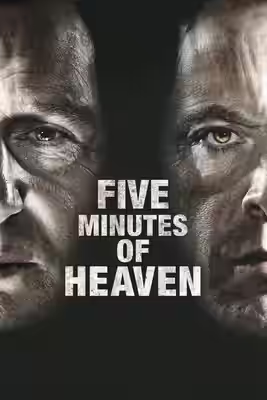
Oliver Hirschbiegel’s small, hard drama about a killer and the boy who watched him is gripping for an hour and finely acted throughout. Then it stages a confrontation that lets everyone, including the film, off more lightly than what came before had promised.
Oliver Hirschbiegel, who made Downfall (2004), and the screenwriter Guy Hibbert have built a film out of a meeting that never happened. Alistair Little and Joe Griffin are real men, and the captions say so. In 1975 the seventeen-year-old Alistair shot Joe’s brother Jim through a front window in Lurgan while Joe, aged eleven, stood on the pavement. The film imagines a television company bringing the two of them, decades on, to a country house to shake hands for the cameras. Everything that follows is about whether they can get through the door.
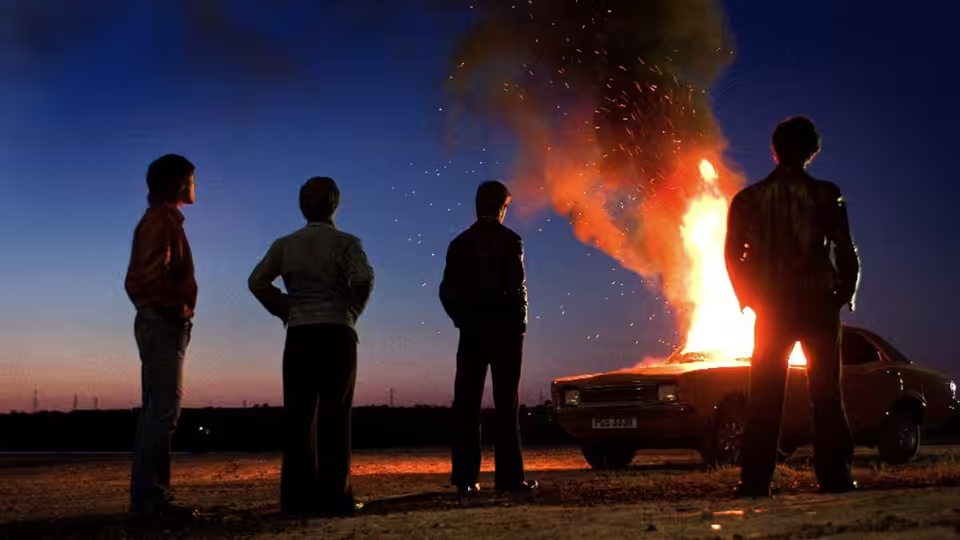
The 1975 section is the best stretch of the film and it lasts perhaps twenty minutes. Ruairí O’Brien shoots it handheld and grainy, close on faces, so the terraced streets feel both small and very public. Mark Lowry’s rooms are brown and cramped, and Maggie Donnelly puts the boys in the flares and denim of the time without ever drawing attention to it. Mark Ryder plays the young Alistair as a boy who wants his friends to see him do it, and Niamh Cusack and Paul Garrett, as his parents, say almost nothing and tell us plenty. We knew exactly what was coming and still flinched when the shot went off. It is the boy on the pavement that did it, not the gun; Hirschbiegel holds on him a beat longer than is comfortable.
Then the film moves to the present and becomes two men in two cars. Joe sits in the back of one, driven by Barry McEvoy’s patient chauffeur, smoking and muttering and starting speeches he does not finish. Alistair sits in the other and is still. Hans Funck cuts between them so that one man’s silence answers the other’s chatter, and David Holmes and Leo Abrahams lay a low electronic pulse under both journeys that never swells and never resolves. It is a plain, confident piece of construction, and it holds.
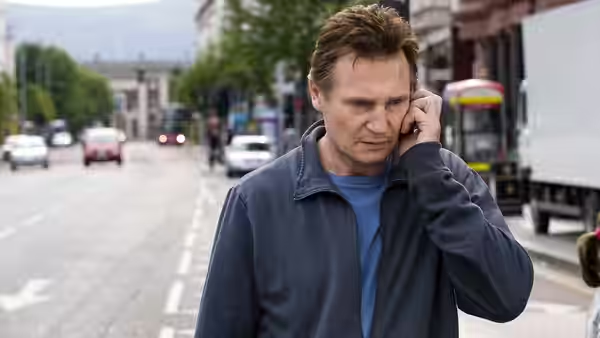
Neeson is doing something unusual for him. His Alistair has turned his crime into a lecture, and Neeson delivers the lecture in a flat, careful voice with the eyes of a man checking whether it is still working. He speaks to the documentary camera in long takes and we are never sure whether we are watching remorse or a routine. Nesbitt is the opposite and some critics have found him too much. We did not, quite. Joe is a man whose life stopped on a pavement at eleven, and Nesbitt plays the twitching, grinning, furious wreck of that without asking to be liked; the film’s failure is that it lets him run in several scenes where one would have done.
Marinca is the quiet asset. Vika is a Romanian runner whose job is to fix Joe’s microphone and keep him calm, and in their two or three exchanges in the corridors of the house she asks him ordinary questions and gets, for the only time in the film, ordinary answers. Richard Dormer’s Michael, who is running the programme, wants a handshake for his edit and is honest enough about it that the satire of television reconciliation lands without needing to be underlined.
The trouble is in the second half. Hibbert’s script has one argument, that forgiveness is something the forgiver needs and the victim may not, and it states it several times, then has Alistair state it again to camera. The middle stalls in the house with people waiting to be called. And the final act takes a turn we will not describe, except to say that it is physical where the first hour was patient, and that it arrives at a conclusion the film had spent eighty minutes telling us was not available. We were moved by the two men and then faintly cheated by what the script did with them.
Downfall watched a monster at close range for two and a half hours without excusing him. This gives Hirschbiegel 89 minutes and a smaller monster and he does the watching just as well; it is the writing that blinks. See it for Ryder’s walk to the window, for the two cars, and for Neeson letting us see a performance inside a performance. Watch it with someone who will argue with you about the ending, because you will want to.