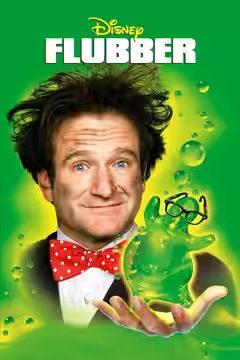
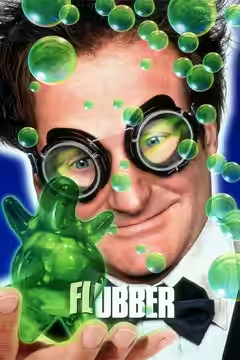
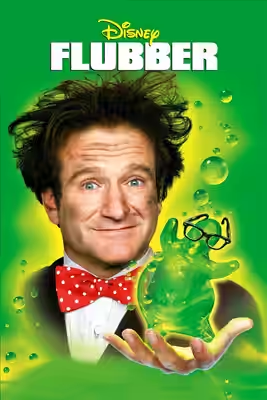
Les Mayfield’s remake of Disney’s The Absent-Minded Professor has a lively green blob, a touching robot and a bouncy Danny Elfman score, and no script to put under them. Robin Williams is reined in; nothing is offered in his place.
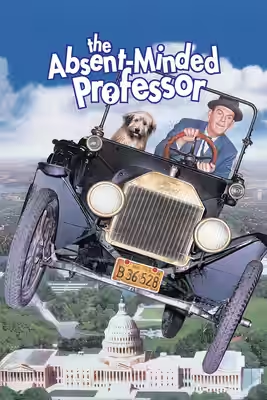
Les Mayfield’s remake of The Absent-Minded Professor (1961) gives Fred MacMurray’s job to Robin Williams and hands the bouncing green rubber to a computer, and the result is a film that works for about forty minutes and then runs out of things to do. Everything in it that pleases is a thing: the Flubber, a hovering robot called Weebo, Danny Elfman’s score. Everything that does not is a person, because the people have been written in a line each. It runs 93 minutes and carries a PG, and that is a fair bargain only if the people on the sofa are under ten.
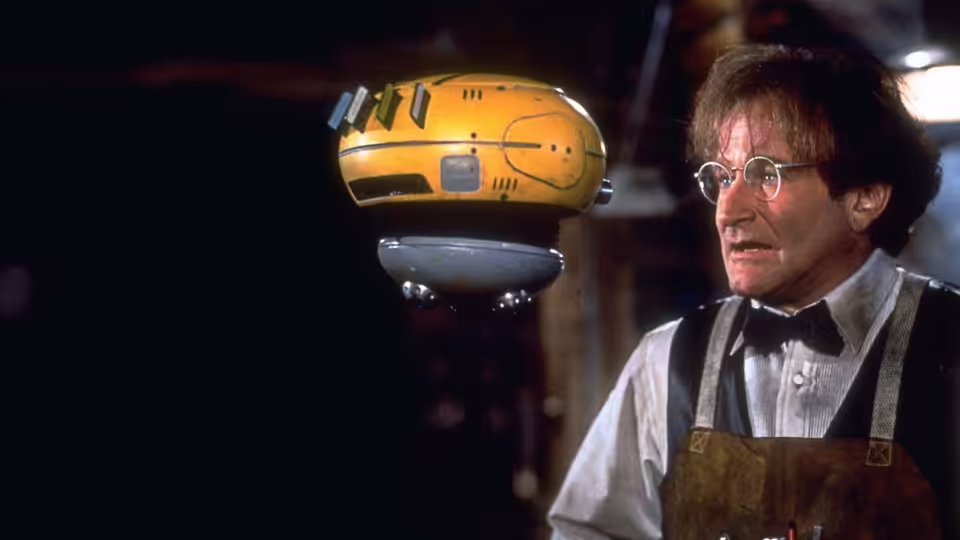
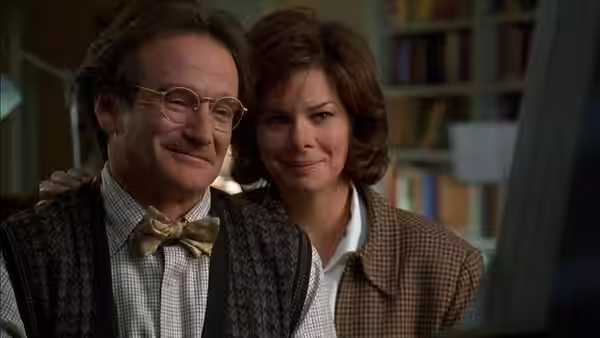
Williams plays Philip Brainard quietly. He wears a bow tie and a mild, faraway smile, forgets his own wedding for the third time without seeming to notice he has done it, and hardly improvises at all. In principle that is a relief; in practice it is a loss, because the screenplay by John Hughes and Bill Walsh does not give him jokes to replace the riffs it has taken away. He is pleasant to watch and he is given almost nothing to do with his hands or his mouth. Marcia Gay Harden has less still, a woman whose job is to be stood up and then to forgive. Christopher McDonald does his smirk as Wilson Croft, and Raymond J. Barry glowers as the man with the loan.
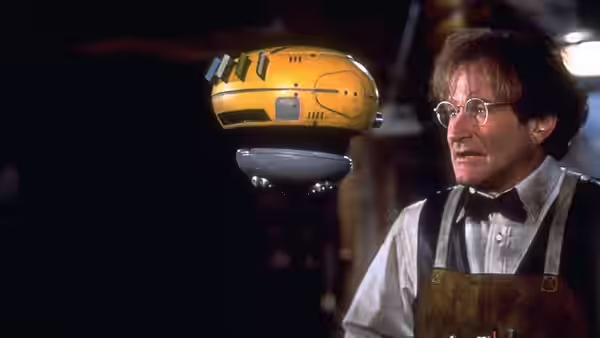
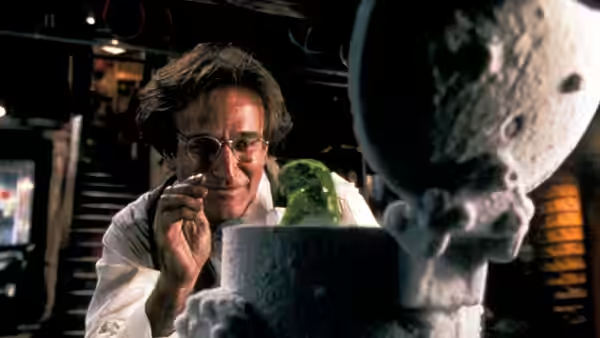
The stuff itself is good. The Flubber squashes, stretches, splits into dozens of small green bodies and reforms, and it has a face when it wants one, which is often. Mayfield gives it a dance number, a mambo on the basement workbench with the little blobs in rows, and we grinned at it, properly, for the length of the song. We also noticed it had nothing to do with anything, and that the film knew that and did it anyway, which tells you how thin the story under it is. The best idea in the film is Weebo, voiced by Jodi Benson, who plays clips from old films on her flip-up screen to say what she cannot, and who is plainly in love with the man who built her. It is the one place where somebody feels something, and the somebody is a machine.
The craft is sound. Dean Cundey, who shot Back to the Future and Jurassic Park, lights the basement in warm yellows and green glass, so the lab looks like somewhere a child would want to be rather than somewhere an accident is about to happen. Andrew McAlpine gives Brainard a clapboard house with every surface covered in half-finished machines and a college of red brick and mown grass. April Ferry dresses the professor in tweed and bow ties and the villains in suits a size too sharp. Elfman’s score is the film’s engine, all tubular bells and a rising brass figure every time the green stuff leaves the floor, and it works harder than the script. Michael A. Stevenson and Harvey Rosenstock keep the set pieces tight and the scenes between them short.
Then there is the other thing Hughes brought with him from Home Alone: the henchmen. Clancy Brown and Ted Levine, both actors who can be frightening when a film asks them to be, are here to be struck on the head. A bowling ball does it. Then another does it. Then the Flubber does it. We laughed at the first, and by the third we were watching two good character actors wait to be hit and felt faintly sorry for them. Children will not share our reservation; the loudest laughter in the house will be at precisely these moments, and it is for the children that the film was made.
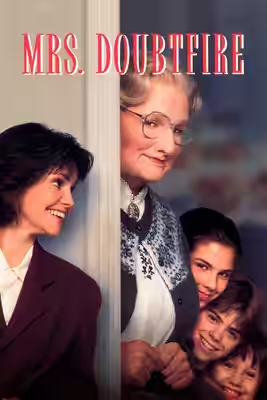
The 1961 original was a modest black-and-white comedy that trusted MacMurray’s bafflement to carry it, and the car that flew was a wonder because so little else did. This one has a car that flies, a basketball game it will not let us forget, and a professor who is a passenger in his own picture. Against Williams’s own record it sits well below Mrs. Doubtfire (1993), where the gags were his, and Jumanji (1995), where the effects at least made him run.
Put it on for the children and stay for the mambo, the robot and the score. Expect to be doing something else by the hour mark. The film will not mind; it is not really looking at you either.