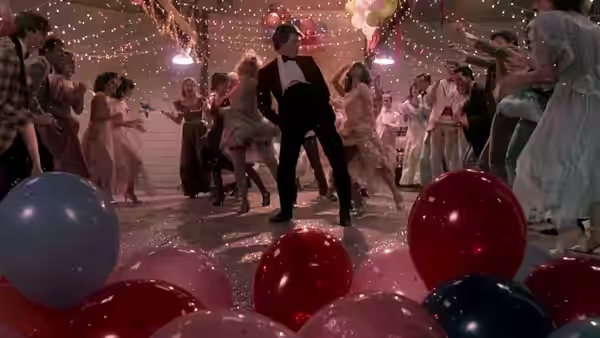
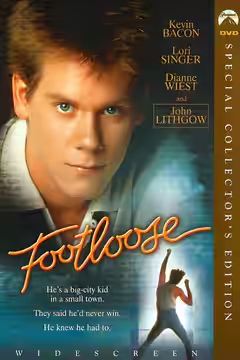
Ren (Kevin Bacon) adjusting his bow tie amid falling confetti at the dance
Film review

Footloose

1984 · Directed by Herbert Ross · 1h 47m · CNC 10

In a sentenceKevin Bacon makes a persuasive case for letting teenagers exhaust themselves on a dance floor

Ren (Kevin Bacon) moves with his mother, Ethel McCormack (Frances Lee McCain), from Chicago to Bomont, a small town where dancing is banned. He wants to settle in without giving up the music and dancing he enjoys, but local disapproval makes that difficult. Rev. Shaw Moore (John Lithgow) defends the restriction, while his daughter Ariel (Lori Singer) takes an interest in the newcomer. Ren finds a friend in Willard (Chris Penn), but friendship alone cannot make the town more welcoming. An ordinary teenage wish to go out and dance brings him into conflict with adults determined to keep their rules.

Plays from YouTube when you press play; nothing loads from them until then.

Fi1m review

Footloose makes a thin rebellion story worth an evening through Kevin Bacon’s restless charm and Herbert Ross’s sympathy for the adults. The sentimentality takes some patience, but the dancing earns its place.

Herbert Ross’s Footloose is an energetic, sentimental teen drama that works better when somebody starts dancing. That is a limitation, but hardly a fatal one for a film so intent on making movement pleasurable. Its enthusiasm survives some clumsy persuasion, and we recommend it with a modest tolerance for emotional overstatement. Dean Pitchford’s screenplay gives its young people an immediately understandable grievance, then presses their case harder than it needs to.

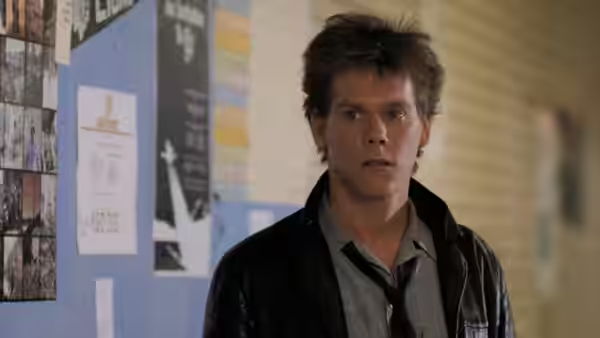
Kevin Bacon is the main reason that pressure remains bearable. His Ren has enough impatience to make the rebellion credible, without becoming such exhausting company that we start sympathising with restrictions on his social life. There is a useful awkwardness beneath the confidence: the performance lets us see the effort involved in being the newcomer who refuses to fit in. Kevin Bacon also understands that charm needs occasional restraint, and does not spend every scene asking to be liked.

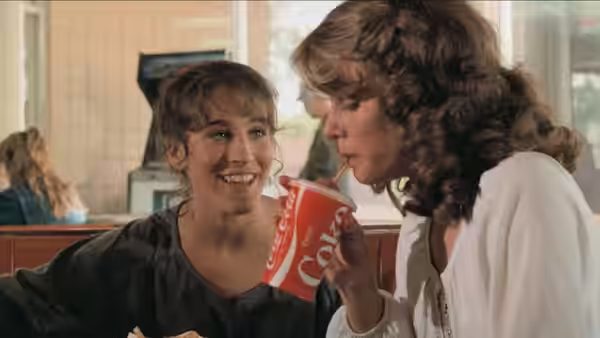
John Lithgow gives Rev. Shaw Moore sufficient seriousness to prevent the adult opposition becoming merely a queue of people waiting to be proved wrong. Herbert Ross allows that seriousness some space, which is an important kindness in a film pitched towards younger viewers. Dianne Wiest’s Vi Moore brings welcome quietness to material that can otherwise insist too loudly on its feelings. Lori Singer’s Ariel is less consistently served by the writing, though her restlessness makes sense alongside Ren’s. The performers make these people more credible than the screenplay always does.

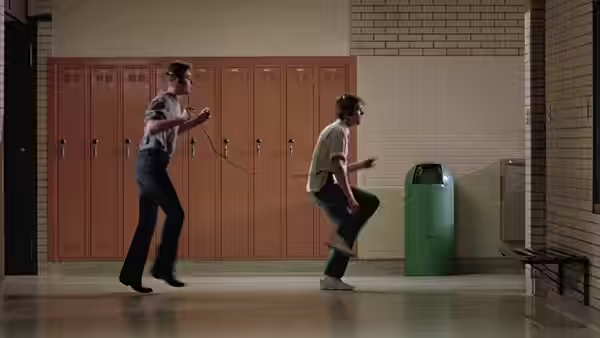
The warehouse dance is where Ric Waite’s cinematography and Ron Hobbs’s production design make their strongest impression. The space gives the movement scale, and the dancing gives us something more immediate to follow than the dispute. We were delighted by it, because the physical exertion makes frustration understandable without another speech explaining it. The sequence is extravagant, certainly, but its extravagance suits a young man with more energy than he knows how to use. The warehouse earns its place as a setting for that release.

Paul Hirsch’s editing keeps the musical passages moving with an assurance the dramatic passages do not always share. The transitions between argument and entertainment can feel abrupt, although the film rarely lingers long enough for the interruption to become a serious drag. Kenny Loggins’s songs help considerably: their directness suits a film whose pleasures depend on committing to the moment. The music is persuasive without requiring the story to become any more sophisticated, which is fortunate for both.

The weakness is how carefully Dean Pitchford manages our sympathies. Too often, an emotion arrives already explained, leaving the actors little to discover within it. Herbert Ross’s willingness to take adults seriously partly corrects this, but the sentimentality still makes some exchanges feel rehearsed for our benefit. We understand why everyone cares; we do not always believe they would express that care quite so neatly. The dramatic scenes need more of the uncertainty that Kevin Bacon brings to his performance.

Within the teen musical, that attention to adult feeling gives Footloose something worth keeping, even when the writing becomes laboured. It also means the quieter performances matter alongside the dancing, rather than simply filling the gaps between songs. The film asks for indulgence and supplies enough enjoyment to earn a reasonable amount of it. Choose it for an evening when music and an engaging cast matter more than a watertight script.


Critical consensus AI synthesised

3 of 6
Positive
1
Mixed
2
Negative
0
Variety
31 December 1983 · Variety Staff
75*

The review finds the film an effective youth-oriented rock picture with an integrated story. It particularly praises Kevin Bacon’s performance and Herb Ross’s adult sensibility.

Read the full review →
Radio Times
★★★ · Alan Jones
60

Jones finds the story silly and overly sentimental, though the film’s performers bring energy to it. He singles out Kenny Loggins’s songs as better than expected.

Read the full review →
Time Out
· GM
55*

The review frames the teen musical as an immediate period piece rather than timeless entertainment. It singles out the film’s mid-1980s studio-musical moment as central to that dated quality.

Read the full review →

Straight answers AI written, from our review

Is Footloose worth watching?
Footloose is worth watching for Kevin Bacon’s restless charm and the dancing; we score it 72 out of 100. We recommend it for an evening when music and an engaging cast matter more than a convincing script, though the thin rebellion story and heavily explained emotions require some patience.
How long is Footloose, and what is it rated?
Footloose runs 1h 47m and is rated 10 by the CNC in France. It is a drama and romance film.
Where can I watch Footloose in France?
Footloose is streaming on Paramount+ and Amazon Prime Video in France, and it is also available to rent from Amazon Prime Video from €2.99. Availability is checked daily; the links above go straight to each service.
How violent or frightening is Footloose, and is it suitable for children?
Footloose carries a UK 15 certificate, so it is suitable for viewers aged 15 and over rather than younger children. The certificate is the clearest guide here: we cannot offer a specific warning about violence or frightening scenes, or reassurance for squeamish viewers, without more detailed content information.
How does Footloose compare to Billy Elliot?
Footloose is our choice for energetic teenage rebellion, while Billy Elliot is the better fit for a funny, moving story about a boy being taken seriously. Both show adults mistaking dancing for disobedience, and both require patience with sentimentality; we recommend Bacon’s restless charm in the former and Jamie Bell and Julie Walters’s performances in the latter.
What should I watch after Footloose?
After Footloose, try Billy Elliot (2000, Fi1m 81): Another young dancer discovers how quickly adults can mistake movement for disobedience. Then Strictly Ballroom (1992, Fi1m 83): Competitive dancing gives family pressure and romantic rebellion a sharper comic edge.

Cast

If you liked this, try…

  1. Billy Elliot (2000, Fi1m 81)Another young dancer discovers how quickly adults can mistake movement for disobedience.

  2. Strictly Ballroom (1992, Fi1m 83)Competitive dancing gives family pressure and romantic rebellion a sharper comic edge.

  3. Shall We Dance? (1996) · not on Fi1m yetA quieter Japanese comedy about the embarrassment and relief of learning to dance.

  4. Girlhood (2014) · not on Fi1m yetMusic and friendship offer teenage freedom, with fewer easy answers from the adults.

  5. Sing Street (2016) · not on Fi1m yetTeenage self-invention through music, with romance and family trouble sharing the rehearsal space.