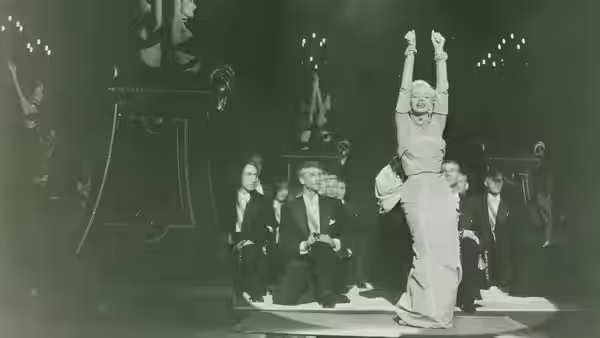
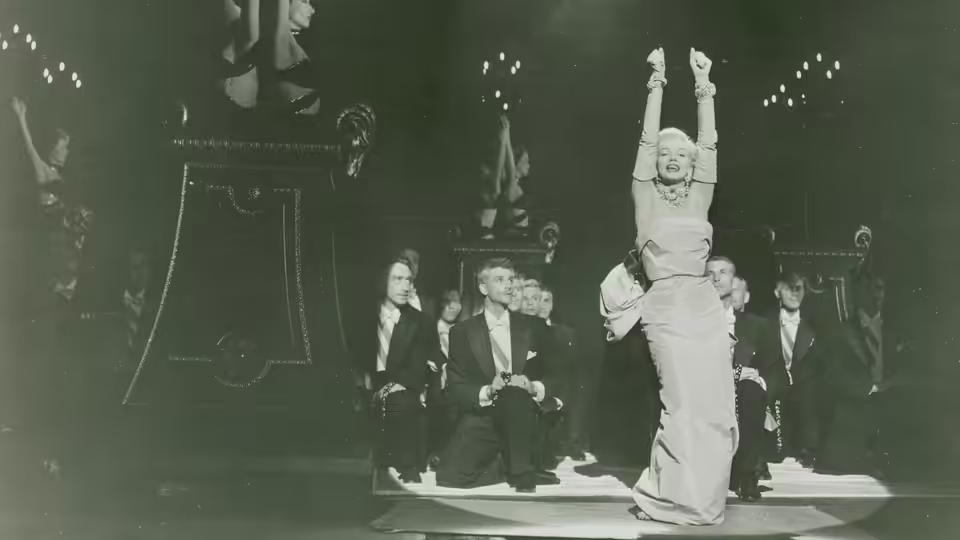
Lorelei Lee (Marilyn Monroe) hangs upside down above seated men on a stage
Film review

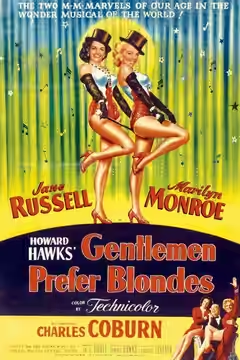
Gentlemen Prefer Blondes

1953 · Directed by Howard Hawks · 1h 31m

In a sentenceThe women know what they want; the men appear to have brought their wallets

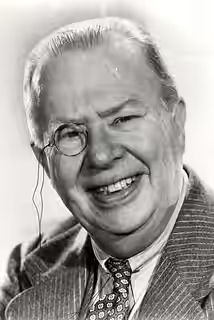
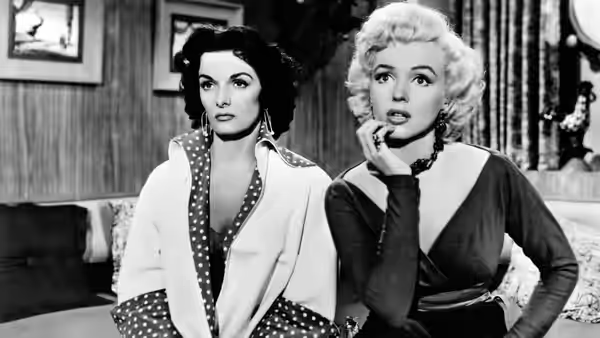
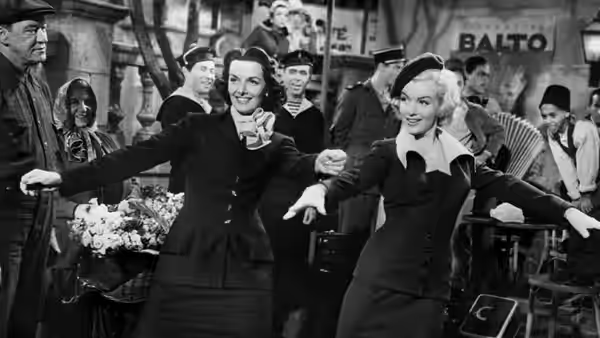
Lorelei Lee (Marilyn Monroe) and Dorothy Shaw (Jane Russell) are the two women at the centre of a musical comedy about romance and money. Around them are Gus Esmond Jr. (Tommy Noonan), Ernie Malone (Elliott Reid) and Sir Francis ‘Piggy’ Beekman (Charles Coburn). Lorelei takes wealth seriously, while Dorothy brings a more sceptical manner to the business of attraction. Their friendship runs through a story of competing romantic interests, with songs giving the women room to say what they want from men and the lives those men might offer.

Plays from YouTube when you press play; nothing loads from them until then.

Fi1m review

Marilyn Monroe and Jane Russell make this musical comedy funny, knowing and warmer than its interest in money might suggest. The plotting grows tiresome, but the women remain worth spending an evening with.

Howard Hawks’s Gentlemen Prefer Blondes is a funny, shrewd musical comedy whose central partnership is considerably better than its plot. Marilyn Monroe and Jane Russell make its interest in money and desire feel brisk and practical, even when the romantic complications grow laboured. The film allows its women to want things without asking them to become more modest or more apologetic. That permission is a good part of the pleasure.

Monroe plays Lorelei Lee with a deliberation that can easily be mistaken for vacancy. Her comic timing asks us to wait for the thought, then reconsider who has understood the situation. Russell’s Dorothy Shaw is quicker and drier, with little interest in disguising her amusement. We laughed at the difference in their delivery: Monroe takes her time while Russell sounds ready to get on with things.

Russell also keeps the film from becoming a long exercise in admiring Monroe. She has her own comic authority, and their scenes together are lively because neither needs to diminish the other. We believe that these women enjoy one another’s company, which gives us a reason to care about them beyond the next joke or song.

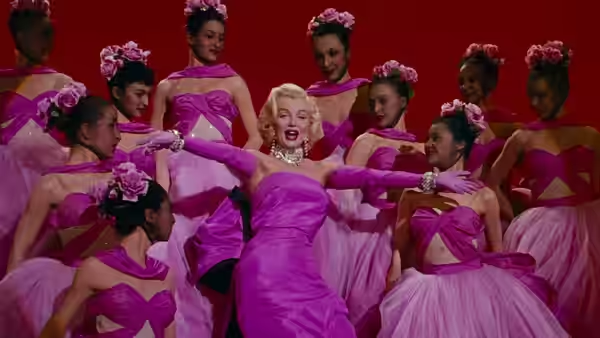
Harry J. Wild’s cinematography gives the colour sufficient force to suit the women’s confidence; a coy visual treatment would have been wrong for this comedy. William Travilla’s costumes are equally important, making the enjoyment of expensive-looking clothes part of a film that is frank about wanting expensive things. The display is pleasurable without making the women seem merely decorative. Hawks keeps their comic intelligence visible through the glamour.

The music, credited to Jule Styne and Lionel Newman, is most effective when it lets a character make her case more boldly than ordinary conversation would allow. Diamonds Are a Girl’s Best Friend is the clearest example: the bluntness of the title is a substantial part of the joke. There is no need to apologise for enjoying possessions, and the comedy improves when it stops pretending otherwise. The number’s confidence suits the film better than its more laborious romantic entanglements.

The weakness is Charles Lederer’s plotting, which grows busy without becoming more involving. There are stretches when we can feel the screenplay arranging the next complication, and the ease of the performances has to compensate. Hugh S. Fowler’s editing cannot entirely solve that problem: the dialogue and songs have a cleaner comic rhythm than the story connecting them. At 91 minutes, the film is hardly indulgent, but it still has passages in which we find ourselves waiting to return to the women together.

As a romantic musical, it is unusually happy to let its heroines be calculating without demanding that we dislike them. Its warmth comes from their friendship, and that saves the frank interest in wealth from becoming exhausting. Come for both leads, not just Monroe. Russell is too funny to be treated as someone waiting beside the main attraction.

Critical consensus AI synthesised

77
Positive
9
Mixed
2
Negative
0

Most critics find Gentlemen Prefer Blondes a lively, sharply comic musical, with praise concentrated on Marilyn Monroe and Jane Russell’s double act. The reviews repeatedly single out Monroe’s ironic delivery and screen presence, alongside Russell’s acerbic humour. The musical numbers, choreography, colour and costumes also draw approval, with “Diamonds Are a Girl’s Best Friend” receiving particular attention. The leads’ contrasting performances give the comedy much of its appeal.

The spread runs from enthusiastic to qualified approval, with no outright negative verdicts among the reviews supplied. Reservations concern the story and how much substance sits beneath the entertainment: Empire finds that the plot meanders in Paris, while Variety describes an entertaining but lightweight musical. Time Out offers a more guarded assessment, finding the film flawed but just about successful as naughty Technicolor comedy. The disagreement is chiefly over how much those limitations matter.

The Guardian
25 February 2010 · Peter Bradshaw
90*

Bradshaw calls the film a sparkling, tremendous musical comedy and a joy. He especially praises Monroe and Russell’s fantastic double act and the contrast between their performances.

Read the full review →
Slant Magazine
1 August 2010 · ★★★½/4 · Christian Blauvelt
88

The review sees the film as a celebration of consumerism that also subverts conventional romantic and sexual mores. It praises Hawks’s portrayal of Lorelei and Dorothy as sexually powerful women who control the screen and the gaze.

Read the full review →
Empire
1 January 2000 · David Parkinson
85*

Parkinson finds the film one of the 1950s’ most charming and entertaining musicals. He praises Hawks’s shaping of Monroe’s screen persona and her scene-stealing performance, while noting that the plot meanders in Paris.

Read the full review →
The New Yorker
85*

The capsule presents the film as a scintillating, sharply comic musical. It particularly praises Monroe’s ironic performance and Jack Cole’s incisive choreography.

Read the full review →
Radio Times
★★★★ · Tony Sloman
80

Sloman describes the musical as scintillating and says Monroe shines. He singles out the production numbers, especially “Diamonds Are a Girl’s Best Friend,” for praise.

Read the full review →
Sight and Sound
80*

The capsule gives the musical an enthusiastic verdict. It singles out the lead performances and praises the sumptuous, ironic numbers and ravishing colour and costumes.

Read the full review →

Straight answers AI written, from our review

Is Gentlemen Prefer Blondes worth watching?
Gentlemen Prefer Blondes is well worth watching for Marilyn Monroe and Jane Russell’s comic partnership, and we score it 82 out of 100. We find the romantic plotting laboured in places, but their timing, the songs and the warmth of their friendship make this an easy recommendation for musical-comedy admirers.
How long is Gentlemen Prefer Blondes, and what is it rated?
Gentlemen Prefer Blondes runs 1h 31m. It is a comedy and romance film.
Where can I watch Gentlemen Prefer Blondes in Switzerland?
Gentlemen Prefer Blondes is available to rent from Apple TV from CHF 4.50. Availability is checked daily; the links above go straight to each service.
How does Gentlemen Prefer Blondes compare to Gold Diggers of 1933?
Gentlemen Prefer Blondes offers a central friendship we warmly recommend, while Gold Diggers of 1933 offers the pleasures of a backstage musical with inventive numbers. Both find comedy where romance meets money, and both have romantic plotting less engaging than their performers. We favour Monroe and Russell’s partnership for the company; the earlier film suits an appetite for backstage comedy.
Is Gentlemen Prefer Blondes based on a true story or a book?
Gentlemen Prefer Blondes is based on a novel by Anita Loos, rather than a true story. We recommend it without any reading beforehand: Lorelei’s interest in wealth, Dorothy’s drier approach to attraction and the warmth between them give the musical comedy its appeal.
What should I watch after Gentlemen Prefer Blondes?
After Gentlemen Prefer Blondes, try Gold Diggers of 1933 (1933, Fi1m 82): Another musical in which romance must negotiate with the household accounts. Then The Lady Eve (1941, Fi1m 90): For another apparently innocent flirtation conducted by someone who knows better; and Women on the Verge of a Nervous Breakdown (1988, Fi1m 84): For women sorting out men’s disorder, with considerably less patience and more farce.

Cast

If you liked this, try…

  1. Gold Diggers of 1933 (1933, Fi1m 82)Another musical in which romance must negotiate with the household accounts.

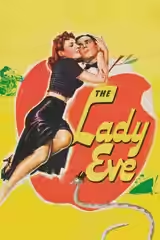
  2. The Lady Eve (1941, Fi1m 90)For another apparently innocent flirtation conducted by someone who knows better.

  3. The Young Girls of Rochefort (1967) · not on Fi1m yetTwo women, romantic confusion and musical colour, with a gentler comic manner.

  4. Women on the Verge of a Nervous Breakdown (1988, Fi1m 84)For women sorting out men’s disorder, with considerably less patience and more farce.

  5. Muriel's Wedding (1994, Fi1m 81)Female friendship, marriage and favourite songs, with considerably more emotional bruising.