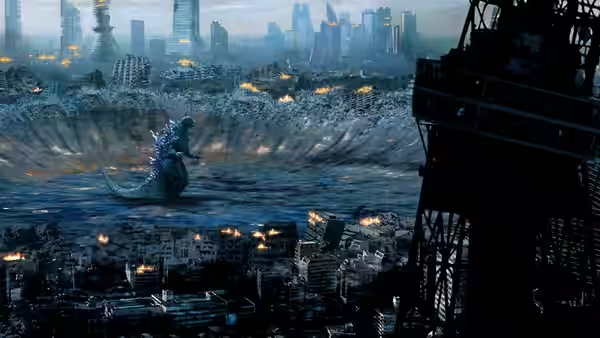
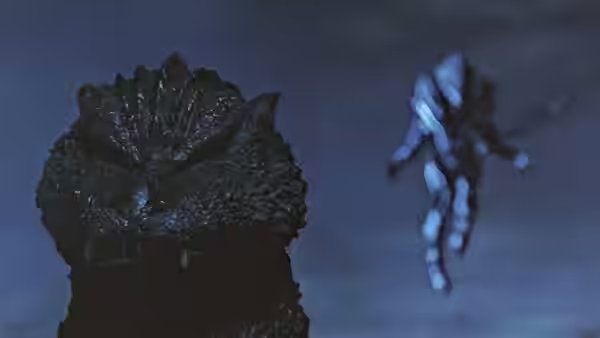
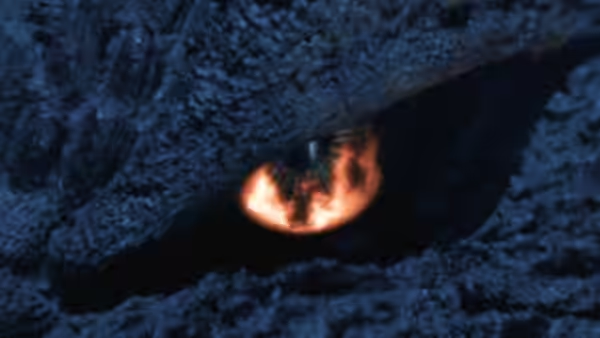
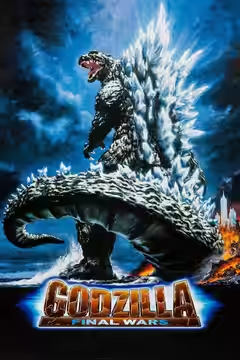
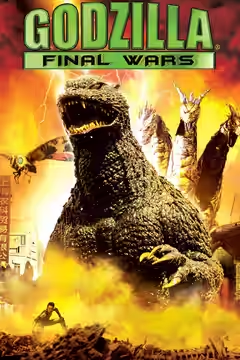
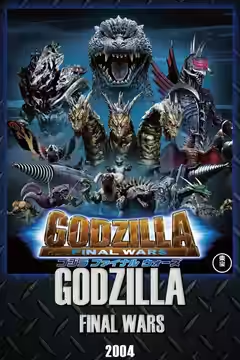
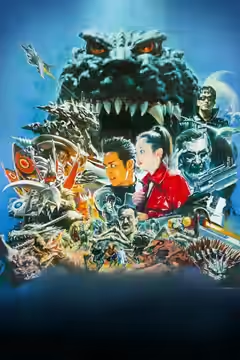
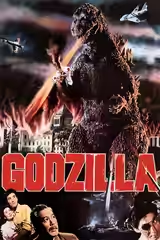
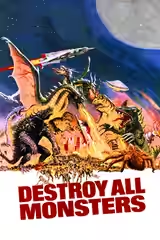
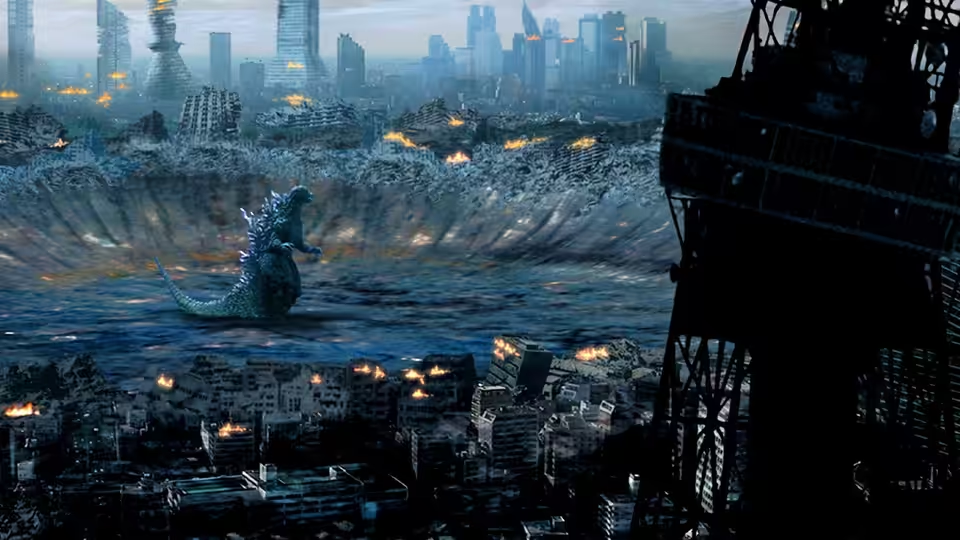
Godzilla rises from a crater amid the burning ruins of a city
Film review

Godzilla: Final Wars

2004 · Directed by Ryuhei Kitamura · 2h 05m

In a sentenceToho throws Godzilla a leaving do and forgets to invite him until the last hour

In the near future, monsters have been attacking the world’s cities for decades, and the Earth Defence Force fights them with a flying, drill-nosed warship called the Gotengo and a corps of mutant soldiers. Years earlier the Gotengo, under Captain Douglas Gordon (Don Frye), buried Godzilla under the ice at the South Pole. Now mutant soldier Shin’ichi Ôzaki (Masahiro Matsuoka) is told to guard the biologist Miyuki Otonashi (Rei Kikukawa), who is examining a mummified monster dug out of the ground in Hokkaido, while her sister Anna (Maki Mizuno) reads the news on television. Then monsters appear everywhere at once, Rodan over New York, Anguirus in Shanghai, and vanish just as suddenly, and a ship arrives from Planet X whose smiling controller (Kazuki Kitamura) says he has come to help.

Plays from YouTube when you press play; nothing loads from them until then.

Fi1m review

Ryuhei Kitamura’s send-off for Godzilla is loud, crowded and often good-humoured, and it spends most of its 125 minutes on men in leather coats kicking each other while the monster of the title waits under the ice. Fun in bursts; tiring as a whole.

Godzilla: Final Wars was made for the fiftieth anniversary of the 1954 film, sold with the tagline “Farewell, Godzilla”, and built as a farewell party. Ryuhei Kitamura and his co-writers Wataru Mimura and Isao Kiriyama invite every monster they can find, a flying warship with a drill for a nose, a race of aliens from Planet X, and a corps of superhuman soldiers who fight in slow motion and sunglasses. As a parade it is a good time in bursts. As a film it is exhausting, and its odd decision is to make Godzilla a supporting player in his own retirement.

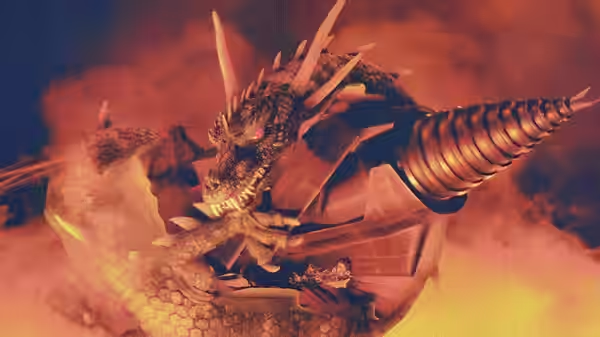
The opening is the best of it. Yukiharu Seshimo’s Gotengo, a grey submarine that flies, drills into Antarctic ice while Godzilla thrashes about below it, and for ten minutes the film is exactly what it promises: big, silly and sure of itself. We sat up. Then the story moves to the present, monsters appear over cities all round the world, and Takumi Furuya shoots the attacks in flat overcast daylight that makes Rodan’s shadow over Manhattan look heavier than it should. The world tour is quick and generous, and it is the last time for an hour that the film seems interested in its own monsters.

What it is interested in is Ôzaki. Masahiro Matsuoka plays him with a frown and a long coat, and Kitamura gives him fights that anyone who saw The Matrix will recognise: the wire-assisted kicks, the leap frozen in mid-air, the fistfight in a corridor of glass. Kane Kosugi’s Kazama gets a motorbike chase through a car park. Shuichi Kakesu cuts these into short, sharp bursts, which keeps them from sagging, and also means every fight has the same shape, a rush, a freeze, a landing, over and over. Somewhere in the second hour we noticed that we had stopped watching and were waiting, and that what we were waiting for was a reptile, not a person.

The humans who work are the ones who know what film they are in. Don Frye, a mixed martial artist rather than an actor, plays Captain Gordon as a slab of moustache and cigar who shouts at aliens and is right to. Akira Takarada, who was in the original 1954 film, is the UN Secretary General, and Kumi Mizuno, another veteran of the 1960s Godzillas, commands the defence force; both are used for a nod to the past and little more, which is a shame, because they are the two people on screen with any gravity. Kazuki Kitamura’s controller of Planet X starts as a smiling diplomat and ends up shrieking, and he is enjoyable in both modes.

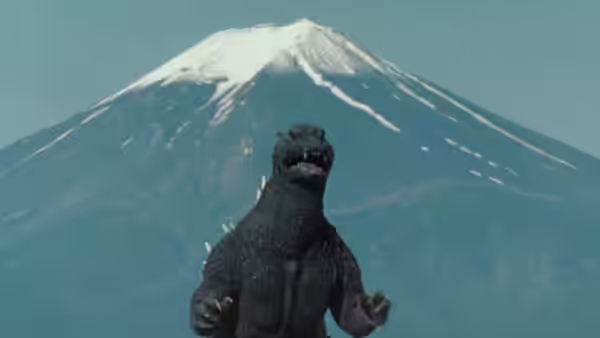
The music tells you where the film’s heart is. Keith Emerson, of Emerson, Lake & Palmer, supplies a synthesiser score that pulses under the mutant fights and dates them instantly. Akira Ifukube’s march, the one every Godzilla film has leant on since 1954, is held back until Godzilla himself is let out, and when it finally arrives it did something to us that two hours of kicking had not: we were, for a moment, properly glad to see him. Whether that is the film’s doing or Ifukube’s is a fair question.

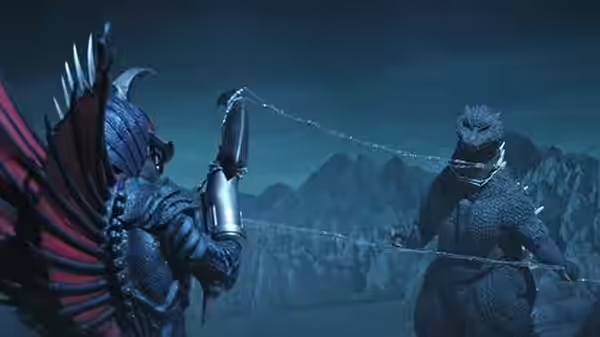
When the monster fights come, they are brief. The suit is lean and fast, and Kitamura stages each bout as a knockout in three or four moves, one opponent after another, so that the film’s long guest list is dealt with the way a bouncer clears a queue. There is a joke at the expense of the 1998 American remake that we will not describe except to say it lasts about as long as it deserves. We laughed, and then wished the joke had been given a scene rather than a shrug.

Destroy All Monsters did the everything-at-once idea in 1968 with more creatures in the same frame and no interest in the people. The 1954 film had one monster and a country in mourning. Final Wars has neither the crowd nor the grief; it has a martial-arts film with monsters attached, and the attachment is loose.

For the devoted it is worth an evening, at home, with company and a willingness to talk through the humans. Everyone else should know that it runs 125 minutes and that perhaps forty of them are the film on the poster.

Critical consensus AI synthesised

3 of 6
Positive
1
Mixed
1
Negative
1
Variety
22 June 2005 · festival review · Dennis Harvey
70*

Harvey finds the film a long but entertaining spectacle, though its abundance of fights becomes repetitive. He praises the contemporary pacing and look, as well as the expertly choreographed martial-arts action.

Read the full review →
Screen Daily
8 December 2004 · Mark Schilling
64*

The accessible page identifies this as a review, but its verdict is not visible. The paywall also hides what the critic singled out for praise or complaint.

Read the full review →
Den of Geek
20 May 2014 · Jim Knipfel
35*

Knipfel finds the film entertaining in places but ultimately a disappointing, derivative finale that leaves him nostalgic for earlier Godzilla classics. He praises its lively monster references and set pieces, while faulting its borrowed action-film style and focus on human characters over the monsters.

Read the full review →

Straight answers AI written, from our review

Is Godzilla: Final Wars worth watching?
Godzilla: Final Wars is worth watching only for the devoted, and we scored it 54. Ryuhei Kitamura's fiftieth-anniversary send-off is loud, crowded and good-humoured in bursts, but most of its 125 minutes go to mutant soldiers kicking each other in slow motion while Godzilla waits under the ice. Watch it at home, with company, and talk through the humans.
How long is Godzilla: Final Wars, and what is it rated?
Godzilla: Final Wars runs 2h 05m. It is an action and adventure film.
Where can I watch Godzilla: Final Wars in Malaysia?
Godzilla: Final Wars is not on any streaming or rental service in Malaysia at the moment. It is available in 3 other countries; change your country at the top of the page to see where. Availability is checked daily.
How violent or frightening is Godzilla: Final Wars, and is it suitable for children?
Godzilla: Final Wars has no UK certificate and is unrated in the US, and what it contains is wire-assisted martial-arts fighting, monsters knocking down cities, and brief monster bouts that end in three or four moves. There is little fear or grief in it; the tone is a farewell party. Older children used to Godzilla films should cope, though the fights are relentless and the mood is closer to a punch-up than a fright.
How does Godzilla: Final Wars compare to Godzilla?
Godzilla: Final Wars is a martial-arts film with monsters loosely attached, while the 1954 Godzilla is a frightening monster film about one creature and a grieving city, and the original is the better of the two by some distance. Final Wars offers a crowded parade of creatures, aliens and slow-motion kicks; Ishirō Honda's film offers destruction that hurts and Akira Ifukube's mournful score. Choose the original unless you want a party rather than a film.
What should I watch after Godzilla: Final Wars?
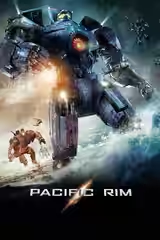
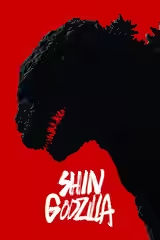
After Godzilla: Final Wars, try Godzilla (1954, Fi1m 88): The original, one monster and a grieving city, and still the one to beat. Then Pacific Rim (2013, Fi1m 70): Del Toro’s robots-versus-monsters film, which loves its creatures and gives them room; and Shin Godzilla (2016, Fi1m 74): Godzilla brought back as a bureaucratic disaster; grave, strange and very Japanese.

Cast

If you liked this, try…

  1. Godzilla (1954, Fi1m 88)The original, one monster and a grieving city, and still the one to beat.

  2. Destroy All Monsters (1968) · not on Fi1m yetThe everything-at-once idea done first, with more monsters on screen and less talk.

  3. Versus (2000) · not on Fi1m yetKitamura’s breakthrough, the same leather coats and wire fights with zombies instead of monsters.

  4. Pacific Rim (2013, Fi1m 70)Del Toro’s robots-versus-monsters film, which loves its creatures and gives them room.

  5. Shin Godzilla (2016, Fi1m 74)Godzilla brought back as a bureaucratic disaster; grave, strange and very Japanese.