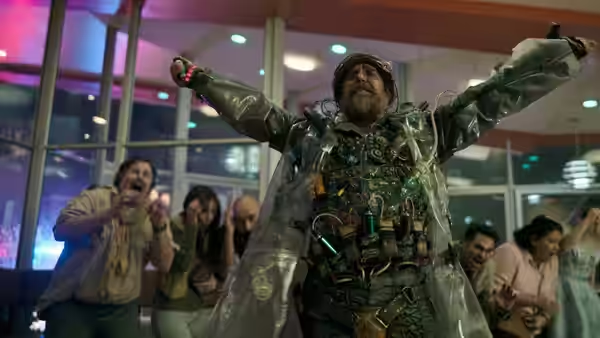
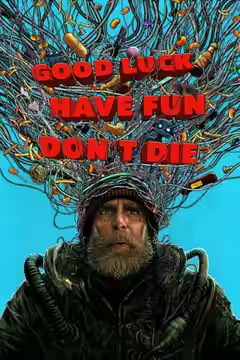
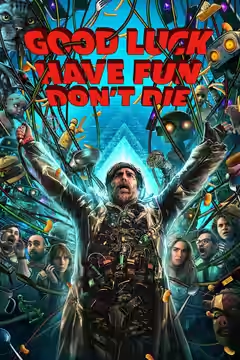
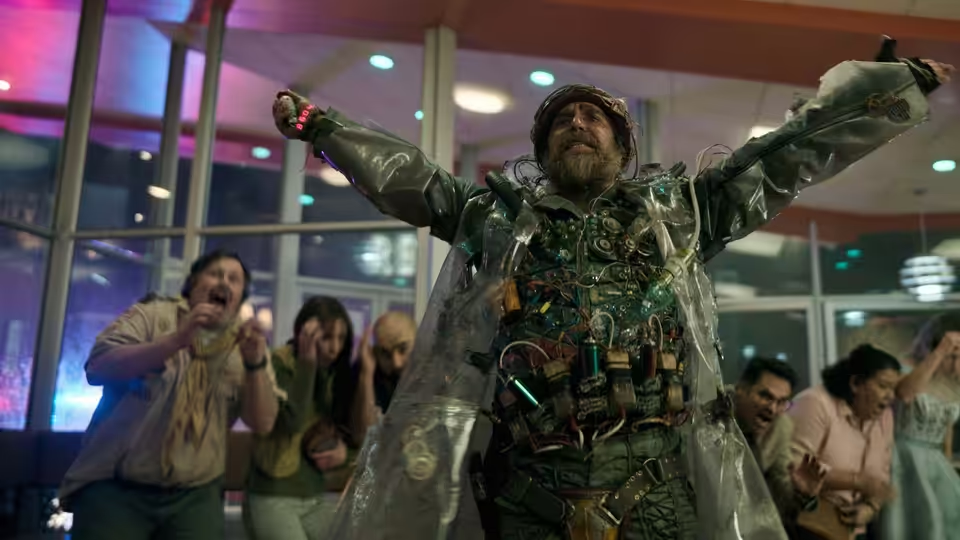
Bearded man in gadget-covered coat extends arms in a crowded room
Film review

Good Luck, Have Fun, Don't Die

2026 · Directed by Gore Verbinski · 2h 14m · MPA R

In a sentenceThe world is about to end and everyone in the diner would rather look at their phones

A dishevelled man who calls himself the Man from the Future (Sam Rockwell) walks into a diner and tells the strangers eating there that artificial intelligence is about to finish off the human race, that he has come back to stop it, and that he needs them. He has said this before, many times, and failed every time. Among the people he presses into service are Susan (Juno Temple), Ingrid (Haley Lu Richardson), Mark (Michael Peña), Janet (Zazie Beetz) and Scott (Asim Chaudhry), none of whom asked to save anything. As he gathers them, the film cuts back to how each of them came to be sitting in that diner, and how the phones, feeds and machines in their lives got them there. The AI itself appears as a boy (Artie Wilkinson-Hunt).

Plays from YouTube when you press play; nothing loads from them until then.

Fi1m review

Gore Verbinski’s return is fast, loud and frequently funny, with Sam Rockwell giving everything as a time traveller trying to save a world that will not look up from its screen. It has about ninety minutes of ideas and 134 minutes of film.

Gore Verbinski has come back with a science fiction comedy about the end of the world, and he has decided the end of the world should be argued about in a diner. A man who says he is from the future (Sam Rockwell) bursts in, tells the customers that the machines are about to win, and starts recruiting. He has been here before. He has tried this many times. Matthew Robinson’s script treats the time loop as a running gag as much as a plot: the hero knows every wrong turn and is too tired to be patient about it. The film is good fun for an hour, patchy for the next half hour, and lost by the end.

Rockwell is the reason to go. He plays the Man from the Future as somebody who has watched the same apocalypse enough times to be bored by it and terrified of it in equal measure, and he does exhaustion better than almost anyone working. He shouts a great deal, because the script asks him to, but the best moments are the ones where he stops, looks at a stranger he has failed before, and decides whether to bother. He is playing a very old joke, the prophet nobody listens to, and he keeps it alive by sheer effort.

The structure is the trouble. Every recruit gets a flashback showing how technology ruined them, so the film keeps stopping to tell short, separate stories about screens. Some are sharp. Juno Temple’s Susan gets a strand about cloning that is unsettling and funny at once, and Temple plays it with a fixed smile that we found harder to watch than any of the action. Haley Lu Richardson’s Ingrid is the one person in the diner who behaves like someone with a life, and the film is steadier whenever it stays with her. Michael Peña and Zazie Beetz get less to do and do it well.

Other vignettes feel like complaints about the internet written some years ago and left in a drawer. Jokes about people staring at their phones, about likes, about nobody talking to each other, arrive with the confidence of a fresh observation. They are not fresh. Each time the film returns to the diner it has to build its momentum again, and Craig Wood’s cutting, brisk as it is, cannot hide how often the story has been put down and picked up.

We laughed, properly and often, in the first hour, mostly at Rockwell’s face as another plan went wrong. Somewhere past the ninety-minute mark, when the film went into yet another backstory, we felt it go slack, and it did not recover. The last act moves into a bigger, stranger place we will not describe. What we can say is that it is where the digital effects do the heaviest lifting, and they are not up to it, and that the film seems to mistake volume for a resolution.

Jim Whitaker shoots the diner in grubby, close, ordinary light and saves the wide, clean frames for the set pieces, which is a sensible choice and makes the set pieces feel earned. David Brisbin’s near future is our present with more screens in it, which is the film’s argument in a single design decision and a good one. Neil McClean dresses Rockwell in clothes that look slept in for a decade. Geoff Zanelli’s score is loud and insistent, and in the finale it is doing the work the pictures should be doing.

Verbinski has always liked chaos more than tidiness, and in Pirates of the Caribbean: The Curse of the Black Pearl (2003) and Rango (2011) the chaos had a spine. Here the spine is an idea about how tired we all are of our devices, and it is a fair idea, but the film says it in the first twenty minutes and then keeps saying it.

See it for Rockwell, for Temple’s strand and for the first hour, which is as lively as anything he has made. Sit near the back so the finale is smaller. It runs 134 minutes and carries a 15.

Critical consensus AI synthesised

68
Positive
14
Mixed
2
Negative
3

Most critics like it, with fourteen positive notices against three negative. The praise gathers around Gore Verbinski’s return: the reviews describe the film as audacious, raucous and full of ideas, a science fiction comedy about a time-loop mission to stop a rogue AI that moves with real energy even when it does not hold together. Sam Rockwell’s manic lead performance is the element singled out most often, and several reviews also pick out the Black Mirror-style vignettes, Juno Temple’s cloning storyline in particular.

The reservations are about shape. Even admiring critics find it overstuffed, the flashbacks cumbersome and the final act confusing or overlong, and a few note dated gags and poor CGI. The spread is wide. The Times finds it dull as well as unhinged, Little White Lies calls the satire hacky and Time Out says it has nothing new to say about life online. Screen Daily, more moderately, misses a human element beneath the glibness.

The Telegraph
19 February 2026
88*

The critic calls the film a riotous and blood-curdlingly timely science fiction satire about humanity’s last stand against AI, praising its grippingly unpredictable energy and sharp observations on tech’s absurd yet grim effects.

Read the full review →
Slant Magazine
29 January 2026 · Justin Clark
85*

The critic praises the film as a fun techno-horror wake-up call that effectively mixes awkward humor with surrealist technological horror, likening it to a 21st-century Bosch painting and highlighting Verbinski’s confident control and bizarre ambition.

Read the full review →
Radio Times
19 February 2026 · ★★★★ · Rosie Fletcher
80

The critic calls the film audacious, fresh and a massive amount of fun despite a confusing final act, praising its clever, unpretentious energy and wild originality. It singles out the strong Black Mirror-style vignettes, especially Juno Temple’s troubling yet funny cloning storyline.

Read the full review →
RogerEbert.com
13 February 2026 · Brian Tallerico
80*

The film is a playful, sharp action-comedy that spins AI concerns into timely entertainment with creative spark and energetic direction, though its structure can feel haphazard. It warns about technology's dangers while celebrating the cast, especially Sam Rockwell's charismatic lead performance.

Read the full review →
The Guardian
12 February 2026
77*

The critic finds fun to be had in Verbinski’s satisfyingly tech-fearing sci-fi comedy adventure but notes it is lively yet overstuffed and could use more restraint. The human mess of the film and standout performances, particularly from Haley Lu Richardson, are singled out positively amid the excess.

Read the full review →
Los Angeles Times
12 February 2026 · Amy Nicholson
75*

Verbinski’s maniacal farce is a sly sci-fi satire about stopping a tech-pocalypse, with an intricate, angry, and ambitious script that feels like a feat to get made. It explores how the internet’s promise has soured through flashbacks and mean observations on digital life.

Read the full review →

Straight answers AI written, from our review

Is Good Luck, Have Fun, Don't Die worth watching?
Good Luck, Have Fun, Don't Die is worth watching for Sam Rockwell and its lively first hour, and we scored it 64. Gore Verbinski's science fiction comedy is fast and often funny, but it keeps stopping for flashbacks about screens and loses its way in a loud, effects-heavy finale. Go for the performances rather than the ending.
How long is Good Luck, Have Fun, Don't Die, and what is it rated?
Good Luck, Have Fun, Don't Die runs 2h 14m and is rated R by the MPA in the US. It is a science fiction and action film.
Where can I watch Good Luck, Have Fun, Don't Die in the US?
Good Luck, Have Fun, Don't Die is streaming on Hulu and Disney+ in the US, and it is also available to rent from Amazon Prime Video from $5.99. Availability is checked daily; the links above go straight to each service.
How violent or frightening is Good Luck, Have Fun, Don't Die, and is it suitable for children?
Good Luck, Have Fun, Don't Die carries a UK 15 certificate, so it is not for children and is aimed at older teenagers and adults. It is a science fiction comedy rather than a horror film, with shouting, set pieces and an unsettling strand about cloning; expect the language and content a 15 implies rather than sustained frights.
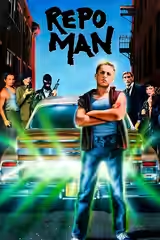
How does Good Luck, Have Fun, Don't Die compare to Repo Man?
Good Luck, Have Fun, Don't Die is bigger, louder and far longer than Repo Man, and the earlier film is the better of the two. Both are scruffy comedies where the world is ending and nobody much minds, but Alex Cox keeps his cast in one register for a lean running time, where Verbinski keeps pausing for backstories. Choose Cox for people, Verbinski for spectacle.
What should I watch after Good Luck, Have Fun, Don't Die?
After Good Luck, Have Fun, Don't Die, try Repo Man (1984, Fi1m 83): Alex Cox’s scruffy Los Angeles science fiction, where the world ends and nobody much minds. Then Twelve Monkeys (1995, Fi1m 82): A time traveller nobody believes, played by Bruce Willis with the same exhausted eyes; and Brazil (1985, Fi1m 83): Terry Gilliam’s bureaucratic nightmare; the machines are dafter and the jokes land harder.

Cast

If you liked this, try…

  1. Repo Man (1984, Fi1m 83)Alex Cox’s scruffy Los Angeles science fiction, where the world ends and nobody much minds.

  2. Twelve Monkeys (1995, Fi1m 82)A time traveller nobody believes, played by Bruce Willis with the same exhausted eyes.

  3. Brazil (1985, Fi1m 83)Terry Gilliam’s bureaucratic nightmare; the machines are dafter and the jokes land harder.

  4. Sorry to Bother You (2018, Fi1m 81)Boots Riley’s satire goes as strange as this one and knows exactly why.

  5. A Cure for Wellness (2016) · not on Fi1m yetVerbinski at his most patient and peculiar; a very different pace, the same appetite.