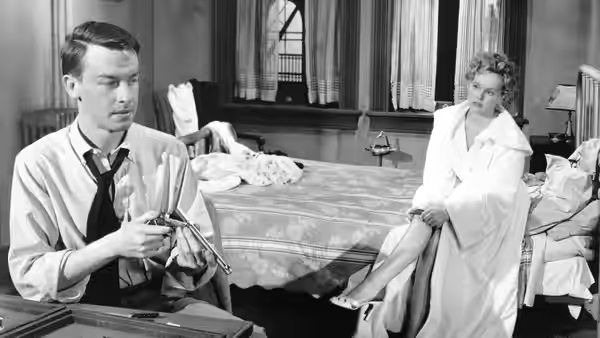
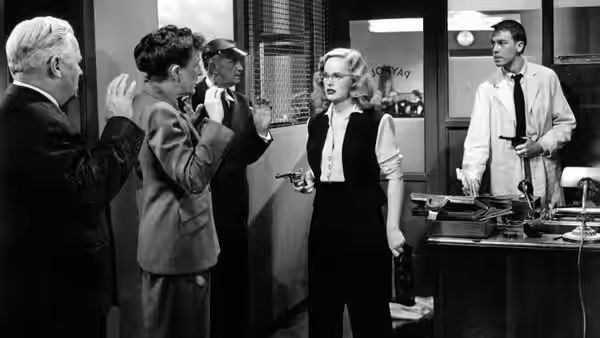
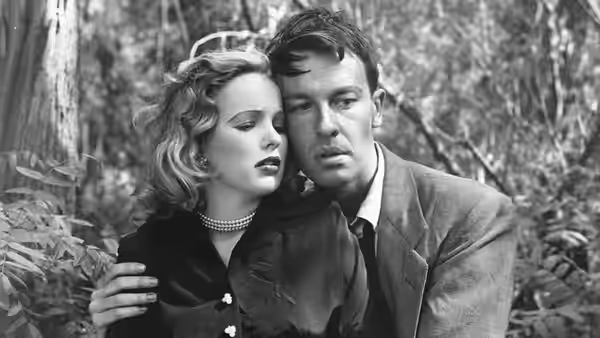
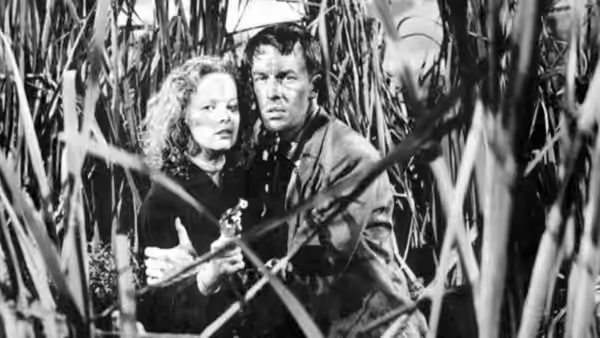
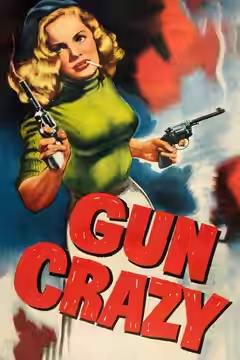
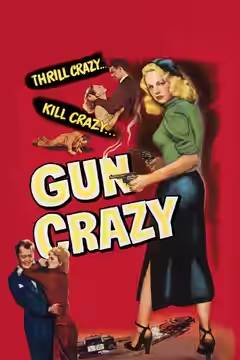
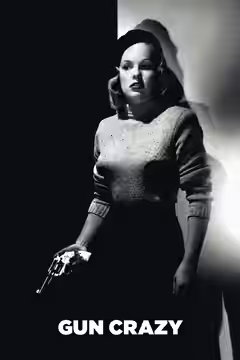
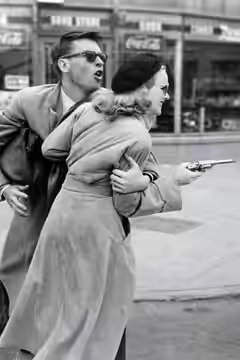
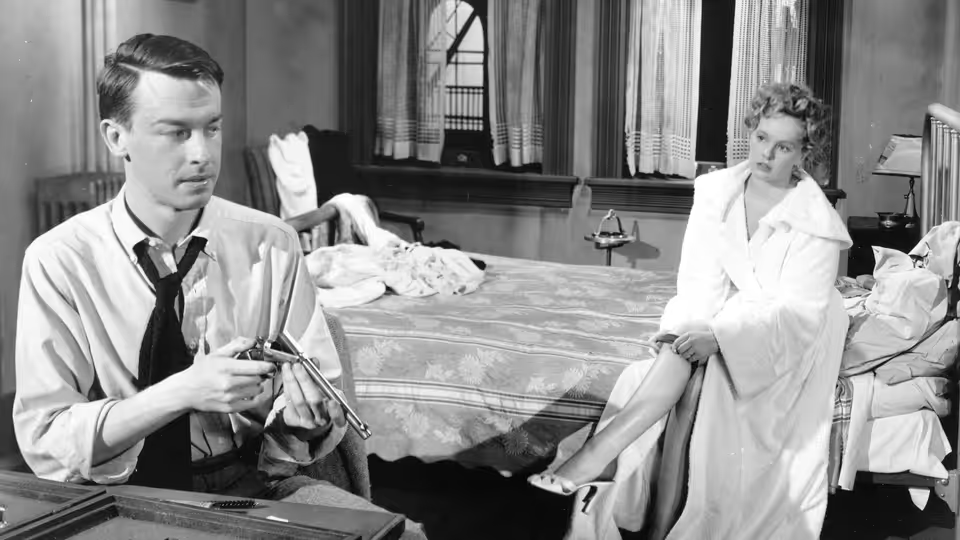
Bart Tare (John Dall) examines a revolver as Annie Laurie Starr (Peggy Cummins) sits on a bed
Film review

Gun Crazy

1950 · Directed by Joseph H. Lewis · 1h 27m

In a sentencePeggy Cummins makes a gun look like a perfectly reasonable basis for a relationship

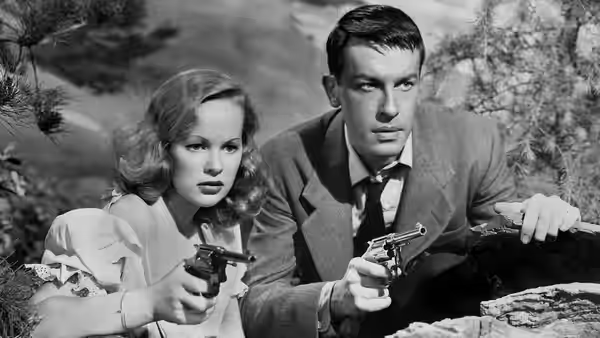
Bart Tare (John Dall) falls for Annie Laurie Starr (Peggy Cummins), a sharpshooter whose confidence and skill with a gun are part of her appeal. He wants to be with her, and their attraction draws them towards crime. Packett (Berry Kroeger) is among those involved as Bart and Laurie’s relationship takes shape. Staying together becomes bound up with taking risks, while Laurie’s ability to manipulate Bart makes it difficult for him to separate his own wishes from hers.

Fi1m review

Joseph H. Lewis’s gripping crime romance earns its tension through Peggy Cummins, John Dall and a camera placed uncomfortably close. The writing can simplify their dependence, but we recommend it for the performances and the nerve.

Joseph H. Lewis asks us to believe that a fascination with guns can be part of falling in love, and Gun Crazy makes the proposition disturbingly plausible. It is a tense, persuasive crime romance, recommended with a small reservation about how fully the lovers are explained. Lewis understands that their attraction has to hold our attention before their criminal adventures can matter. The film’s force comes from how closely it watches them together.

Peggy Cummins plays Annie Laurie Starr with enough volatility to make her appeal worrying from the start. We can see the manipulation, but it takes effort to look away from the woman doing it. John Dall’s Bart Tare gives that performance someone worth working upon: his attachment makes the pairing more affecting than a simple contest between a schemer and a fool. There is vulnerability in their dependence, and both actors let it show without making the relationship seem healthy.

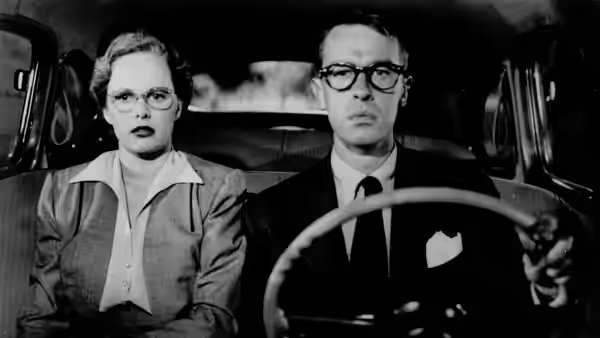
The robbery filmed in a continuous take from inside the getaway car is the clearest example of Lewis’s judgement. Russell Harlan’s camera keeps us in that confined position, making the decision not to cut increasingly hard to ignore. We felt trapped in the car, because the shot would not give us the relief of looking elsewhere. The length of the take makes the waiting itself tense. It is an audacious piece of camerawork that never feels detached from the couple’s predicament.

Harry Gerstad’s editing gives the chase passages a speed that keeps the danger immediate. The contrast with the unbroken robbery shot matters: Lewis does not use the same method for every kind of suspense. Gordon Wiles’s production design is less conspicuous, and we remember the people within the spaces more clearly than the spaces themselves. That seems right for a film so preoccupied with its lovers. Victor Young’s music contributes to the excitement, although the performances hardly need encouragement.

The screenplay credited to MacKinlay Kantor, Millard Kaufman and Dalton Trumbo is less sure when it comes to explaining the attachment. Laurie’s power over Bart can sometimes stand in for a fuller account of what keeps him there. Dall makes the dependence credible, but there are stretches where we would welcome a little more resistance from the writing. It is the film’s main limitation, and it leaves the actors supplying some of the emotional complexity that the plot takes for granted.

Among films about lovers on the run, this one gives unusual weight to the couple’s need for one another. The gunplay does not make the romance incidental. Watching Cummins and Dall, we understand why a sensible warning would have trouble getting a hearing, even if we cannot accept every turn of their behaviour. Their attraction is worrying enough to sustain the tension without constant action, and Lewis gives the performances room to do that work.

At 87 minutes, it asks for little patience and rewards close attention. Allow for the thin patches in the writing; the two leads keep finding feeling where a less careful film would settle for excitement. See it for Cummins, and keep an eye on what Dall lets her do to him.

Critical consensus AI synthesised

76
Positive
6
Mixed
0
Negative
1

Most critics respond warmly to Gun Crazy, with praise concentrated on Joseph H. Lewis’s charged direction, the inventive camerawork and Peggy Cummins’s performance. The bank robbery filmed in a continuous take from inside the getaway car is a recurring example of the film’s confidence and resourcefulness. Cummins’s allure and volatility give the crime story much of its force. Several reviews also find emotional sensitivity and unexpected complexity beneath the lurid lovers-on-the-run premise.

The spread is wide, although the disagreement comes chiefly from one negative review rather than a broadly divided consensus. Variety enjoys the fast-moving chases and finds the latter half exciting, but regards the film as cold and emotionally shallow, blaming writing and direction that remain on the surface. That objection runs directly against the emotional depth other critics find in the central relationship; most see more here than stylish criminal adventure.

The Guardian
27 February 2009 · Peter Bradshaw
90*

Bradshaw praises the film as an addictive, perfectly formed noir masterpiece. He particularly singles out the bold camerawork, including its continuous bank-robbery take.

Read the full review →
The New Yorker
90*

The review is highly enthusiastic about the film’s stylish take on lovers-on-the-run crime. It especially praises Joseph H. Lewis’s charged direction and the famous robbery filmed from inside the getaway car.

Read the full review →
IndieWire
15 July 2015 · Vikram Murthi
85*

Murthi finds the film a sensitive, compelling noir whose lurid surface gives way to a tragic love story. He especially praises the charged performances and the eerie, emotionally potent final scene.

Read the full review →
Time Out
24 February 2009 · ★★★★ · Tom Huddleston
80

Huddleston gives the film a positive four-star review. He singles out Peggy Cummins’s manipulative allure as sharpshooter Laurie Starr.

Read the full review →
Empire
26 February 2009 · Kim Newman
70*

The review finds the film darker and more subtly complex than expected for a 1950s crime caper. It praises that unexpected complexity.

Read the full review →
Variety
31 December 1949 · Variety Staff
35*

The review finds the film exciting in its latter half but ultimately cold and emotionally shallow. It praises the fast-moving chase sequences while faulting the writing and direction for staying on the surface.

Read the full review →

Straight answers AI written, from our review

Is Gun Crazy worth watching?
Gun Crazy is worth watching for its tense crime romance, Peggy Cummins and John Dall’s performances, and unusually close camerawork; we score it 86. We recommend it to anyone drawn to dangerous screen relationships, with a reservation about writing that sometimes lets Laurie’s manipulation substitute for a fuller explanation of Bart’s attachment.
How long is Gun Crazy, and what is it rated?
Gun Crazy runs 1h 27m. It is a crime and romance film.
Where can I watch Gun Crazy in Singapore?
Gun Crazy is not on any streaming or rental service in Singapore at the moment. It is available in 3 other countries; change your country at the top of the page to see where. Availability is checked daily.
How violent or frightening is Gun Crazy, and is it suitable for children?
Gun Crazy contains gunplay, robbery and tense chases, and we would not recommend it for young children. No UK or US certificate is supplied, so there is no age rating here to guide suitability. The review describes suspense built through confinement and a manipulative romance, rather than establishing how graphic the violence is; those pressures may trouble sensitive viewers.
How does Gun Crazy compare to Badlands?
Gun Crazy is the closer, more emotionally involving crime romance, while Badlands watches its fleeing couple with greater coolness and an unsettlingly casual brutality. We favour Gun Crazy for the lovers’ palpable dependence and immediate suspense; Badlands is the stronger choice for anyone seeking a funny, frightening account of lovers who barely understand themselves.
What should I watch after Gun Crazy?
After Gun Crazy, try Badlands (1973, Fi1m 91): Another fleeing couple, observed with a cooler gaze and an unsettlingly casual brutality. Then Victoria (2015, Fi1m 76): A single sustained take makes a criminal misadventure feel alarmingly difficult to escape.

Cast

If you liked this, try…

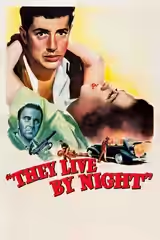
  1. They Live by Night (1948) · not on Fi1m yetYoung lovers try to build a future while crime steadily limits their choices.

  2. Pierrot le Fou (1965) · not on Fi1m yetA runaway romance in which colour and recklessness compete for our attention.

  3. Badlands (1973, Fi1m 91)Another fleeing couple, observed with a cooler gaze and an unsettlingly casual brutality.

  4. Deep Crimson (1996) · not on Fi1m yetDesire and criminal partnership turn uglier still in this unsentimental Mexican crime romance.

  5. Victoria (2015, Fi1m 76)A single sustained take makes a criminal misadventure feel alarmingly difficult to escape.