Charles Ferguson’s account of the 2008 crash is the clearest we have seen, and angry without once raising its voice. A prosecution, superbly assembled, that occasionally enjoys the squirming too much and ends by asking for a hope it has spent an hour disproving.
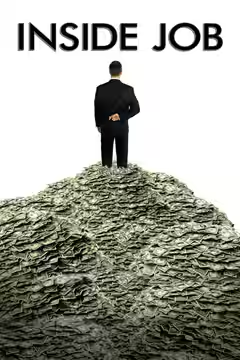
Charles Ferguson has made a film about the financial crash of 2008 that assumes you do not know what a collateralised debt obligation is, and that you will be angry once you do. It runs 109 minutes, Matt Damon narrates it in the voice of a man reading out a charge sheet, and it is the clearest account of the crisis we have seen on a screen. It is also a prosecution and does not pretend to be anything else. We think that is mostly to its credit, and we will come to the part that is not.
It begins in Iceland, which is a shrewd place to begin. The economists Gylfi Zoega and Sigridur Benediktsdottir explain how three privatised banks borrowed their way to a size the country could not carry, and the writer Andri Snær Magnason describes what the money did to the place while it lasted. Kaylanee Mam and Svetlana Cvetko shoot much of the film from helicopters: Icelandic lava fields, then Manhattan at dusk, glass towers with nothing visible inside them. The aerials are the one indulgence Ferguson permits himself, and they earn their keep by giving you somewhere to look while the numbers settle.
The method is a lecture built like a thriller. Damon walks us from the deregulation of the Reagan years through the derivatives boom, and animated diagrams turn a mortgage into a security into a triple-A rating in three moves anyone can follow. Adam Bolt and Chad Beck cut between archive footage of Senate hearings, sit-down interviews and those diagrams at a steady pace, one step of the argument at a time, and Alex Heffes puts low strings and a ticking pulse under all of it. Scored like that, a lecture on credit default swaps ought to feel as if it is trying too hard. It does not, because every promise the music makes, the evidence keeps.
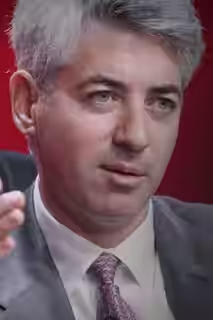
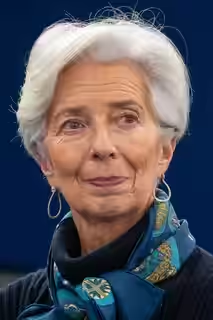
The interviews sort themselves into two kinds. Paul Volcker, Christine Lagarde, George Soros, Dominique Strauss-Kahn and Barney Frank talk freely, and they are the people who either warned of the crash or were left to clear up after it. Then there are the men Ferguson has come for: the regulators who went to work for the banks, the academics who wrote paid reports and did not mention the pay. Ferguson stays off camera and asks the follow-up question, and the answers turn evasive. One economist tells him how many minutes he has left and invites him to make the most of them. We laughed, and then we were angry, and we were still angry on the way home, because the man was not embarrassed. None of them are. That is what the film is about, and it is why it stays with you.
The flaws are the flaws of a prosecutor who is enjoying himself. The camera holds on a flustered face a beat longer than fairness needs, and the list of people who declined to be interviewed is read out like a roll of the guilty. Jonathan Alpert, a therapist whose clients work in finance, is here to tell us what bankers spend their bonuses on, and it is gossip. If you followed the crash in the papers you will learn little you did not already know; what you will get is the order of events, and the faces. And the closing minutes, in which Damon tells us over the New York skyline that some things are worth fighting for, ask for a hope the previous hundred minutes have spent carefully taking away.
Ferguson’s No End in Sight (2007) did this for the war in Iraq: patient interviews, documents, no stunts. Here he has added a film star and a helicopter and lost a little of that earlier film’s restraint. He has kept the thing that matters, which is the willingness to sit in a room with a powerful person and ask the same question twice.
Watch it with someone who has a pension. It is certificate 12 and 109 minutes, and hardly anyone in it says sorry.