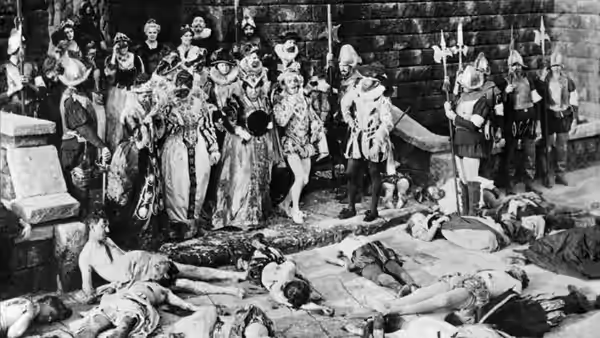
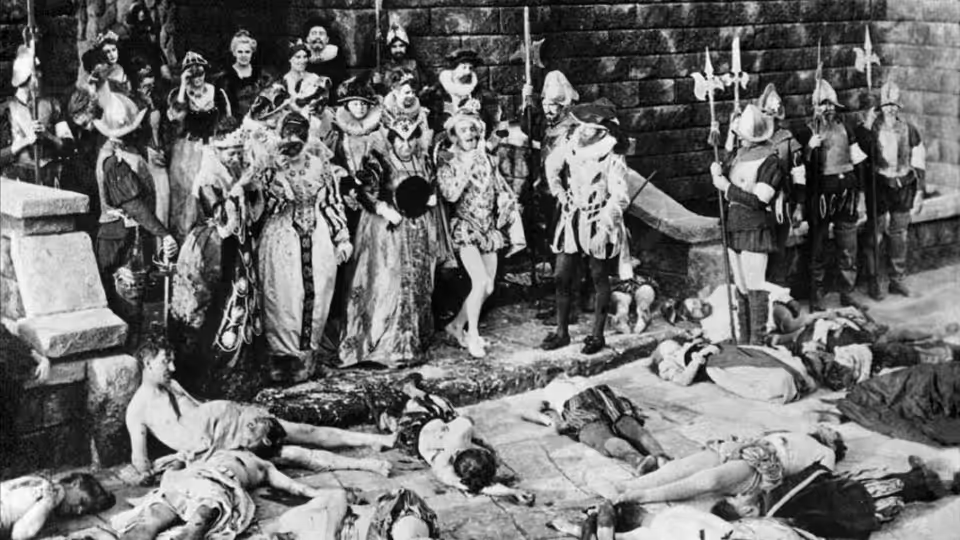
A group of men and women gather around bodies lying across a stone courtyard
Film review

Intolerance: Love's Struggle Throughout the Ages

1916 · Directed by D.W. Griffith · 3h 17m

In a sentenceFour stories, two and a half millennia, one cradle, and a Babylon so big the extras need a map

D.W. Griffith cuts between four stories set centuries apart. In a present-day American mill town, factory owner Arthur Jenkins (Sam De Grasse) cuts wages to pay for the reform charity run by his sister Mary T. Jenkins (Vera Lewis), and a strike follows. The Dear One (Mae Marsh) and her father (Frederick A. Turner) are driven to the city, where she meets the Boy (Robert Harron), who has fallen in with a gang. In Paris in 1572, the Huguenot Brown Eyes (Margery Wilson) is courted by Prosper Latour (Eugene Pallette) while Catholic and Protestant tempers rise. In Judea, Christ turns water to wine at Cana. In Babylon, Belshazzar’s court feasts while the Persian army of Cyrus gathers outside the walls. Between them, a woman (Lillian Gish) rocks a cradle.

Plays from YouTube when you press play; nothing loads from them until then.

Fi1m review

Griffith’s four-strand spectacle is still an astonishing piece of construction: a Babylon built at full size, a modern story acted with real feeling by Mae Marsh, and cross-cutting that sets the pace a century on. Two of the four strands barely exist, and the sermon never stops.

D.W. Griffith made Intolerance in 1916, the year after The Birth of a Nation, and it runs 197 minutes. It tells four stories at once. A mill town in the present, where Arthur Jenkins (Sam De Grasse) cuts his workers’ wages to fund his sister’s charity. Judea in the time of Christ. Paris in August 1572, on the eve of the massacre of the Huguenots. Babylon, under siege by the Persians. Between them, Lillian Gish rocks a cradle. It is still worth an evening, and the modern story and the Babylonian one would justify it on their own. The other two are placards.

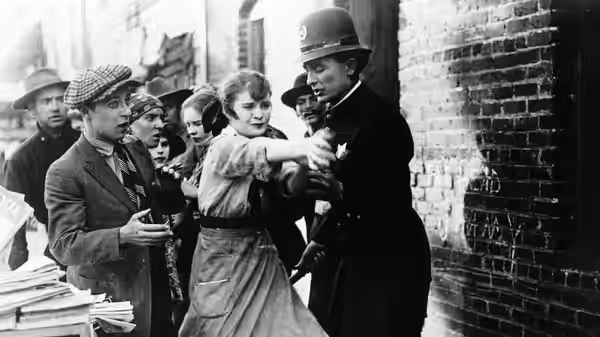
The modern story is the best thing in it, and Mae Marsh is the reason. As the Dear One she is a mill girl who practises walking like the fashionable women she sees in the street, then gives it up when her father (Frederick A. Turner) catches her at it. Marsh acts small in a film where everyone else acts large, and the difference shows. Robert Harron’s Boy is a decent lad who takes the only work the city offers him, and Vera Lewis’s Mary T. Jenkins leads a committee of reformers who go about improving the poor by taking their children. Griffith plainly loathes these women, and his contempt makes the scenes sharper than his pity does elsewhere.

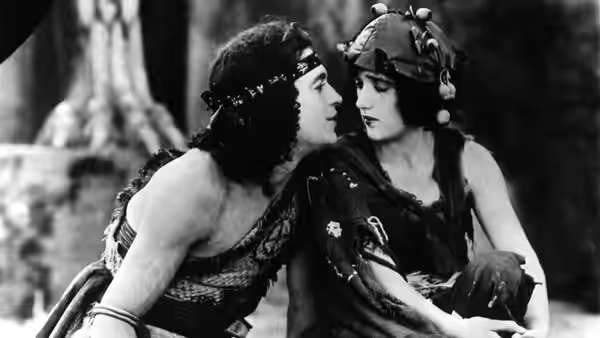
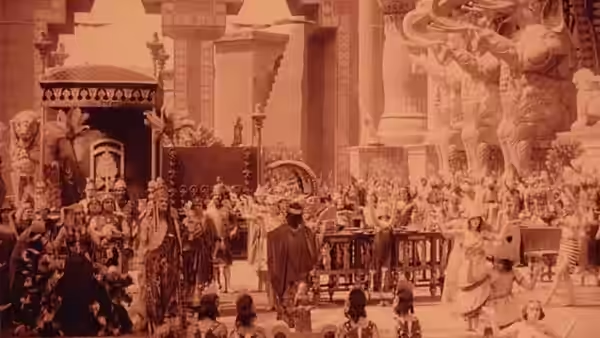
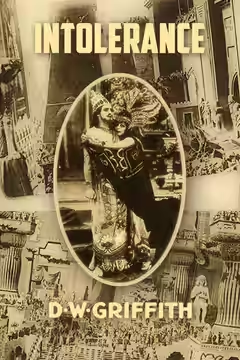
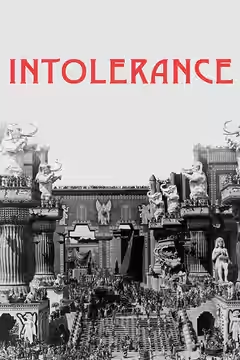
Babylon is the part everyone remembers, and rightly. Griffith is credited as his own production designer, and he built the court at full scale, with elephants standing on the columns and steps wide enough for a parade. Billy Bitzer photographs it from far above and moves down and in towards the dancers, and we sat up in our seats, because a hundred years later it is still not obvious how he did it. The siege that follows has towers rolled against the walls and defenders pouring fire from the top, and it is real people on real walls, not a painting. Clare West’s costumes put the Persians in scale armour and the Babylonian court in feathers and gold thread, so at a glance you know which side of the wall you are on.

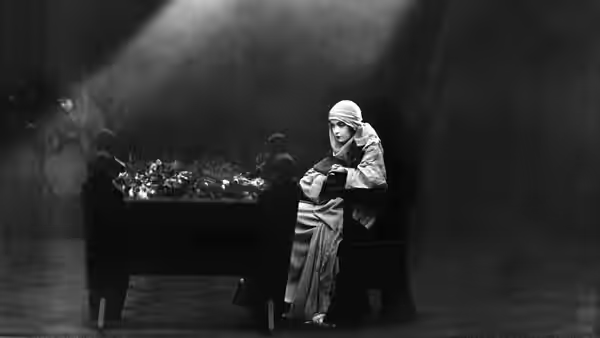
The Judean story is a handful of tableaux: the wedding at Cana, with Bessie Love as the bride, the woman taken in adultery, Erich von Ritzau’s Pharisee praying in the street so he can be seen doing it. It is punctuation, not a story. The French strand is thinner still. Margery Wilson’s Brown Eyes and Eugene Pallette’s Prosper Latour get a courtship and a massacre, and between them sit long scenes of court intrigue that we were honestly bored by, and then irritated by, because we could feel the film losing the time it needed elsewhere.

Then there are the titles. Frank E. Woods and Anita Loos are the credited writers, and the intertitles do not trust us for a moment. The word intolerance turns up every few minutes, sometimes with a footnote. A film that spends this much money showing us a wall should not need to tell us what the wall means.

What holds it together is the cutting. Griffith edited it with James Smith and Rose Smith, and as the film goes on the shots shorten and the four stories start to alternate faster, until the last half hour has all four running against a clock at once. We will not say how any of them resolves. What we can say is that the rhythm still works on the pulse. We were aware of our own breathing in the final reels, in a film made before our grandparents were born.

It was made by a man answering critics of the most poisonous film in American cinema, and its argument for tolerance is entirely sincere and entirely unexamined. We do not think that spoils it. It makes it stranger, and worth arguing with.

Give it an evening rather than a slot. At home you can stop it, and we would not blame anyone who did in Paris and started again in Babylon. It is a PG, and there is nothing in it a child cannot watch, only a great deal a child will not sit through.

Critical consensus AI synthesised

83
Positive
5
Mixed
0
Negative
0
Slant Magazine
30 November 2013 · ★★★★½ · Bill Weber
90

The review celebrates Griffith’s film as a masterpiece whose influence and social critique remain striking. It especially praises the restoration’s exceptionally clear imagery and the orchestral score that complements the epic.

Read the full review →
The Guardian
21 December 2014 · Philip French
90*

French calls the film a powerful, humane statement and a towering work of art. He singles out the contemporary story as the most compelling and the Babylonian tale as breathtakingly spectacular.

Read the full review →
Empire
6 April 2006 · David Parkinson
85*

Parkinson regards the film as flawed but monumental and essential viewing. He singles out Griffith’s ambitious parallel structure and lavish recreation of Babylon for praise.

Read the full review →
Time Out
· CA
78*

The page presents Griffith’s film as immensely influential. It singles out the intercutting of four historical tales, but the review text is unavailable.

Read the full review →
Variety
1 January 1916 · Variety Staff, Derek Ramsay
70*

The review is positive about Griffith’s achievement, though it says the four-story structure works only more or less successfully. It singles out the Babylonian battle scenes and feasts as visually stupendous.

Read the full review →

Straight answers AI written, from our review

Is Intolerance: Love's Struggle Throughout the Ages worth watching?
Intolerance: Love's Struggle Throughout the Ages is worth an evening for anyone with the patience for 197 minutes of silent cinema, and we scored it 83. The modern story, acted small and well by Mae Marsh, and the full-scale Babylon would justify it alone. The Judean and French strands are thin, and the intertitles preach without pause.
How long is Intolerance: Love's Struggle Throughout the Ages, and what is it rated?
Intolerance: Love's Struggle Throughout the Ages runs 3h 17m. It is a drama and history film.
Where can I watch Intolerance: Love's Struggle Throughout the Ages in the Netherlands?
Intolerance: Love's Struggle Throughout the Ages is not on any streaming or rental service in the Netherlands at the moment. It is available in 2 other countries; change your country at the top of the page to see where. Availability is checked daily.
How does Intolerance: Love's Struggle Throughout the Ages compare to Metropolis?
Intolerance: Love's Struggle Throughout the Ages and Metropolis are both cities built at reckless scale, but Griffith's is a real Babylon of elephants and walls while Lang's is a future one, with the better villain. Intolerance is the more uneven, carrying two dead strands and a sermon; Metropolis is tighter but its cure for class conflict is much too easy.
What should I watch after Intolerance: Love's Struggle Throughout the Ages?
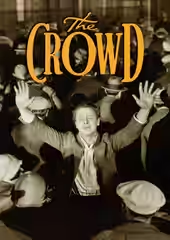
After Intolerance: Love's Struggle Throughout the Ages, try Metropolis (1927, Fi1m 87): Lang’s city of the future built at the same reckless scale, with a better villain. Then The Crowd (1928, Fi1m 90): Vidor’s story of an ordinary couple in the city, done without any sermon at all.

Cast

If you liked this, try…

  1. Cabiria (1914) · not on Fi1m yetThe Italian spectacle Griffith was answering; ancient Carthage, a giant slave, and a moving camera.

  2. Metropolis (1927, Fi1m 87)Lang’s city of the future built at the same reckless scale, with a better villain.

  3. The Crowd (1928, Fi1m 90)Vidor’s story of an ordinary couple in the city, done without any sermon at all.

  4. Andrei Rublev (1966) · not on Fi1m yetTarkovsky’s medieval Russia: faith, cruelty and a bell cast by people who do not know how.

  5. Cloud Atlas (2012) · not on Fi1m yetSix stories across centuries cut into one another, the Griffith idea a hundred years on.