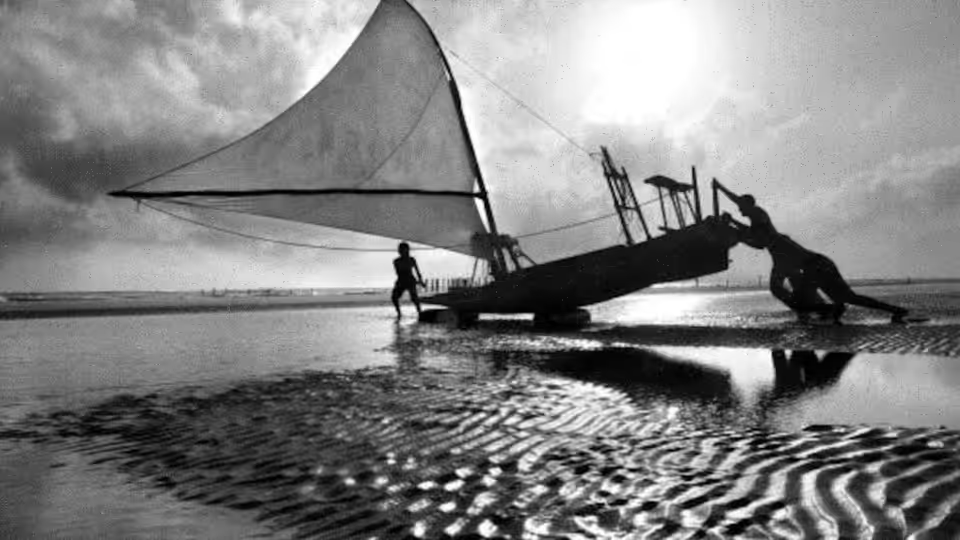
A documentary about Orson Welles’ abandoned Brazilian film, half talking heads and half the film itself. The heads are useful; the fifty-year-old footage of fishermen on a raft is the reason to watch, and it is remarkable.
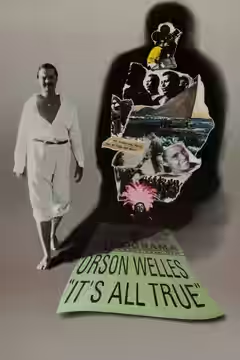
In 1942 Orson Welles, a year past Citizen Kane, flew to Brazil at his studio’s urging and with the American government’s blessing, to film the Rio Carnival as part of Washington’s wartime courtship of South America. He came home months later without a finished film and, shortly afterwards, without a studio. The footage went into a vault and stayed there, most of it presumed gone, for decades. It’s All True is two films about what happened: a documentary, narrated by Miguel Ferrer, that lays out the story, and a reconstruction of one segment, Four Men on a Raft, from the reels that turned up. The first is useful. The second is the reason to watch.
The documentary half is the work of Myron Meisel, Bill Krohn and Richard Wilson, who wrote it between them; Wilson had been on the original shoot, which gives the account some authority. Gary Graver films the interviewees the way documentaries of the period did, seated, lit evenly, looking a little past the lens. Nobody is meant to look at the framing, and nobody will. What the talkers say is worth the time: how Welles left Los Angeles with The Magnificent Ambersons not yet finished and returned to find it cut without him; how the studio’s management changed while he was away; how the Carnival material, with Grande Otelo grinning through the middle of it, unsettled executives who had wanted a travelogue. There are glimpses of Norman Foster’s Mexican segment, My Friend Bonito, a boy and a bull, and archive clips of Carmen Miranda, Hollywood’s idea of Brazil at the time.
It is a story of bad luck and bad faith, and Ed Marx cuts it briskly enough that the 89 minutes do not sag. What it lacks is a point of view. Krohn, Meisel and Wilson are so careful to be fair to everyone that the film never quite says what it thinks happened, and the studio men who put the reels away are barely named. We wanted someone to be angry, and nobody is.
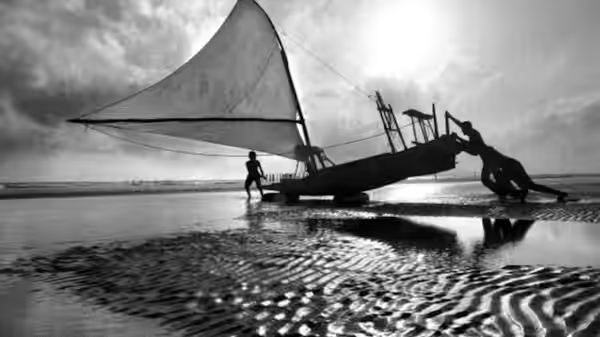
Then the interviews stop and the 1942 footage begins, and the film changes character entirely. Four Men on a Raft follows the jangadeiros of Fortaleza, four fishermen led by Manuel “Jacaré” Olimpio Meira, who sailed a log raft down the Brazilian coast to Rio de Janeiro to put their grievances to the president. Welles staged their story with the men themselves, in their own village, and George Fanto shot it in black and white, silent, from low on the sand so that the men and their sails stand against enormous skies. Nobody in it is an actor. There is a wedding, a funeral procession down the dunes, women waiting in the surf, and long passages of nothing but the raft and the sea.
We were moved more than we had expected, and it was Jacaré’s face that did it. He squints into the sun with the patience of a man who has been asked to do the same thing four times, and the documentary has already told us, before a frame of this footage is shown, what became of him. Knowing that, every shot of him at the tiller lands differently, and we found we could not watch the sequence as a film-history curiosity, whether or not anyone intended us to.
Two reservations, both fair. The reconstruction has been assembled with evident respect, and respect is not what Welles was known for; his cutting was quick and his narration was half the point, and neither is here. What we get is even-paced and handsome and a little too calm. Jorge Arriagada’s score, written for this release, fills the silence where Welles’ voice would have been, and it fills it too fully; the images would have carried more with less under them.
Set against the legend, this is a modest film. It does not claim to be the picture Welles would have made, only to show what he shot and why nobody saw it, and on those terms it keeps its word. Watch the first half with patience and the second with the lights off, and do not skip ahead, because the fishermen mean more once you know what it cost to put them on a raft.