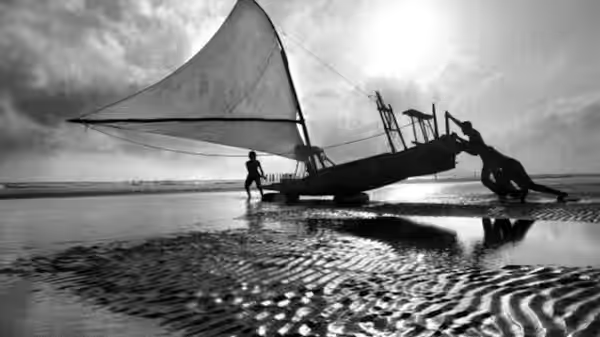
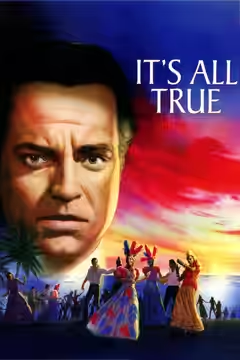
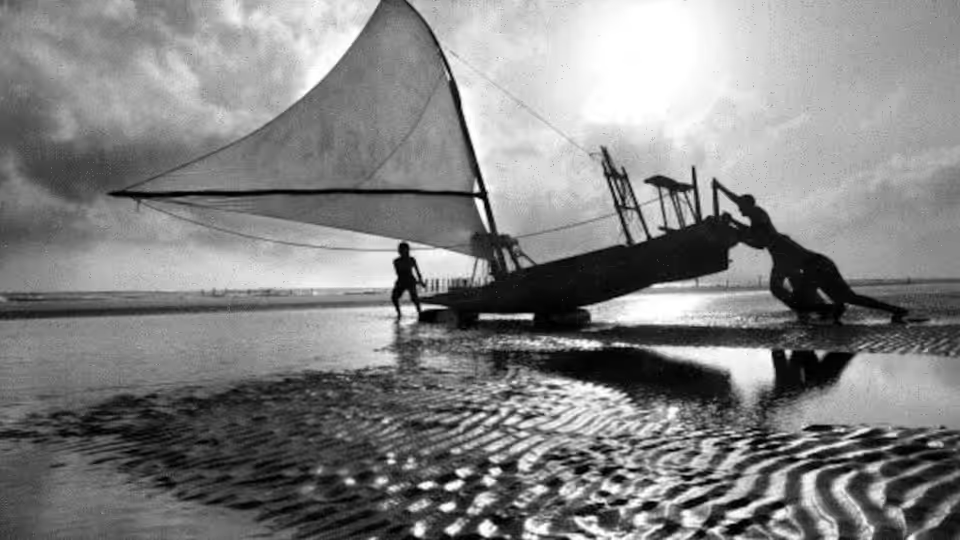
two men with a sailboat on wet sand at the water's edge
Film review

It's All True

1993 · Directed by Bill Krohn, Myron Meisel, Richard Wilson, Orson Welles, Norman Foster · 1h 29m

In a sentenceForty-odd minutes of people explaining what Hollywood lost, then the thing itself, and it is better than they said

In 1942 Orson Welles leaves Hollywood for Rio de Janeiro to film Carnival for a three-part picture called It’s All True. Narrated by Miguel Ferrer, this documentary sets out what happened: samba sequences with Grande Otelo, clips of Carmen Miranda, a studio nervous at the cost, and Welles’ decision to follow four fishermen from Fortaleza, Manuel “Jacaré” Olimpio Meira, Jeronimo André De Souza, Raimundo ‘Tata’ Correia Lima and Manuel ‘Preto’ Pereira Da Silva, who sailed a log raft down the coast to petition their president. Surviving collaborators describe how the production collapsed and the reels vanished. The second half presents the rediscovered footage of that segment, Four Men on a Raft.

Fi1m review

A documentary about Orson Welles’ abandoned Brazilian film, half talking heads and half the film itself. The heads are useful; the fifty-year-old footage of fishermen on a raft is the reason to watch, and it is remarkable.

In 1942 Orson Welles, a year past Citizen Kane, flew to Brazil at his studio’s urging and with the American government’s blessing, to film the Rio Carnival as part of Washington’s wartime courtship of South America. He came home months later without a finished film and, shortly afterwards, without a studio. The footage went into a vault and stayed there, most of it presumed gone, for decades. It’s All True is two films about what happened: a documentary, narrated by Miguel Ferrer, that lays out the story, and a reconstruction of one segment, Four Men on a Raft, from the reels that turned up. The first is useful. The second is the reason to watch.

The documentary half is the work of Myron Meisel, Bill Krohn and Richard Wilson, who wrote it between them; Wilson had been on the original shoot, which gives the account some authority. Gary Graver films the interviewees the way documentaries of the period did, seated, lit evenly, looking a little past the lens. Nobody is meant to look at the framing, and nobody will. What the talkers say is worth the time: how Welles left Los Angeles with The Magnificent Ambersons not yet finished and returned to find it cut without him; how the studio’s management changed while he was away; how the Carnival material, with Grande Otelo grinning through the middle of it, unsettled executives who had wanted a travelogue. There are glimpses of Norman Foster’s Mexican segment, My Friend Bonito, a boy and a bull, and archive clips of Carmen Miranda, Hollywood’s idea of Brazil at the time.

It is a story of bad luck and bad faith, and Ed Marx cuts it briskly enough that the 89 minutes do not sag. What it lacks is a point of view. Krohn, Meisel and Wilson are so careful to be fair to everyone that the film never quite says what it thinks happened, and the studio men who put the reels away are barely named. We wanted someone to be angry, and nobody is.

Then the interviews stop and the 1942 footage begins, and the film changes character entirely. Four Men on a Raft follows the jangadeiros of Fortaleza, four fishermen led by Manuel “Jacaré” Olimpio Meira, who sailed a log raft down the Brazilian coast to Rio de Janeiro to put their grievances to the president. Welles staged their story with the men themselves, in their own village, and George Fanto shot it in black and white, silent, from low on the sand so that the men and their sails stand against enormous skies. Nobody in it is an actor. There is a wedding, a funeral procession down the dunes, women waiting in the surf, and long passages of nothing but the raft and the sea.

We were moved more than we had expected, and it was Jacaré’s face that did it. He squints into the sun with the patience of a man who has been asked to do the same thing four times, and the documentary has already told us, before a frame of this footage is shown, what became of him. Knowing that, every shot of him at the tiller lands differently, and we found we could not watch the sequence as a film-history curiosity, whether or not anyone intended us to.

Two reservations, both fair. The reconstruction has been assembled with evident respect, and respect is not what Welles was known for; his cutting was quick and his narration was half the point, and neither is here. What we get is even-paced and handsome and a little too calm. Jorge Arriagada’s score, written for this release, fills the silence where Welles’ voice would have been, and it fills it too fully; the images would have carried more with less under them.

Set against the legend, this is a modest film. It does not claim to be the picture Welles would have made, only to show what he shot and why nobody saw it, and on those terms it keeps its word. Watch the first half with patience and the second with the lights off, and do not skip ahead, because the fishermen mean more once you know what it cost to put them on a raft.
Critical consensus AI synthesised

82
Positive
7
Mixed
0
Negative
0

The reviews are uniformly favourable. Most critics treat the documentary as an act of restoration first and a film second, and praise it on those terms: surviving footage from Welles’s abandoned 1942 Brazilian project, set inside interviews and the story of how the trip went wrong. The praise clusters on one sequence, the near-complete “Four Men on a Raft”, which several critics single out as the reason to see it, and on what the material reveals about how Welles’s style was changing.

The spread is narrow and no review is negative. The reservations concern the frame rather than the footage. The New Yorker finds the mix of travelogue, fable and documentary an odd one, with Welles himself barely on screen. The Independent, the coolest of the seven, admires the fishermen’s footage but argues the assembled version lacks Welles’s rapid cutting and narration and is tamer than it might have been, saving its anger for the studios that sat on the material so long.

Slant Magazine
5 December 2004
88*

The documentary is an essential piece in the Orson Welles puzzle that clears away conjecture about his Brazil project and presents newly discovered footage of one segment. The 45-minute 'Four Men on a Raft' fragment is singled out as stunning.

Read the full review →
Los Angeles Times
24 October 1993
85*

The documentary investigates the origins of Welles' unfinished project and reconstructs key segments from rediscovered footage. It shows how much valuable material resulted from the ill-fated trip and clarifies its impact on his career.

Read the full review →
RogerEbert.com
27 October 1993 · Roger Ebert
85*

The documentary reconstructs surviving footage from Orson Welles' unfinished 1942 Latin American project and adds interviews. Ebert praises the impressive raft sequence and its insight into Welles' style and career setbacks.

Read the full review →
Variety
18 October 1993 · Todd McCarthy
85*

The lovingly assembled documentary presents surviving Welles footage within the story of the 1942 misadventure, highlighted by the virtually intact 'Four Men on a Raft' sequence. It is a film buff's delight offering crucial insight into Welles' evolving style.

Read the full review →
The New York Times
15 October 1993 · festival review
84*

The film reconstructs the story of Welles' aborted 1942 project using surviving footage and interviews. It is called a long, seductive footnote to a cinema legend and a must-see at the festival.

Read the full review →
The New Yorker
25 October 1993 · Anthony Lane
80*

The hybrid of unearthed Welles footage and documentary material creates a peculiar mix of travelogue, treachery, fable and dance. The spirit of Welles hovers over the enterprise despite his limited onscreen presence.

Read the full review →

Straight answers AI written, from our review

Is It's All True worth watching?
It's All True is worth watching for anyone interested in Orson Welles or in what Hollywood buried, and we scored it 78. The first half is a fair, careful documentary that never quite says what it thinks; the second half, the rediscovered 1942 footage of four fishermen on a raft, is the reason to sit through it, and it moved us more than we expected.
How long is It's All True, and what is it rated?
It's All True runs 1h 29m. It is a documentary film.
Where can I watch It's All True in Türkiye?
It's All True is not on any streaming or rental service in Türkiye at the moment. It is available in 3 other countries; change your country at the top of the page to see where. Availability is checked daily.

Cast

If you liked this, try…

  1. Que Viva México! (1979) · not on Fi1m yetEisenstein’s abandoned Mexican footage, assembled decades later by a colleague; the same ache, a different genius.

  2. Man of Aran (1934) · not on Fi1m yetFlaherty’s islanders fishing from rocks in a gale; staged, silent-ish and no less true for it.

  3. The Other Side of the Wind (2018) · not on Fi1m yetWelles’ other unfinished film, finished; noisier, angrier and a useful companion to this one.

  4. Lost in La Mancha (2002) · not on Fi1m yetTerry Gilliam’s Quixote collapses on camera; the definitive record of a production going under.

  5. Black Orpheus (1959) · not on Fi1m yetCarnival in Rio as a studio would never have dared shoot it in 1942, in colour.

It’s All True (1993) review: the fishermen were worth the wait (Türkiye) | Fi1m