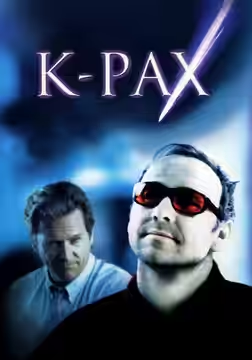
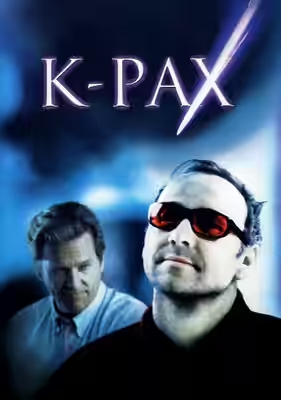
Prot (Kevin Spacey) stands in sunglasses in a crowded railway station
Film review

K-PAX

2001 · Directed by Iain Softley · 2h 00m

In a sentenceJeff Bridges listens so carefully that we almost forget how little the mystery has to tell him

Prot (Kevin Spacey) presents Dr. Mark Powell (Jeff Bridges) with a problem: his account of his origins invites an extraterrestrial explanation where the doctor expects a medical one. Powell wants to establish who Prot is and what help he needs, but their encounters keep competing explanations in play. Listening to his patient becomes a test of how much the doctor is prepared to entertain without proof. Alongside that inquiry is Powell’s home life, involving Rachel Powell (Mary McCormack). As the two men try to understand each other, Powell must decide how to respond to an account he cannot readily accept.

Fi1m review

K-PAX has a persuasive listener in Jeff Bridges and an intriguing problem in Prot. The performances and careful direction hold our attention longer than a thin, sentimental mystery deserves.

K-PAX is an engaging idea given a patient hearing and a disappointing script. Director Iain Softley wants to make a science-fiction mystery in which taking another person seriously matters as much as establishing what is true. That is a worthwhile aim, and the film has enough curiosity and kindness to get us interested. The problem is that it grows sentimental just when its questions need to become more difficult.

Dr. Mark Powell (Jeff Bridges) is the reason to stay with it. Faced with Prot (Kevin Spacey) and the uncertainty surrounding his origins, he makes professional attention interesting: we can see the effort involved in hearing someone out without accepting everything they say. We were moved by his willingness to keep listening, because the performance makes that patience feel like something the doctor has to work at. His responses give their conversations an interest that survives some fairly unconvincing writing.

Kevin Spacey is less consistently persuasive. His controlled manner supplies the strangeness the part needs, but it can also make Prot seem pleased with his ability to unsettle everybody else. The performance keeps inviting us to inspect it for clues, which becomes distracting when the film asks for sympathy. There is pleasure in watching the two actors together, though the doctor is often more interesting than the man he is trying to understand.

John Mathieson’s cinematography gives the mystery useful assistance through his handling of light, making us receptive to possibilities that the dialogue struggles to sell. Iain Softley’s compositions encourage us to look closely, and his restraint suits the encounters between the two men. John Beard’s production design supports that approach without competing with the actors for attention. There is care in the surroundings, although the people outside the central pairing could have used more of it.

Charles Leavitt’s screenplay, adapted from Gene Brewer’s novel, is particularly weak on the doctor’s life away from Prot. Rachel Powell (Mary McCormack) belongs to a home-life subplot that ought to deepen our understanding of him but feels underdeveloped. It gives us another reason to consider his humanity without doing enough to make her interesting in her own right. More troublesome is the treatment of mental illness, which too often seems to exist to help other people arrive at reassuring thoughts.

Craig McKay’s editing preserves the unhurried pace, but at 120 minutes the repeated uncertainty begins to feel like delay. Edward Shearmur’s music adds to the film’s gentleness; we would have welcomed less encouragement to find the material touching. A mystery can leave questions open and still satisfy us, provided the people asking them become more interesting as it proceeds. Here the competing possibilities keep receiving attention while the drama runs short of fresh reasons for us to care.

There is enough in the two leading performances to explain why this will work for some viewers, and the direction rarely bullies us. As reflective science fiction, though, it asks for more credit for raising questions than its thin supporting drama has earned. Approach it for the actors, with a tolerance for sentiment and a mystery that becomes less compelling as it goes.


Critical consensus AI synthesised

53
Positive
1
Mixed
7
Negative
4

The reviews lean towards mixed: K-PAX attracts praise for its performances and visual craft, but less confidence in its storytelling. Kevin Spacey and Jeff Bridges provide the central appeal for several critics, who find their exchanges engaging even when the surrounding drama falters. Iain Softley’s restrained direction also earns approval, while Variety singles out his compositions and John Mathieson’s use of light. The mystery offers an intriguing starting point for much of the discussion.

The main reservation is that the film struggles to sustain that intrigue, with complaints about derivative plotting, an underwritten home-life subplot and an unsatisfying conclusion. The spread is wide, particularly over its ambiguity and Spacey’s performance. Eye for Film finds the uncertainty thoughtful and rewarding, praising both leads; Slant Magazine rejects the film’s sentimentality about mental illness and finds Spacey especially poor. Between those poles, most critics see worthwhile elements without finding the whole convincing.

Los Angeles Times
26 October 2001 · Kenneth Turan
65*

Turan finds the film an honorable, engaging entertainment whose story ultimately tries too hard to preserve both sides of its mystery. He praises the performances of Kevin Spacey and Jeff Bridges, while criticizing the conclusion as too glib and pat.

Read the full review →
Screen Daily
25 October 2001 · Emanuel Levy
64*

The available page identifies this as a review, but the critic’s verdict is not visible. No specific praise or complaint can be determined from the accessible text.

Read the full review →
The New York Times
26 October 2001
64*

The URL identifies this as a film review, but the article text is inaccessible. Its verdict and any specific praise or complaint cannot be verified.

Read the full review →
Time Out
· GA
64*

The page identifies this as a review, but its text is unavailable. No verdict or specific praise or complaint can be established from the accessible material.

Read the full review →
RogerEbert.com
26 October 2001 · ★★½/4 · Roger Ebert
62

Ebert’s verdict is mixed, finding the film intriguing but ultimately unsatisfying. He singles out the uncertainty around Prot’s identity as an engaging idea that the story does not fully resolve.

Read the full review →
Empire
1 January 2000 · Angie Errigo
60*

Errigo finds the film charming and humane, but says its mix of genres and attempt to embrace competing explanations make it difficult to sell. She particularly praises the performances, restrained direction, and cinematography, while faulting the underwritten home-life subplot.

Read the full review →

Straight answers AI written, from our review

Is K-PAX worth watching?
K-PAX is worth considering for Jeff Bridges and patient, conversational science fiction, but we score it 56 because its sentimental mystery disappoints. We find Bridges’s attentive doctor more compelling than the questions surrounding his patient; the careful direction helps, though the thin supporting drama makes two hours feel long.
How long is K-PAX, and what is it rated?
K-PAX runs 2h 00m. It is a science fiction and drama film.
Where can I watch K-PAX in Thailand?
K-PAX is not on any streaming or rental service in Thailand at the moment. It is available in 20 other countries; change your country at the top of the page to see where. Availability is checked daily.
How violent or frightening is K-PAX, and is it suitable for children?
K-PAX carries a UK 12 certificate, so it is not a choice for younger children; that rating alone does not establish how violent or frightening it is. Its focus on mental illness and uncertain identity makes it a more natural fit for teenagers interested in reflective drama, though we find its treatment of illness too reassuring.
How does K-PAX compare to Solaris?
K-PAX is the gentler, more reassuring choice, but we recommend Solaris as the more rewarding patient science-fiction drama. Both ask for sustained attention: K-PAX relies on its central performances to sustain a thinning mystery, while Solaris gives grief and loneliness room to become uncomfortable, despite some over-explanatory philosophical conversations.
Is K-PAX based on a true story or a book?
K-PAX is adapted from Gene Brewer’s novel, rather than presented as a true story, with a screenplay by Charles Leavitt. No familiarity with the book is needed to follow the central question of how a doctor should respond to his patient’s extraordinary account, though we find the film’s handling of that question increasingly sentimental.
What should I watch after K-PAX?
After K-PAX, try Starman (1984, Fi1m 77): Another mysterious visitor, with more warmth and less fuss about proving his origins. Then Solaris (1972, Fi1m 87): Patient science fiction that gives its questions about grief room to become uncomfortable; and Take Shelter (2011, Fi1m 83): An unsettling account of private conviction, with a family bearing the strain.

Cast

Awards

NAACP Image Award for Outstanding Actress in a Motion Picture, 2002

Nominated
NAACP Image Award for Outstanding Actress in a Motion Picture

Saturn Awards, 2002

Nominated
Best Actor

Golden Schmoes for Best Sci-Fi Movie of the Year, 2001

Nominated
Golden Schmoes for Best Sci-Fi Movie of the Year

If you liked this, try…

  1. Starman (1984, Fi1m 77)Another mysterious visitor, with more warmth and less fuss about proving his origins.

  2. Man Facing Southeast (1986) · not reviewed yetA stranger in psychiatric care prompts harder questions about who needs treating.

  3. Solaris (1972, Fi1m 87)Patient science fiction that gives its questions about grief room to become uncomfortable.

  4. Take Shelter (2011, Fi1m 83)An unsettling account of private conviction, with a family bearing the strain.

  5. The Man from Earth (2007) · not reviewed yetPeople sit and discuss an impossible claim; the conversation earns its running time.

Free account

Know what to watch tonight

Two lists that know where things are streaming, collections you can share, your own score beside ours, and Discover that remembers what you have seen.

  • Want to see, sorted by what is streaming now
  • Seen, with your score out of ten
  • No adverts, ever