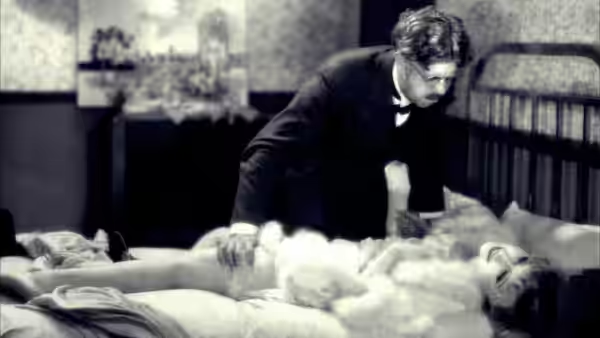
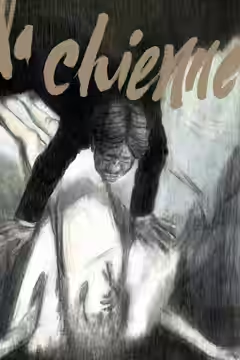
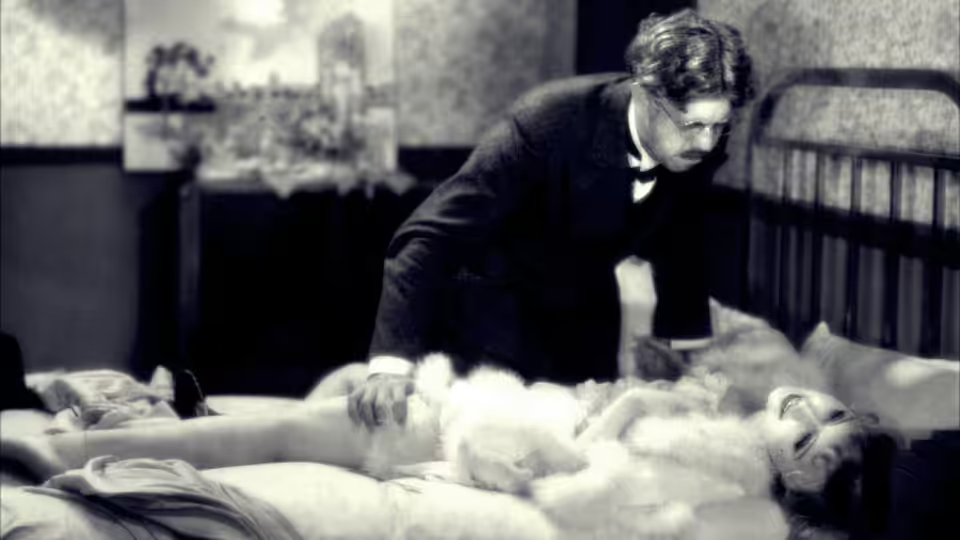
Maurice Legrand (Michel Simon) leans over a woman lying on a bed
Film review

La Chienne

1931 · Directed by Jean Renoir · 1h 36m

In a sentenceA romantic triangle with nobody we’d trust to explain their side of it

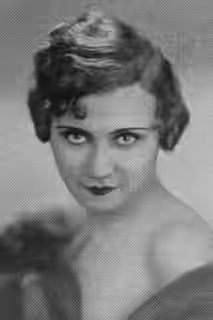
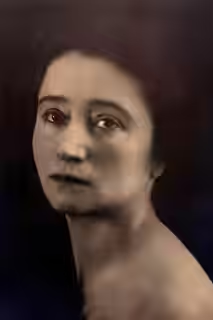
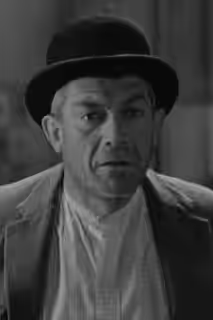
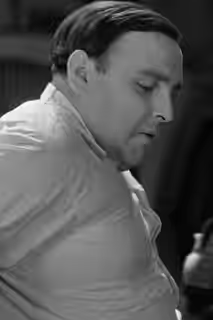
Maurice Legrand (Michel Simon) becomes part of a romantic triangle with Lucienne ‘Lulu’ Pelletier (Janie Marèse) and Andre ‘Dédé’ Govain (Georges Flamant). Their involvement with one another places romance at the centre of a crime story, with farce and social realism sharing the same ground. The other people in their story include Adèle Legrand (Magdeleine Bérubet), Monsieur Dugodet (Jean Gehret) and Wallstein (Lucien Mancini). Jean Renoir directs the film and writes its screenplay, adapting a novel by Georges de La Fouchardière.

Fi1m review

Jean Renoir makes a romantic triangle funny and uncomfortable, with Michel Simon giving the cruelty a recognisable human face. The crime story is less gripping than the people, but we recommend its patient, unsentimental company.

La Chienne is a good crime drama with an unusually patient interest in people behaving badly. Jean Renoir lets the romantic triangle generate farce without treating the people inside it as disposable fools. We recommend it with a reservation about its suspense, which sometimes struggles to compete with the pleasure of watching the actors. The film gives us time to consider these people, including time when we might prefer to dismiss them and move on.

Michel Simon’s performance as Maurice Legrand is the main reason to stay. There is so little theatrical emphasis in his playing that it becomes difficult to keep the character safely at a distance, even when the farce offers an excuse. We laughed, then felt uncomfortable about how readily we had laughed. Michel Simon makes the man seem too recognisable for us to enjoy his difficulties quite as freely as the comedy invites.

Georges Flamant contributes a similarly unforced performance as Andre ‘Dédé’ Govain. His naturalness keeps the crime material from becoming an exhibition of conspicuously disreputable behaviour, with every actor signalling what we should think. Janie Marèse completes the triangle as Lucienne ‘Lulu’ Pelletier, though we wanted a stronger sense of her apart from the two men. That imbalance limits how much the relationships can move us, and gives the central performance more work to do.

Theodor Sparkuhl’s cinematography keeps more than the central figures available to the eye. Deep focus and camera movement let us look into the surrounding space, giving the actors a world that remains interesting when they are not commanding our attention. Gabriel Scognamillo’s production design benefits from that freedom to look: the surroundings feel inhabited, worth attending to beyond their immediate usefulness to the story. This helps prevent a drama concentrated on three people from becoming airless.

The natural sound matters just as much. It helps the places on screen feel occupied, and gives the performances an everyday setting in which their restraint makes sense. Jean Renoir uses that ordinary quality to make the unpleasantness harder to shrug off; there is no reassuring distance between these people and the world we recognise. There is pleasure in attending to their surroundings, although it sometimes competes with the pressure a crime story needs.

Editors Paul Fejos, Denise Batcheff and Marguerite Renoir handle the changes between farce and social observation without much strain. The film can alter its tone without making the performances seem to belong to different works. The weakness is urgency: we can remain interested in the people while feeling little need for the next development to arrive. At 96 minutes, it still has stretches where patience becomes part of the bargain, and the humour occasionally makes the hurt easier to evade.

Within crime drama, this is a worthwhile alternative to the familiar demand that every scene tighten the plot. Jean Renoir allows sympathy to persist when the characters have done little to encourage it, and the actors justify that attention. We would have welcomed more emotional depth around the central triangle, but the film’s curiosity about people is persuasive enough to carry it. Choose it for the performances and allow the suspense to take its time.
Critical consensus AI synthesised

75
Positive
4
Mixed
2
Negative
0

The available reviews lean positive, with praise clustering around Renoir’s camerawork, sound and handling of morally compromised people. Critics admire the vivid surroundings created through deep-focus photography, mobile framing and natural sound. Several find a humane intelligence in the film’s treatment of its characters, while the combination of farce and social realism draws particular admiration. The performances also earn praise for their naturalism, especially those of Georges Flamant and Michel Simon.

The reservations concern dramatic force, thematic depth and subject matter rather than technical assurance. The AV Club finds the film less gripping than Scarlet Street and less thematically developed than Renoir’s later work. Variety admires the acting and construction but objects to the sordid material. The recorded scores range from qualified approval to strong enthusiasm, with no negative entries; however, two of the six entries lack accessible review text, limiting what can be said about their reservations.

The New Yorker
25 April 1976 · Penelope Gilliatt
90*

Gilliatt praises the film as a work where farce and social realism become one, moving from discord to harmony. She singles out Renoir’s deep-focus photography and natural sound for their evocative power.

Read the full review →
The AV Club
11 June 2016 · B+ · Noel Murray
83

Murray sees the film as an intriguing early step toward Renoir’s later masterpieces, though it lacks their thematic depth and is less gripping than Scarlet Street. He praises how Renoir combines mobile camerawork and sound to create a vivid world.

Read the full review →
Slant Magazine
14 June 2016 · ★★★★ · Chuck Bowen
80

Bowen regards the film as a brilliantly ironic, pivotal work and praises Renoir’s humane, morally ambiguous vision. He singles out the film’s vivid framing and carefully observed moments, alongside the restoration’s tactile image and improved sound.

Read the full review →
Variety
31 December 1930 · Variety Staff
70*

The review finds the film cleverly made and beautifully acted, while criticizing its sordid subject matter and content. It especially praises the natural, realistic performances of Georges Flamant and Michel Simon.

Read the full review →
The New York Times
1 May 1976 · Vincent Canby
64*

The page is blocked, so the critic’s verdict cannot be determined. The headline identifies the film’s romantic triangle as its subject.

Read the full review →
Time Out
· WH
64*

The page identifies this as a film review, but the review text is unavailable. The critic’s verdict and any specific praise or complaint cannot be determined.

Read the full review →

Straight answers AI written, from our review

Is La Chienne worth watching?
La Chienne is worth watching for its patient, unsentimental attention to people behaving badly, and we score it 80 out of 100. Michel Simon’s recognisably human performance makes the comedy uncomfortable in rewarding ways, though we recommend it more for the acting and inhabited surroundings than for the sometimes slack crime-story suspense.
How long is La Chienne, and what is it rated?
La Chienne runs 1h 36m. It is a drama and crime film.
Where can I watch La Chienne in Switzerland?
La Chienne is not on any streaming or rental service in Switzerland at the moment. It is available in 2 other countries; change your country at the top of the page to see where. Availability is checked daily.
How violent or frightening is La Chienne, and is it suitable for children?
La Chienne has no UK or US certificate supplied here, so we cannot give a reliable age recommendation for children. We find its cruelty and uncomfortable humour unsettling, but that does not establish how graphic its violence is. Its romantic triangle and patient treatment of unpleasant behaviour make it better suited to viewers interested in adult relationship drama.
How does La Chienne compare to A Simple Plan?
La Chienne offers more farce and social observation than A Simple Plan, which we find more emotionally painful in its treatment of recognisable people making bad decisions. We favour A Simple Plan for the hurt its performances bring to a familiar crime story; choose La Chienne for its uncomfortable comedy and willingness to let suspense take second place to character.
Is La Chienne based on a true story or a book?
La Chienne is adapted from a novel by Georges de La Fouchardière, with Jean Renoir writing the screenplay as well as directing. We cannot establish how faithfully it follows the book, but we recommend it on the strength of its performances and observation of human behaviour, without requiring familiarity with the source.
What should I watch after La Chienne?
After La Chienne, try Le jour se lève (1939, Fi1m 82): Romantic jealousy and ordinary working lives give the crime its weight. Then A Simple Plan (1998, Fi1m 86): Recognisable people make bad decisions, then discover how difficult stopping can be.

Cast

If you liked this, try…

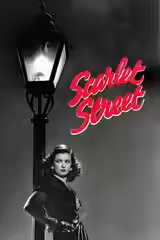
  1. Scarlet Street (1945) · not on Fi1m yetA harsher treatment of desire and self-deception, with less room for laughter.

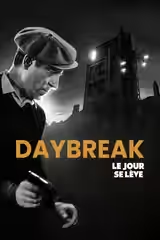
  2. Le jour se lève (1939, Fi1m 82)Romantic jealousy and ordinary working lives give the crime its weight.

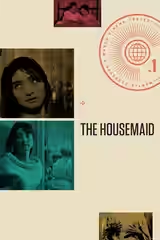
  3. The Housemaid (1960) · not on Fi1m yetDomestic resentments become frightening when desire rearranges the balance of power.

  4. The Merchant of Four Seasons (1972) · not on Fi1m yetA troubled man’s humiliations receive close attention without easy promises of comfort.

  5. A Simple Plan (1998, Fi1m 86)Recognisable people make bad decisions, then discover how difficult stopping can be.

La Chienne (1931) review: A sharp crime drama with room for pity (Switzerland) | Fi1m