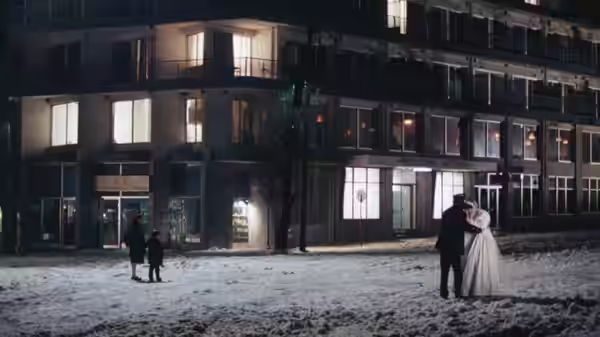
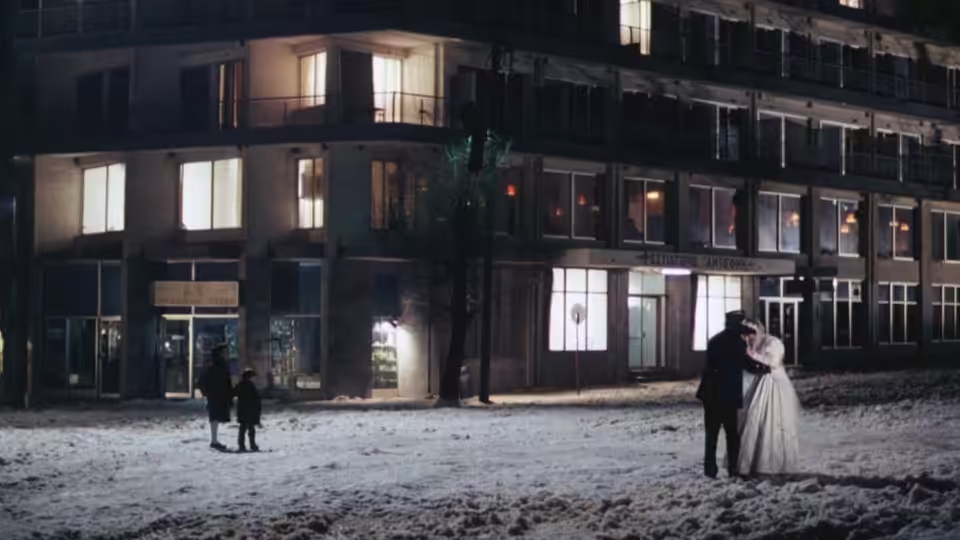
A couple embraces in a snowy street while two children stand nearby
Film review

Landscape in the Mist

1988 · Directed by Thodoros Angelopoulos · 2h 05m

In a sentenceTwo children walk across a grey Greece towards a father nobody else believes in, and the weather never lets up

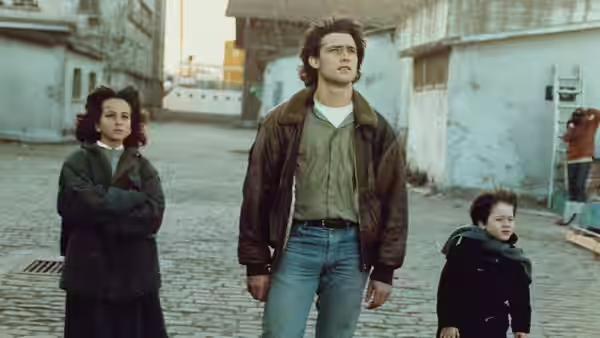
In a Greek city, Voula (Tania Paleologou), still a child but only just, and her much younger brother Alexandros (Michalis Zeke) go to the railway station every evening to watch the train for Germany leave, and every evening lose their nerve. Their mother has told them their father lives there. One night they board without tickets, are found by the conductor and handed to the police, and an uncle tells the officers there is no father in Germany at all. The children run. They walk north along wet roads and railway lines, through towns where nobody offers help, and fall in with Orestis (Stratos Tzortzoglou), a young man travelling with a troupe of ageing actors who can no longer find an audience. At night Voula tells Alexandros a story that begins with the darkness and never gets further.

Fi1m review

Angelopoulos follows two children across a wet, grey Greece towards a father who may not exist, in long takes that ask for patience and repay it. It is slow, bleak and hard on its young leads, and one scene in the snow has stayed with us for years.

Thodoros Angelopoulos sends two children, Voula (Tania Paleologou) and her small brother Alexandros (Michalis Zeke), out of a Greek city and north towards a border, looking for a father they have been told lives in Germany. That is nearly the whole plot. The script, by Angelopoulos with Thanasis Valtinos and Tonino Guerra, has little interest in whether they get there. It wants to know what Greece looks like to two children with no money, in winter, and what the adults they meet do about them. Mostly the adults do nothing. It is a good film and a hard one to sit through.

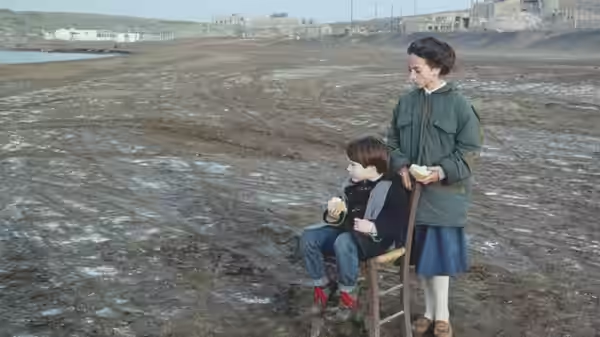
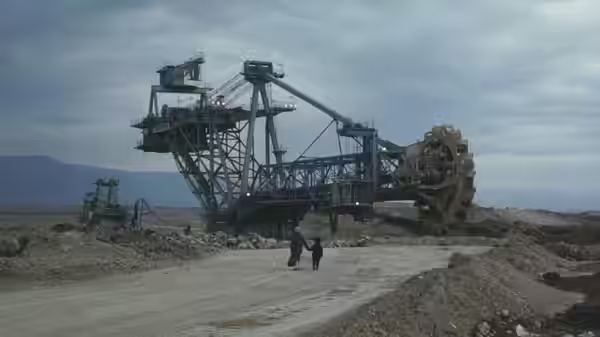
Giorgos Arvanitis shoots almost everything in one take, from a distance, in a blue-grey light that looks like the last hour before dark even at midday. Roads, railway sidings, petrol stations, a beach with nobody on it. When something happens, the camera does not go to it; it waits and lets the thing come into the frame, or not. In one town snow begins to fall and every person in the street simply stops and looks up, and Arvanitis holds on the whole street until the children are the only things moving. Yannis Tsitsopoulos cuts so rarely that when he does it registers as an event. Eleni Karaindrou’s score is a slow theme for strings and a single wind instrument, used sparingly and never to tell us what to feel; it arrives after the feeling has already happened.

Here is what it did to us. Early on, a horse is dragged behind a tractor and left in the snow to die, and Alexandros finds it. Behind him a wedding party spills out of a hall, singing, and dances off across the frame without a glance. He kneels by the horse and cries, and Zeke, who cannot be more than five or six, cries the way children actually cry, in confusion more than grief, while Paleologou stands behind him not knowing whether to comfort him or hurry him on. We were undone by it. Nothing in the film is louder than that scene and nothing needs to be.

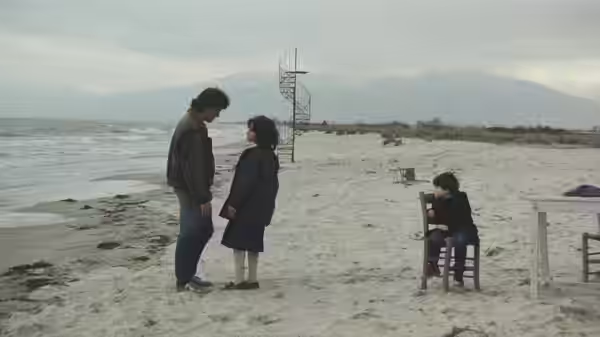
Stratos Tzortzoglou plays Orestis, the young man who gives them a lift, as the one adult who speaks to the children as if they were people, and the one with troubles of his own that he does not hand to them. Voula, on the edge of adolescence, watches him. The film lets us see it and says nothing, which is right. His troupe are the same travelling actors from Angelopoulos’s The Travelling Players (1975), older now, standing on a beach reciting lines from a play nobody will pay to see, trying to sell their costumes. This is the director quoting himself, and it is where the film starts to take itself too seriously. An actor in a seagull costume (Ilias Logothetis) crosses the sand for no reason the film cares to give.

It is gruelling, and not only by design. At 125 minutes and this pace, some stretches of waiting in stations and walking along verges go on past the point where the waiting means anything, and we found ourselves simply waiting too. The adults are so uniformly indifferent that after an hour we stopped expecting anything of them, which may be Angelopoulos’s point and is also a limit on his drama. The second half contains one act of cruelty towards a child, kept off screen, that we will not describe. The film cuts away and then moves on as the children do, and we still cannot decide whether that is wisdom or a flinch.

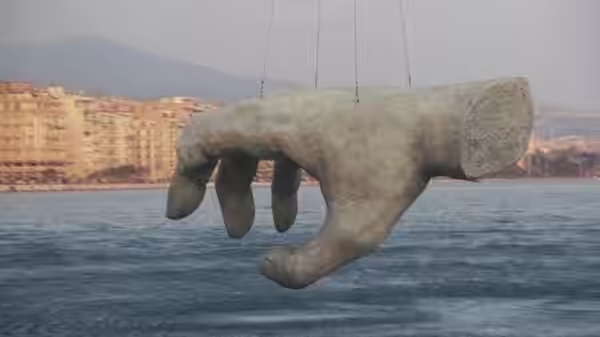
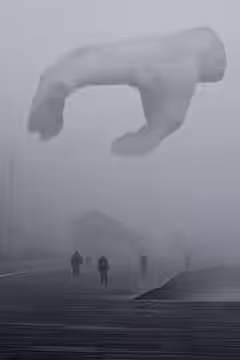
Against the director’s own work this is his most approachable film. The Travelling Players ran close to four hours and was about the history of a nation; this has two children, a road and a goal, and you can follow it without notes. There is an image in the middle, of an enormous stone hand with a finger missing being lifted out of the sea by a helicopter, that we could not explain and did not want explained. Anastasia Arseni keeps the children in the same coats from the first scene to the last, and lets them get grubbier.

It came to British cinemas on 16 June 1989. Watch it at home on a dark evening with nobody who talks, and give it all 125 minutes; it does not work in pieces. Do not put it on late. It will not let you nod off, and it will not forgive you for wanting to.
Critical consensus AI synthesised

73
Positive
2
Mixed
3
Negative
0

With only 5 reviews in so far, the lean is warm but thin. Those who admire it, at the Los Angeles Times and Slant Magazine, respond to the long, carefully composed takes that make the two children’s journey feel vast and lonely, and to how gently the camera follows their feelings; Slant thinks it more humane than Angelopoulos’s other films, for all his self-importance. Radio Times finds it gruelling, granting the moody photography but little else beyond the circus performer who befriends the children. Two further reviews cannot be read in full, so how wide the disagreement runs is not yet clear.

Los Angeles Times
31 October 1990 · MICHAEL WILMINGTON
90*

Wilmington calls the film a piercingly sad masterpiece and a work of cinematic poetry. He praises its beautifully composed imagery and choreographed long takes, which make the children’s lonely journey feel vast and unsettling.

Read the full review →
Slant Magazine
3 December 2005 · ★★★½/4 · Fernando F. Croce
88

Croce finds the film moving and more humane than Angelopoulos’s other epics, despite the director’s self-important tendencies. He especially praises the tender, respectful way the camera follows the children’s bruised emotions.

Read the full review →
The New York Times
14 September 1990 · Vincent Canby
64*

The page is inaccessible, so the critic’s verdict cannot be verified. The available text does not reveal what the review praised or criticized.

Read the full review →
Time Out
· GA
64*

The page identifies this as a review of the 1988 film. Its text is unavailable, so the critic’s verdict and any singled-out praise or complaint cannot be determined.

Read the full review →
Radio Times
★★★ · David Parkinson
60

The critic finds the film a gruelling experience. He notes its moody photography, but singles out circus performer Stratos Tzortzoglou as the only character to sympathise with the children.

Read the full review →

Straight answers AI written, from our review

Is Landscape in the Mist worth watching?
Landscape in the Mist is worth watching for anyone with the patience for long takes and a grey, wet Greece, and we scored it 83. It is slow, bleak and hard on its two young leads, and some stretches of walking and waiting go on too long. Give it the full 125 minutes on a dark evening; it does not work in pieces.
How long is Landscape in the Mist, and what is it rated?
Landscape in the Mist runs 2h 05m. It is a drama film.
Where can I watch Landscape in the Mist in Portugal?
Landscape in the Mist is not on any streaming or rental service in Portugal at the moment. It is available in 1 other country; change your country at the top of the page to see where. Availability is checked daily.
How does Landscape in the Mist compare to The Spirit of the Beehive?
Landscape in the Mist and The Spirit of the Beehive both follow children under an absent father in a country that offers them nothing, but Angelopoulos sends his two out on the road while Erice keeps his sisters at home. The Greek film is the harsher and more gruelling of the two; the Spanish one is gentler and more inward. Both ask for patience and repay it.

Cast

Awards

International Submission to the Academy Awards, 1990

Nominated
International Submission to the Academy Awards

European Film Award for Best Cinematographer, 1989

Nominated
European Film Award for Best Cinematographer

European Film Award for Best Director, 1989

Nominated
European Film Award for Best Director

European Film Award for Best Film, 1989

Won
European Film Award for Best Film

European Film Award for Best Screenwriter, 1989

Nominated
European Film Award for Best Screenwriter

If you liked this, try…

  1. Eternity and a Day (1998) · not on Fi1m yetAngelopoulos again, a dying poet and a stray boy, gentler and just as slow.

  2. Germany Year Zero (1948) · not on Fi1m yetA child alone in a ruined city, and the adults are no help there either.

  3. Where Is the Friend's House? (1987) · not on Fi1m yetKiarostami’s small boy on a small errand that becomes the whole world.

  4. The Spirit of the Beehive (1973, Fi1m 87)Two sisters, an absent father, and a Spain that will not explain itself.

  5. Nobody Knows (2004) · not on Fi1m yetKore-eda’s children left to run a Tokyo flat; patient, plain and quietly ruinous.

Landscape in the Mist (1988) review: bleak, slow and worth the patienc (Portugal) | Fi1m