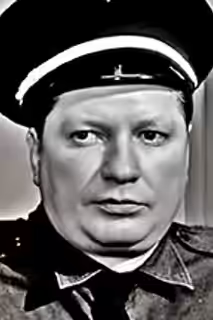
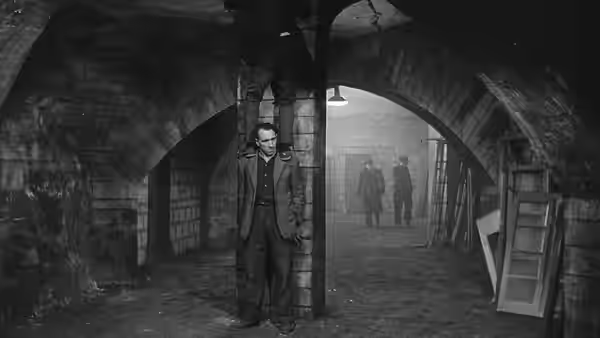
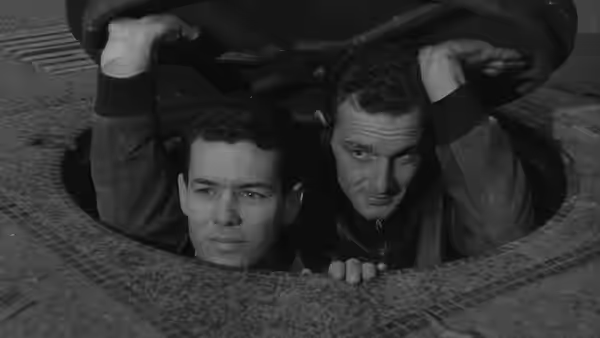
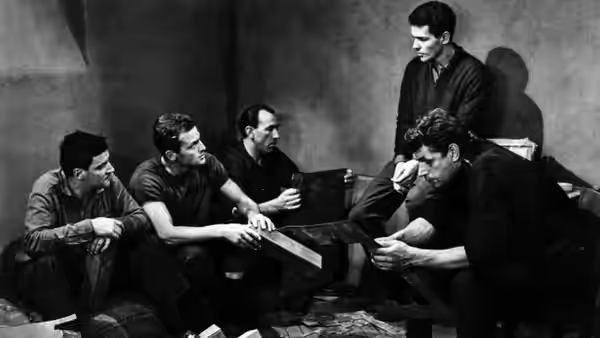
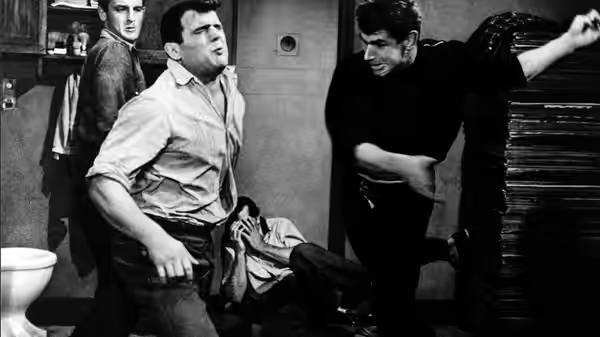
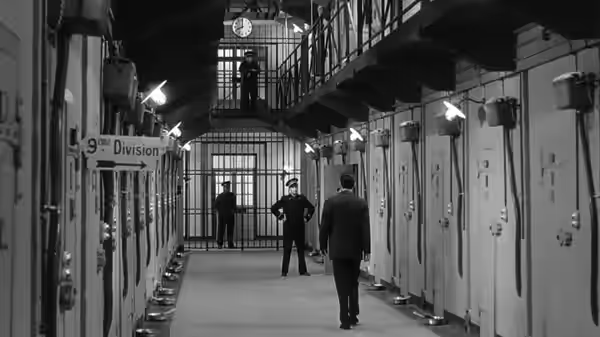
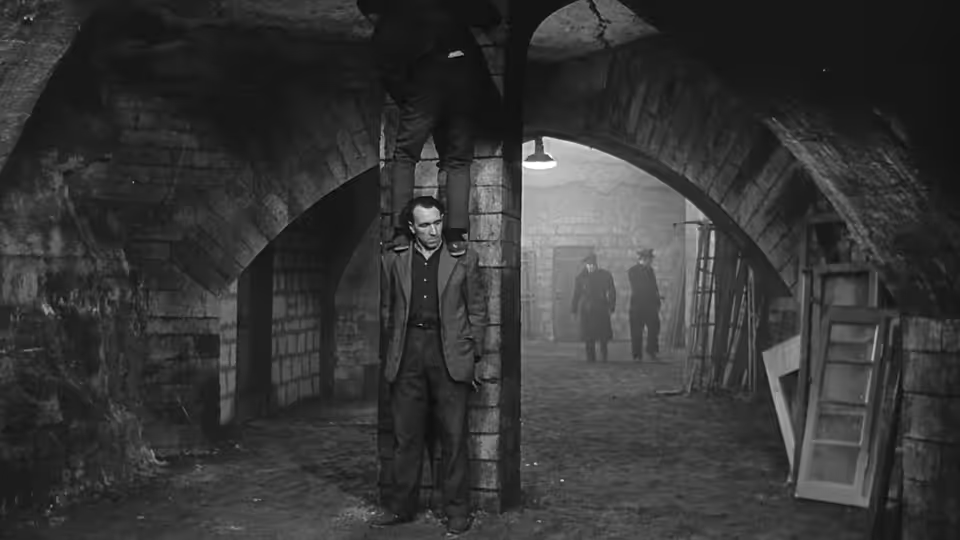
A man stands beneath stone arches in a prison cellar as two figures approach
Film review

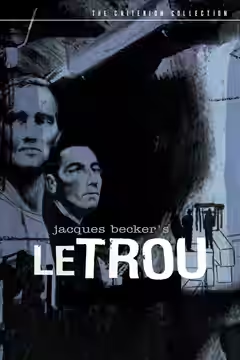
Le Trou

1960 · Directed by Jacques Becker · 2h 12m

In a sentenceWe became unreasonably invested in the progress of a hole

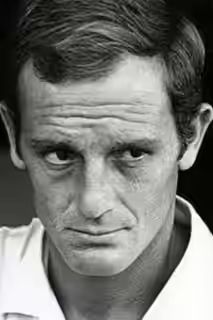
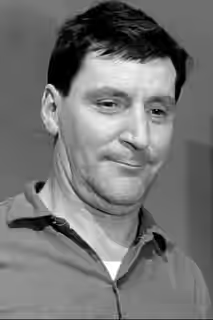
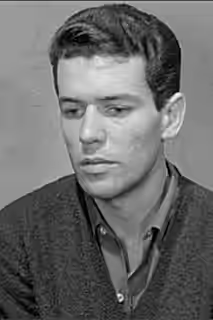
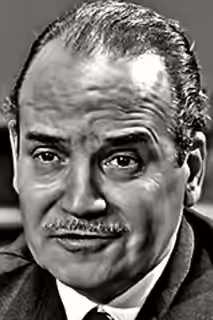
Claude Gaspard (Marc Michel), Geo Cassine (Michel Constantin) and Roland Darban (Jean Keraudy) are prisoners planning an escape, alongside Manu Borelli (Philippe Leroy). Their route out depends on digging, and the men have to carry out the work themselves. As they confront the physical difficulty of getting through the prison, their attention turns to the details of the job and the effort it requires. The attempt binds them to a common task, with freedom dependent on what they can accomplish together.

Plays from YouTube when you press play; nothing loads from them until then.

Fi1m review

Jacques Becker makes the labour of a prison escape gripping enough to justify almost every minute. Le Trou asks for patience, occasionally too much, but its physical detail and convincing ensemble repay the effort.

We recommend Le Trou warmly, with one reservation: its patience occasionally outlasts ours. Jacques Becker makes a prison escape depend on sustained physical work, and spends 132 minutes giving that work the attention a brisker thriller might deny it. The digging is allowed to be difficult, repetitive and tiring before it becomes exciting. That is a considerable risk for a thriller, but the men doing it give us good reason to stay.

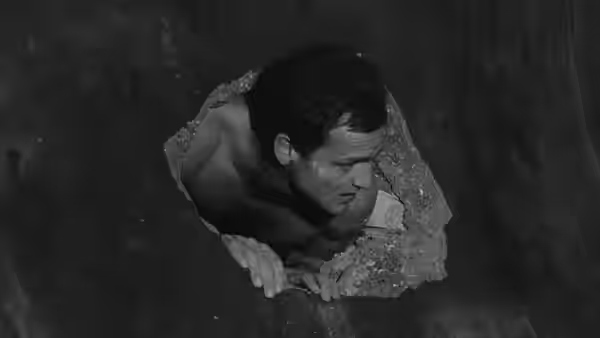
We grew tense watching the digging, because every small advance seemed to cost so much effort. The detail makes it difficult to take any progress for granted. We stopped waiting for the film to get past the practicalities and became absorbed in them. Once that happens, even a modest gain can provide more satisfaction than an elaborate escape stunt, because we understand what it has taken to achieve it.

Ghislain Cloquet’s cinematography makes the physical process readable, an essential courtesy in a film so concerned with how things are done. The digging has weight because we can follow the work and appreciate its difficulty. Rino Mondellini’s production design likewise earns its place through the tangible resistance of the surroundings. The prison is convincing as a place that will be difficult to get out of, and the detailed attention to the escape keeps us conscious of that difficulty.

Editors Marguerite Renoir and Geneviève Vaury allow the labour to occupy stretches that another film might shorten considerably. This gives small advances a value they would lose in a brisk sequence of highlights. Philippe Arthuys is credited for music, but natural sound does the important work here. Listening to the digging makes the effort harder to dismiss and the confinement more oppressive. A more insistent musical accompaniment would tell us something the physical action has already made clear.

Jean Keraudy, playing Roland Darban, has the convincing presence this approach needs: we watch someone engaged in a difficult job without being distracted by the performance. Michel Constantin’s Geo Cassine and Philippe Leroy’s Manu Borelli help establish the same collective seriousness. The ensemble never feels like a collection of actors waiting for their next substantial speech. That restraint gives the labour more force, while allowing the men to hold our interest as people rather than simply as participants in an escape.

The cost is some repetition, and we would not pretend every stretch has an equal grip. Once the film has taught us to appreciate the labour, it occasionally continues the lesson longer than necessary. A little compression would preserve the sense of exhaustion without making us quite so conscious of the running time. This is a limited complaint, but it matters in a film whose success depends so heavily on keeping us attentive to small developments.

Within the prison-break thriller, this is a persuasive case for slowing down and letting a group of people work. Its patient observation gives the escape a physical credibility that remains exciting without needing constant new complications. There is enough empathy in the performances to keep the practical detail from becoming merely instructional. Set aside an uninterrupted evening, and do not mistake the quiet for an invitation to talk.

Critical consensus AI synthesised

74
Positive
4
Mixed
3
Negative
0

Most critics respond favourably to Le Trou, with praise clustering around the detailed escape work, convincing performances and steadily mounting tension. The reviews repeatedly stress how much the suspense depends on watching physical labour: digging feels slow, difficult and exhausting, and the patient storytelling builds dread. Several also find warmth and empathy in the prisoners’ relationships. Sight and Sound singles out the natural sound and absence of a musical score as particular strengths.

The clearest reservation comes from The New Yorker, which admires the precise craftsmanship and empathy but argues that silence about the criminal past of the film’s source compromises its perspective. This is a disagreement about what the film leaves unexamined, rather than how effectively it stages the escape. The supplied ratings range from enthusiastic to mixed, with none negative, though two incomplete review texts limit what can be said about the less favourable responses.

Los Angeles Times
31 August 2017 · Kenneth Turan
90*

Turan regards the restored film as a standout among prison-break movies, with steadily escalating tension. He especially praises its authenticity, detailed craft and convincing performances.

Read the full review →
Sight and Sound
85*

The page presents Becker’s film as a gripping and emotionally affecting final work. It singles out the austere use of natural sound, with no music score.

Read the full review →
Variety
31 December 1959 · Variety Staff
75*

The review regards the film as taut and solidly constructed, with its human focus elevating the jailbreak story. It especially praises the dynamically detailed escape and the clear performances by the non-actors.

Read the full review →
Time Out
· EC
69*

The available page does not reveal the critic’s verdict. Its metadata identifies the film as a huis-clos and notes its place in Time Out’s ranking of the 100 best French films.

Read the full review →
The New York Times
23 June 2017
65*

The URL identifies a review of Becker’s prison drama, but the page itself is inaccessible. Its specific verdict and praised elements cannot be verified from the supplied text.

Read the full review →
The New Yorker
50*

The critic finds the film meticulously crafted and deeply empathetic, but sees its perspective as compromised by its silence about the criminal past of its source. The precise, physical depiction of the escape plot is singled out for praise.

Read the full review →

Straight answers AI written, from our review

Is Le Trou worth watching?
Le Trou is well worth watching for patient thriller viewers, and we score it 88 out of 100. We find its painstaking digging and convincing ensemble unusually gripping because every advance takes visible effort. Some stretches repeat the lesson longer than necessary, so its 132 minutes suit an uninterrupted evening rather than casual viewing.
How long is Le Trou, and what is it rated?
Le Trou runs 2h 12m. It is a drama and thriller film.
Where can I watch Le Trou in Bulgaria?
Le Trou is not on any streaming or rental service in Bulgaria at the moment. Availability is checked daily.
How violent or frightening is Le Trou, and is it suitable for children?
Le Trou builds tension through difficult digging and oppressive confinement; it has no UK certificate supplied and is rated NR in the US. Those labels provide no firm age guidance or assurance about violence. We recommend caution for children: the sustained anxiety and patient attention to physical work make it a better fit for mature viewers.
How does Le Trou compare to A Man Escaped?
Le Trou and A Man Escaped both make prison escape gripping through patient observation, practical ingenuity and mounting anxiety; we recommend both warmly. We favour Le Trou for its convincing ensemble and tangible physical labour, though it occasionally drags. A Man Escaped suits viewers drawn to painstaking preparation and sound-led suspense, with the caveat that its restraint can distance the other prisoners.
Is Le Trou based on a true story or a book?
Le Trou is adapted from a novel by José Giovanni. We recommend approaching it as a prison thriller whose detailed attention to digging makes the escape understandable without prior familiarity with the book. Its strength is the way it draws us into the prisoners’ shared work, rather than any background knowledge it asks us to bring.

Cast

If you liked this, try…

  1. A Man Escaped (1956, Fi1m 90)Another prison escape built from patient observation, practical ingenuity and mounting anxiety.

  2. The Hill (1965) · not on Fi1m yetConfinement and physical endurance again, with a more openly confrontational ensemble.

  3. Escape from Alcatraz (1979) · not on Fi1m yetA similarly practical escape thriller, attentive to routine and the difficulty of leaving.

  4. The Ascent (1977) · not on Fi1m yetAnother patient study of people under pressure, with a harsher spiritual weight.

  5. A Hijacking (2012) · not on Fi1m yetPatient suspense built around collective strain, where waiting becomes part of the ordeal.

Le Trou (1960) review: a patient and gripping prison escape drama (Bulgaria) | Fi1m