Steven Soderbergh puts Streep, Bergen and Wiest on the Queen Mary 2 with a sketch of a script and a week to shoot, and lets them talk. The talk is often good and the ship is a pleasure; the film underneath is slight until its final minutes.
Alice Hughes, a celebrated novelist, is to receive a prize in England and will not fly, so her agent books her on the Queen Mary 2. She brings her nephew Tyler and two college friends she has not seen in decades; the agent comes aboard too, without telling her. That is the setup for Steven Soderbergh’s Let Them All Talk, and there is not much more. Deborah Eisenberg wrote the screenplay as an outline; the cast improvised most of what is said; Soderbergh shot it in seven days on the real ship, mid-crossing, and cut it himself. The result is good company for most of its 113 minutes, and it is thin.
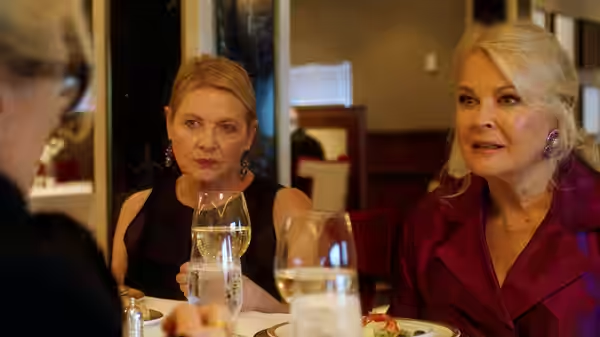
The best thing is Candice Bergen. Roberta believes Alice’s famous novel took her life and her marriage and gave nothing back, and has come aboard with a plan: find a wealthy man before Southampton. Bergen plays her sour, funny and unashamed, stalking the lounges and appraising every grey head at the bar. We laughed at nearly all of it. It is the one performance here that never waits for the script to turn up.
Streep plays Alice as grand, vague and easily hurt, a woman who talks about her work as if it were weather she happens to be standing in. It is a controlled comic turn and it is hard to like. Dianne Wiest’s Susan is the peacemaker, mild and watchful, and Wiest does a great deal with her face while the other two talk. Lucas Hedges’s Tyler runs messages between the women and falls for Gemma Chan’s Karen, who has asked him to find out what his aunt is writing. Chan is crisp and underused, and their romance is one of several threads the film picks up and puts down. Daniel Algrant’s Kelvin Krantz has one good scene about how many books he sells and how little Alice thinks of him.
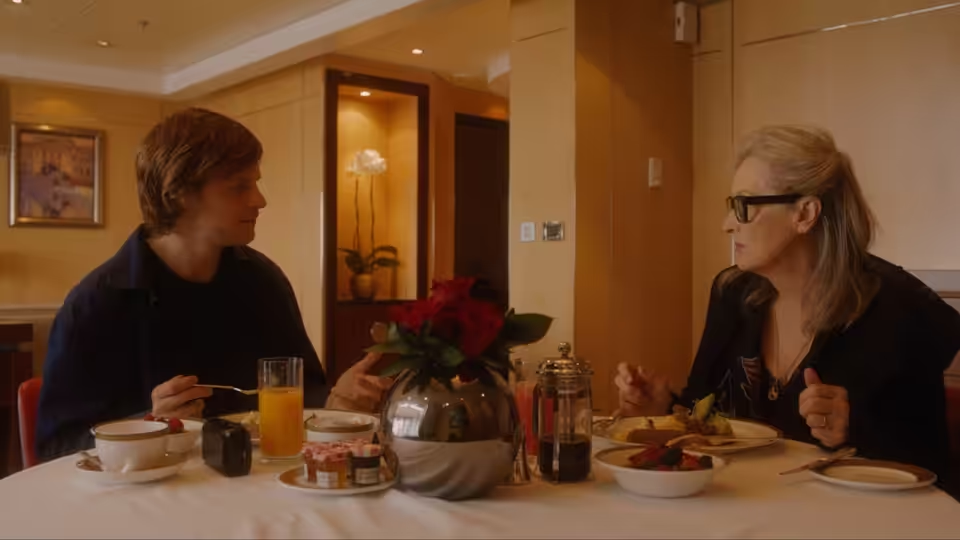
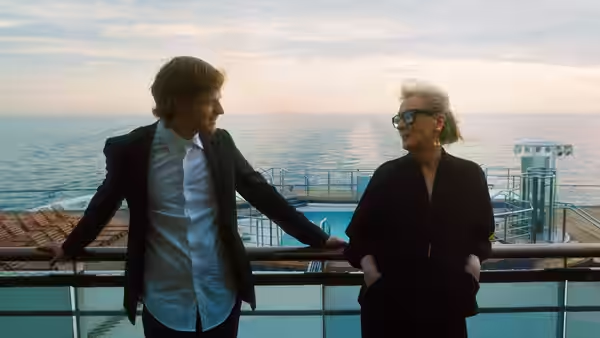
Soderbergh is his own cinematographer and shoots the ship as he found it: available light, carpeted corridors, the dining room at full stretch, wind on the top deck. The digital image is a little flat and the interiors run brown, which suits a film about tired people in expensive rooms. Ellen Mirojnick dresses Alice in layers of cream and grey scarf and Roberta in the sharper colours of a woman who has come to be looked at. Thomas Newman’s score is brushed drums and piano, light and quick, and it carries the film down corridors when the conversation cannot.
What does not work is the improvising. Some scenes find a shape; more of them find a subject and circle it, with actors audibly waiting for the other to finish. Soderbergh the editor cuts in and out mid-sentence, which gives the impression of pace without supplying any. The quarrel between Alice and Roberta is kept at a simmer for most of the crossing, which is honest about old friends; it also leaves an hour with nothing at stake beyond who sits where at dinner.
Then the last quarter turns, and we will not say how. It moved us more than we expected, partly because Streep plays the pivot with almost nothing and partly because the film had been so careless of our attention that it caught us off guard. We also came out a little resentful: the turn shows the tighter film Eisenberg could have written and Soderbergh chose not to make.
He has worked fast before and it has not always cost him; Ocean’s Eleven (2001) is loose and every scene in it is written. Here the looseness is in the material, not the manner, and it shows in the long middle.
Watch it at home, with somebody who likes actors, and argue afterwards about whether the ending pays for the hour before it. We think it pays for about half. The ship is worth the fare either way.