Todd Field’s second film is a sharp, uncomfortable study of a suburb in which nobody has grown up, and Kate Winslet and Jackie Earle Haley are both exceptional in it. A narrator keeps explaining what we have already understood, and the final half hour strains.
Todd Field’s second film, five years after In the Bedroom, takes Tom Perrotta’s novel and treats it as a comedy of manners into which something frightening has moved. Two bored parents drift towards an affair across one summer; a few streets away a convicted sex offender comes home to his mother, and a former policeman decides the neighbourhood needs protecting from him. It is sharp, uncomfortable and well acted. It is also narrated, and the narration is where our reservations start.
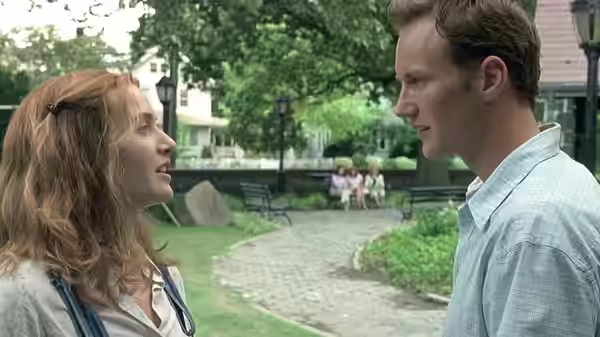
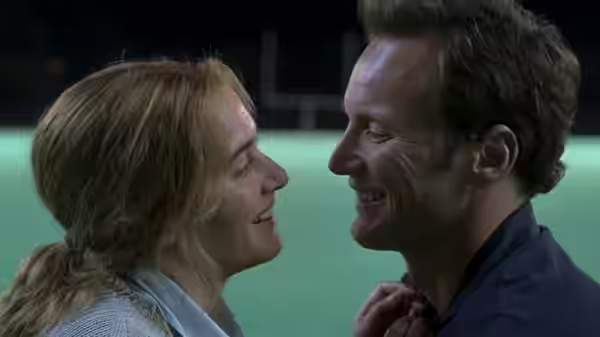
Winslet plays Sarah Pierce as a woman who has read too much to be happy on a park bench and not enough to know what to do about it. She gives her a slack-shouldered boredom that turns, when Brad Adamson appears, into something alert and slightly ashamed. Patrick Wilson’s Brad is a handsome man who has stopped expecting anything of himself; he is meant to be revising for a third attempt at the bar exam and instead stands outside the library watching teenagers skateboard. Their scenes together are written with wit and played without vanity. When they finally touch, both of them look relieved.
The other half of the film belongs to Jackie Earle Haley, remarkable as Ronnie McGorvey. He plays a man who knows what he is and cannot stop, with a thin voice and a stare that never settles, and Phyllis Somerville as his mother May loves him with a fierceness that makes everything worse. The scene most critics mention is the one at the public pool, where Ronnie arrives in mask and flippers, and we were horrified in a way we did not expect. Field holds the camera underwater while Ronnie glides past small kicking legs, Antonio Calvache lets the surface light ripple across his back, and when a parent on the side realises who he is the pool empties in seconds. We were frightened of him, and then ashamed of how fast we had joined the crowd on the concrete. Noah Emmerich, as Larry Hedges, the ex-cop who has made Ronnie his project, is the film’s second surprise: a loud, needy man whose rage is plainly about something else, and Emmerich never asks us to like him.
David Gropman’s suburb is clapboard and clipped hedges, and he sorts the households by clutter. Sarah’s kitchen is a mess of unopened post and her husband’s laptop, the Adamsons’ house has good furniture nobody sits on, and the McGorveys’ is dim and over-stuffed. Melissa Economy dresses the playground mothers in matching pastels and puts Sarah in a man’s shirt and a swimsuit that does not fit. Thomas Newman’s score ticks along on the marimba and chimes he used for American Beauty, and we have heard this suburb before. Leo Trombetta cuts between the two stories so that a joke about snack time sits next to a flyer with a mugshot on it, and the one keeps souring the other.
Then there is the narrator. A grave male voice, in the manner of a public-television documentary, tells us what Sarah is thinking while we watch Winslet think it, and spells out the irony of a scene we have just understood. Sometimes it is funny; the deadpan account of a touch-football match has the ring of a wildlife programme. More often it is a hand on the shoulder from a film that does not need one. The screenplay also runs a book club discussion of Madame Bovary at which the women say aloud what the film is about, and Jennifer Connelly, as Brad’s wife Kathy, is given a camera, a mother and about four scenes. At 137 minutes it is a quarter of an hour long, and the final stretch pulls everyone towards a single evening with a tidiness the first hour would have mocked.
In the Bedroom trusted silence; this one does not quite. Most critics liked it and so, with reservations, did we. See it for Winslet and Haley, for the pool, and for a portrait of parenthood that is not sentimental for a second. Then decide whether the voice telling you what to think was part of the joke or the film’s nerves. We think it was the nerves.