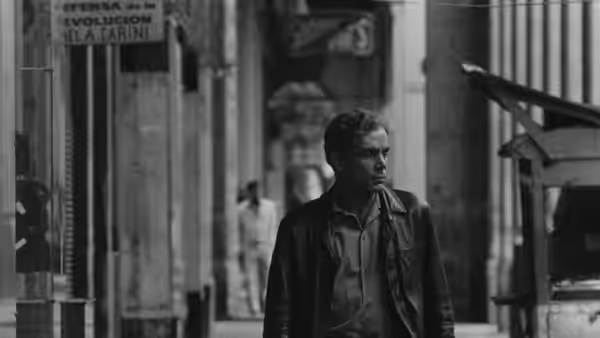
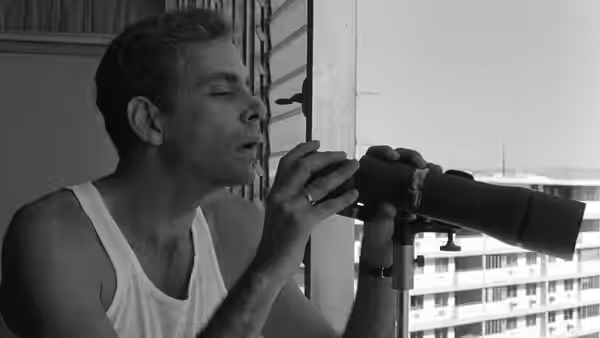
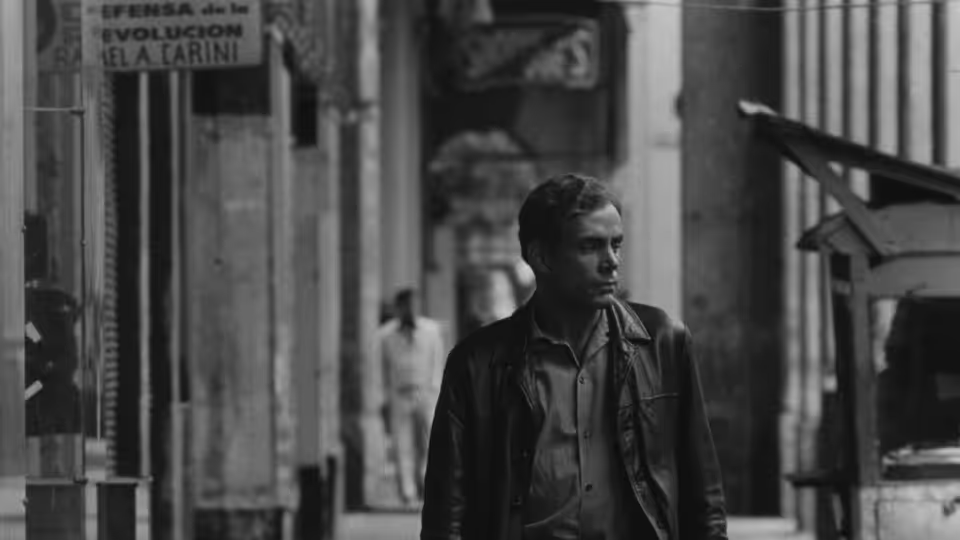
Sergio Carmona Mendoyo (Sergio Corrieri) stands in a city passage, looking to one side
Film review

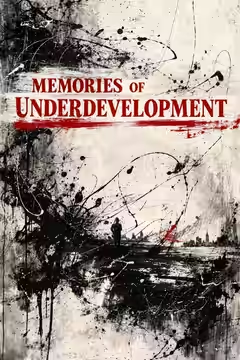
Memories of Underdevelopment

1968 · Directed by Tomás Gutiérrez Alea · 1h 39m

In a sentenceA revolution is no excuse to stop thinking about yourself

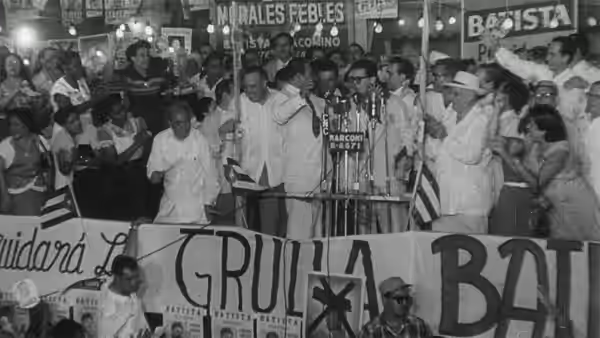
In post-revolutionary Havana, Sergio Carmona Mendoyo (Sergio Corrieri) observes a society changing around him while remaining unable to find his own place in it. He has charm and opinions, but little capacity to act on either. Around him are Elena (Daisy Granados), Noemi (Eslinda Núñez) and Pablo (Omar Valdés). His detachment keeps him at a distance from the people and events he observes, even as history gives him more to consider. Dialogue gives way to still photographs and documentary footage, bringing the city’s public life into a story centred on one man’s difficulty in participating.

Fi1m review

Tomás Gutiérrez Alea makes post-revolutionary Havana absorbing and its detached observer hard to forgive. Sergio Corrieri holds together a demanding, rewarding film whose fragments sometimes keep us further from the people than we would like.

Memories of Underdevelopment is a sharp, demanding film about a man who can observe change without finding a way to take part in it. Tomás Gutiérrez Alea puts Sergio Carmona Mendoyo in post-revolutionary Havana and refuses to make his intelligence an excuse for his detachment. Its mixture of fiction, still photographs and documentary footage keeps asking us to look beyond him. We recommend it, though its people can feel kept at arm’s length.

Sergio Corrieri makes that a difficult request, because he gives us a man whose company is easy to enjoy. The charm matters: without it, Sergio’s failure to commit himself would become tiresome much sooner. We smiled despite ourselves during the Hemingway Museum sequence, because Sergio Corrieri makes Sergio’s detachment so easy to enjoy. The performance allows us to recognise his shortcomings without losing interest in him, and the film makes good use of our willingness to keep watching.

Ramón F. Suárez’s cinematography gives Sergio enough presence to compete with the documentary material without making the surrounding city feel incidental. Nelson Rodríguez’s editing supplies much of the friction, moving between acted scenes, photographs and footage that will not stay politely in the background. Those changes require attention, but they also prevent Sergio’s thoughts from becoming our only way into Havana. We keep having to reconsider how much authority to grant him.

Julio Matilla’s production design has the awkward job of sitting alongside documentary images, where deliberately arranged surroundings can easily look false. It survives that comparison: the fictional scenes do not seem sealed off from the Havana in the footage. Leo Brouwer’s music helps sustain the unease, although the changes of image are what most strongly direct our attention. The score is effective without becoming our main reason to feel anything.

The larger achievement is that Tomás Gutiérrez Alea lets political change remain difficult without treating Sergio’s withdrawal as a satisfactory response to it. A political drama can grow dull when each character arrives carrying a position the audience must approve or reject. Here, it is harder to settle into that sort of certainty, because Sergio’s story repeatedly gives way to photographs and documentary footage. We are allowed to question the revolution without accepting this observer as a reliable guide.

The approach can also be wearing. Some of the returns to Sergio’s paralysis tell us little that the performance has not already made clear. The fragments can start to feel like further demonstrations of a point we have grasped, and the difficulty of caring about him occasionally becomes plain indifference. At 99 minutes the film is not long, but it still has passages where we want something to challenge Sergio rather than another opportunity to consider him. Watch it when there is time to argue about Sergio afterwards.
Critical consensus AI synthesised

79
Positive
6
Mixed
2
Negative
0

Most critics respond warmly to Memories of Underdevelopment, with praise clustering around its blend of fiction, still photography and documentary footage. The reviews find this approach politically complex, conveying post-revolutionary Havana without reducing it to propaganda or an uncomplicated account of revolutionary progress. Sergio Corrieri’s performance also draws admiration: his charm and emotional and intellectual paralysis give critics a compelling way into the film’s treatment of a man at odds with the history around him.

The reservations concern the demands the film makes and the distance it keeps from its protagonist. Empire finds it challenging but worth the attention, while The Hollywood Reporter notes that Sergio earns interest more readily than sympathy. The verifiable responses range from measured approval to strong enthusiasm, rather than sharp disagreement. Two entries lack sufficient accessible review text to establish their verdicts, so they offer no reliable evidence of a dissenting argument.

Slant Magazine
14 May 2003 · ★★★★/4 · Ed Gonzalez
100

Gonzalez finds the film difficult and enigmatic, portraying Cuba as trapped in an unfulfilled revolutionary promise. He praises its politically charged blend of fiction, still photography, and documentary footage.

Read the full review →
The Guardian
10 July 2008 · Peter Bradshaw
90*

Bradshaw calls the film tremendous, fascinating and a must-see. He praises its blend of dialogue, still photographs and documentary footage for conveying post-revolutionary Havana without dogmatism or wishful thinking.

Read the full review →
The New Yorker
90*

The critic calls it one of the great films of its era. They praise Sergio Corrieri’s performance and single out the Hemingway Museum sequence for its rich ironies.

Read the full review →
Total Film
11 July 2008 · ★★★★ · Total Film
80

The review is positive, finding the film a vibrant and surprising work rather than Marxist propaganda. It praises Sergio Corrieri’s portrayal of a charming man emotionally and intellectually paralyzed by history.

Read the full review →
Empire
9 June 2006 · David Parkinson
75*

The critic finds the film challenging but well worth the attention it demands. He praises its complex political perspective and use of documentary footage to illuminate Sergio’s outsider status.

Read the full review →
The Hollywood Reporter
12 January 2018 · THR Staff
70*

The review regards the restored film as a distinctive, still-relevant landmark and a useful introduction to Cuba’s cinematic history. It praises Alea’s blend of documentary and fictional techniques, while noting the protagonist earns interest more than sympathy.

Read the full review →

Straight answers AI written, from our review

Is Memories of Underdevelopment worth watching?
Memories of Underdevelopment is worth watching for those drawn to demanding political drama, and we score it 84 out of 100. Sergio Corrieri makes its detached observer compelling company, while fiction, photographs and documentary footage keep challenging his view of Havana. We recommend it with a caveat: the fragmentation sometimes makes the people difficult to care about.
How long is Memories of Underdevelopment, and what is it rated?
Memories of Underdevelopment runs 1h 39m. It is a drama film.
Where can I watch Memories of Underdevelopment in Indonesia?
Memories of Underdevelopment is not on any streaming or rental service in Indonesia at the moment. It is available in 2 other countries; change your country at the top of the page to see where. Availability is checked daily.
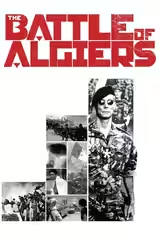
How does Memories of Underdevelopment compare to The Battle of Algiers?
Memories of Underdevelopment is more inward-looking than The Battle of Algiers, which we recommend as the more immediately gripping political drama. Both use documentary methods to bring upheaval close, but Alea concentrates on an observer’s failure to participate, while Pontecorvo follows a campaign. We favour the former for uncomfortable self-examination and the latter for lucid reconstruction, though both sometimes keep people at a distance.
Is Memories of Underdevelopment based on a true story or a book?
Memories of Underdevelopment is adapted from a novel by Edmundo Desnoes. Its post-revolutionary Havana setting and documentary footage bring public events into Sergio’s fictional story, rather than making it a straightforward account of a real person. We recommend approaching it without homework: the film gives us enough to question Sergio through his behaviour and the city around him.
What should I watch after Memories of Underdevelopment?
After Memories of Underdevelopment, try The Battle of Algiers (1966, Fi1m 93): Fiction and documentary methods make political upheaval feel close and difficult to dismiss. Then A Separation (2011, Fi1m 93): Small personal decisions make class and social pressures impossible to keep outside.

Cast

If you liked this, try…

  1. La Notte (1961) · not on Fi1m yetAnother watchful study of cultivated people struggling to turn intelligence into feeling.

  2. The Headless Woman (2008) · not on Fi1m yetPrivilege makes a poor guide through this quietly troubling study of evasion.

  3. The Battle of Algiers (1966, Fi1m 93)Fiction and documentary methods make political upheaval feel close and difficult to dismiss.

  4. The Firemen's Ball (1967) · not on Fi1m yetPublic ceremony exposes private failings, with more laughter and no comforting exemption.

  5. A Separation (2011, Fi1m 93)Small personal decisions make class and social pressures impossible to keep outside.