Film review

Mission to Mars

2000 · Directed by Brian De Palma · 1h 54m · MPA PG

In a sentenceDe Palma can float a camera round Mars beautifully; nobody gave him a line worth saying once it stops

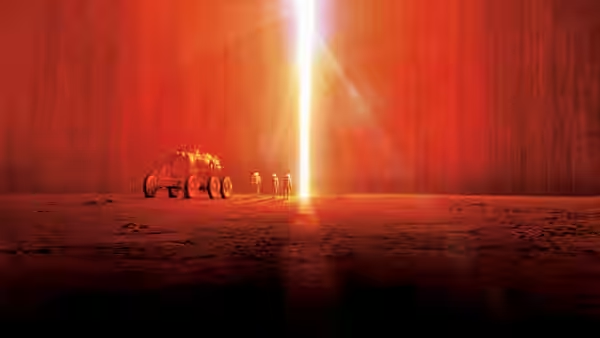
The first manned mission to Mars is a day from launch, and the crew gathers for a barbecue. Commander Luke Graham (Don Cheadle) says goodbye to his wife Debra (Elise Neal). Jim McConnell (Gary Sinise), who trained for the mission and was taken off it after his wife died, watches from the edge of the party. Woody Blake (Tim Robbins) and Terri Fisher (Connie Nielsen), married and on the backup crew, try to cheer him up. On Mars, Luke and his team (Peter Outerbridge, Kavan Smith, Jill Teed) find a formation on the surface their instruments cannot explain, and something tears through them when they go to look. One garbled transmission reaches the station. Woody, Terri, Jim and Phil Ohlmyer (Jerry O’Connell) are sent to find out what happened.

Fi1m review

Brian De Palma stages the space walk with the patience of a man who loves the machinery, and for twenty minutes the film is alive. The rest is a rescue told in press-release dialogue, with a last act whose answer is sillier than its question.

Brian De Palma’s Mission to Mars wants to be two films, a NASA procedural about a rescue and a hushed picture about where life came from, and it gets about half of each. The first is done with real care for how hatches seal and how people move in a suit. The second is done with a swelling choir and a script that explains itself at the end as if to a slow class. We admired several stretches of it and cannot recommend the whole, which is roughly where most critics landed in 2000 and where we land now.

It opens well. Stephen H. Burum’s camera follows the crew of the first manned Mars mission round a barbecue in a single long take, drifting from a beer cooler to a child on a swing to Jim McConnell (Gary Sinise) standing apart from it all, and by the time the shot ends we know who is going, who is staying and who has been left behind. The dialogue is not good even here, but the shot carries it. For a few minutes the film feels like De Palma’s.

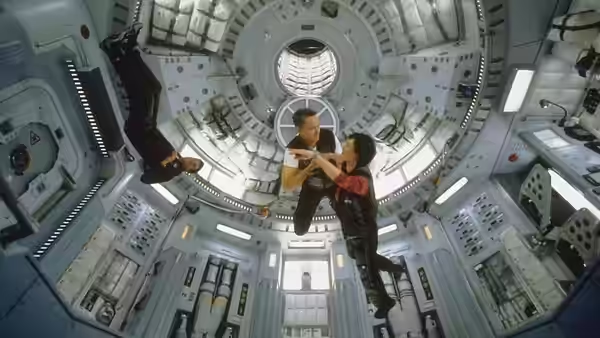
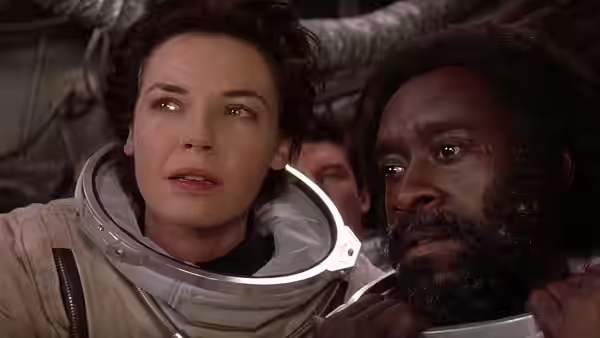
The cast are good enough to survive what they are given. Sinise plays McConnell as a man who has stopped arguing with his grief and is simply carrying it, and he is the only person on screen whose sadness reads as real. Tim Robbins and Connie Nielsen, as the married Woody Blake and Terri Fisher, are relaxed and likeable, and their scenes together, including a slow weightless dance in the ship, are the warmest things in the film. Don Cheadle spends much of the running time alone and manages to look like a man who has been alone for a year. Jerry O’Connell is the joker, and is written as one.

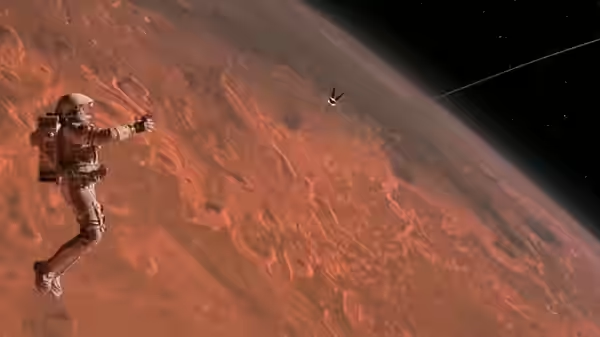
The middle stretch, in orbit and on the approach to Mars, is the reason to watch. De Palma stages a hull breach and a space walk at a patient, almost stately pace, with Burum holding the wide shot so we can read distances and Paul Hirsch cutting only when something has changed. Blood leaves a wound and hangs in the cabin as a string of slow red beads, and the film treats this as something to look at rather than a shock. We sat forward and stopped noticing the dialogue for about twenty minutes. It is unhurried, physical film-making, and there is not much of it in space pictures.

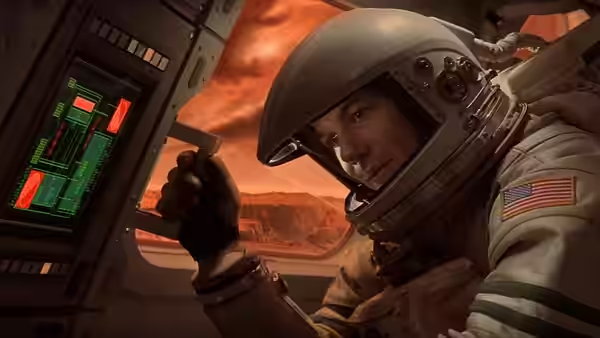
Ennio Morricone scores all of this as if it were a mass. Low strings, then a choir, then a theme that keeps rising towards a resolution that never quite arrives. On the space walk it works, because the images are large enough to bear it. Over a briefing, or a man opening a packet of sweets, it is absurd, and there are a lot of briefings. Sanja Milkovic Hays’s suits and the ship interiors look borrowed from an actual space agency, and the film is at its best whenever it trusts that hardware to be interesting on its own.

It does not trust it for long. John Thomas, Jim Thomas and Graham Yost’s screenplay has people say what they are doing while they do it, then say what it means, then say it again for the person who has just arrived. Nobody in the film has a trait that is not also a plot function. The mystery on the surface is handled as a puzzle, and once the crew are at a table working it out with a bag of sweets, the dread has gone and it does not come back.

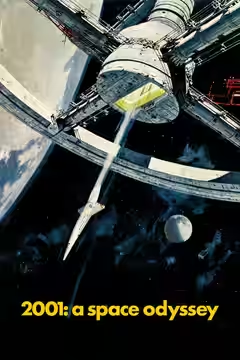
The last act goes somewhere we will not describe, except to say that the film answers its own question in full, slowly, with visual aids. We laughed at a moment plainly meant as wonder, and we did not enjoy laughing, because the people who made it were sincere. Against 2001: A Space Odyssey (1968), which it borrows from openly, it makes the mistake Kubrick did not: it tells you.

De Palma made Mission: Impossible four years earlier, a film that also had a thin script and got by on set pieces and nerve. This one has the set pieces and none of the nerve. Watch it for the middle forty minutes, in the dark, and decide for yourself whether to stay for the choir. At 114 minutes, with a PG certificate, it is at least a Mars film you can show a ten-year-old, who may take the ending better than we did.

Critical consensus AI synthesised

38
Positive
2
Mixed
4
Negative
10

Most critics find Mission to Mars a failure, and a cold one. The reviews are largely negative, and the few compliments cluster in one place: the look of the thing. The space walks, the long takes in zero gravity and the planetary sequences earn respect even from critics who dislike everything around them, and several concede that De Palma’s technical command is intact. Sinise draws the odd kind word for holding the emotional centre together.

The complaints are about words rather than images. Critics fault clunky, expository dialogue, characters who barely register, a slow opening and a finale most find silly, with 2001 named repeatedly as the film it borrows from without matching. The spread is wide. Contemporary reviews are almost uniformly hostile; the dissent comes later, with Slant Magazine and Collider arguing years afterwards that this is an underrated, ambitious De Palma work whose calm and optimism were misread as dullness.

Slant Magazine
27 August 2006 · Eric Henderson
70*

The critic defends the film as an underrated De Palma work with formalist elegance and a bold take on evolution, praising its becalmed direction and poetic blood effects in zero gravity. It marks the start of the director's 'old man cinema' phase despite studio intentions for a more conventional space adventure.

Read the full review →
Sight and Sound
· Philip Strick
50*

The review finds the film a visually pleasing display of space exploration and heroism that disguises its string of disasters and offstage storytelling. It singles out the grandeur of the space walks and planetary sequences for praise while noting De Palma's work here is largely on autopilot.

Read the full review →
Los Angeles Times
10 March 2000 · Kenneth Turan
30*

The review finds the film notably lifeless and cold, with clunky, unconvincing dialogue that overwhelms its beautifully composed visuals, resulting in a pro forma plotting that feels deadly despite the director's focus on technical challenges and luminous images. It highlights the gap between stunning space shots and what is said on screen.

Read the full review →
RogerEbert.com
10 March 2000 · Roger Ebert
30*

The critic finds the film uneven, praising three sequences of real vision and wonder while criticizing the screenplay for long stretches of boilerplate dialogue, perfunctory characters, and illogical actions that drag the story down. It has intriguing ideas and a spirit reminiscent of 2001 but ultimately misses too many marks to recommend.

Read the full review →
The AV Club
10 March 2000 · Keith Phipps
30*

The critic finds the film dull and derivative despite strong effects and production design, criticizing underdeveloped characters, excessive exposition, and a kitschy finale that fails to deliver emotional impact. It borrows too heavily from classics like 2001 without matching their awe.

Read the full review →
The Guardian
14 April 2000 · Peter Bradshaw
30*

The critic finds Brian De Palma's film a mish-mash of familiar sci-fi elements from Kubrick's 2001 and other movies, with an outrageously silly ending and an unbelievably slow first 20 minutes.

Read the full review →

Cast

If you liked this, try…