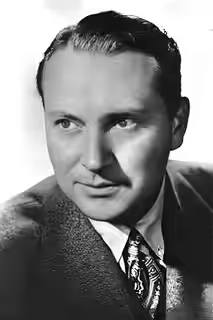
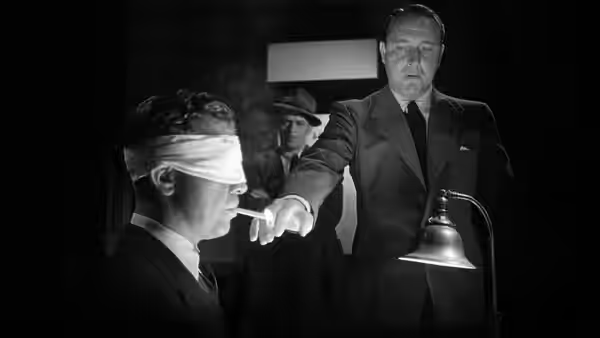
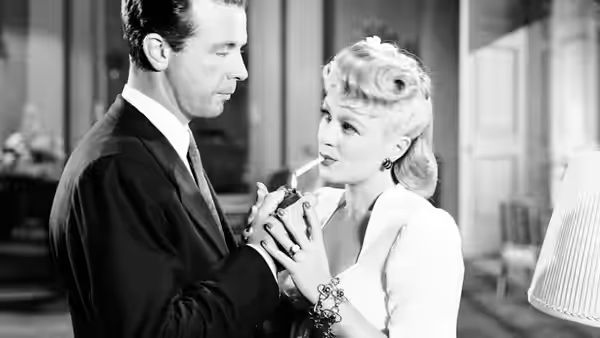
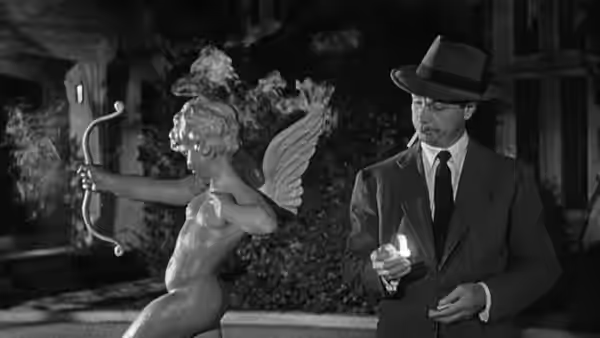
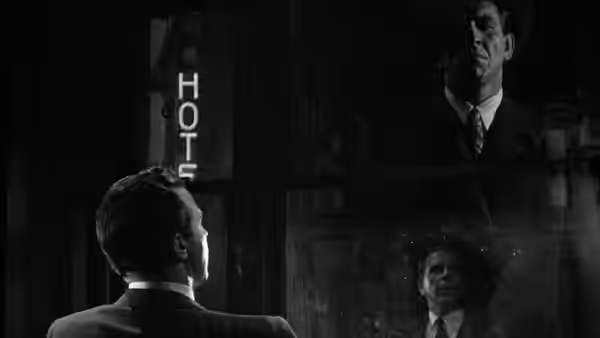
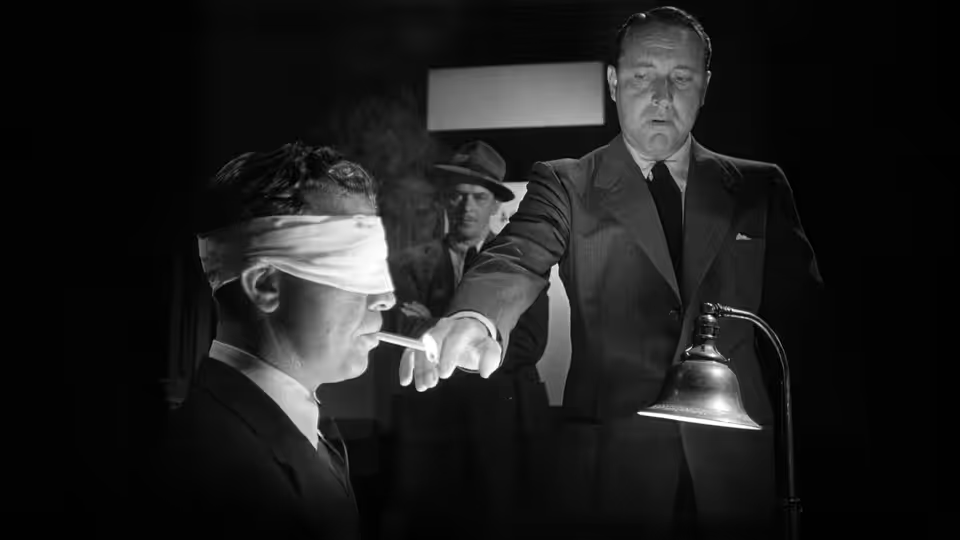
A blindfolded man sits beside a lamp as a suited man points toward him
Film review

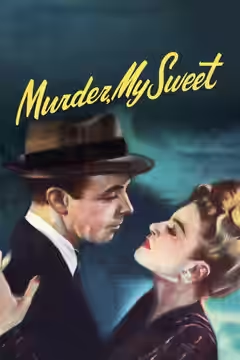
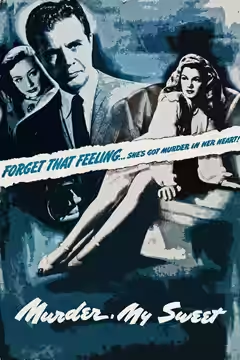
Murder, My Sweet

1944 · Directed by Edward Dmytryk · 1h 35m

In a sentenceDick Powell sounds annoyed that criminals expect him to take them seriously

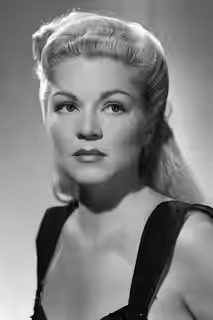
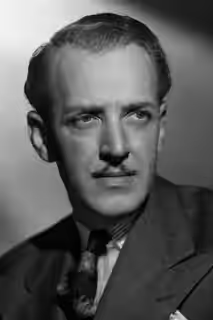
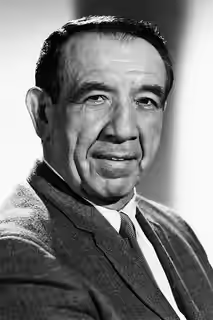
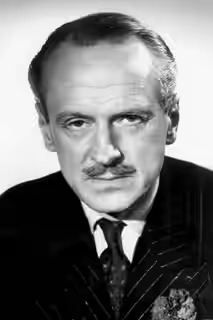
Philip Marlowe (Dick Powell) tells this crime story in voiceover. Helen Grayle (Claire Trevor), Ann Grayle (Anne Shirley) and Joe “Moose” Malloy (Mike Mazurki) are among the people in his account, alongside Jules Amthor (Otto Kruger), Lindsay Marriott (Douglas Walton) and Police Lt. Randall (Don Douglas). The film follows Marlowe through a sordid world, combining mystery with crime drama and suspense. Edward Dmytryk directs John Paxton’s adaptation of a novel by Raymond Chandler, with the story running for 95 minutes.

Plays from YouTube when you press play; nothing loads from them until then.

Fi1m review

Edward Dmytryk’s Murder, My Sweet is a sharp, grubby crime thriller with a wonderfully impertinent Dick Powell. Its dialogue is more reliable than its plotting, but the performances make the slow stretches worth tolerating.

Edward Dmytryk’s Murder, My Sweet is a sharp, grubby crime thriller, worth the evening even when the mystery loses some of its momentum. Dick Powell gives Philip Marlowe the impatience of someone who has heard too many plausible stories already. It is an entertaining performance, with a trace of smugness that occasionally gets in the way. John Paxton’s screenplay, adapted from a novel by Raymond Chandler, supplies enough good talk to make that a tolerable fault.

Powell understands that a cutting remark need not be announced as one. His conversational delivery makes even the sharper lines sound habitual, and the hard-boiled manner benefits from that lightness. We laughed at his insolence. The pleasure comes from how little effort he seems to spend on being offensive, though there are moments when his readiness with an answer makes Marlowe feel too comfortable. A little hesitation would have given the performance more weight.

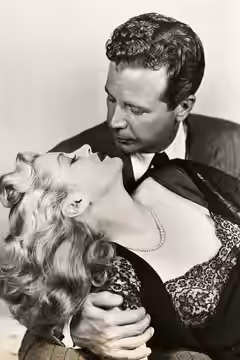
Claire Trevor’s Helen Grayle gives Powell someone worth watching just as closely. Trevor has the assurance the film needs: she holds our attention without competing with his verbal manner, and the contrast makes both performances more effective. Her presence also helps stop Marlowe from dominating the film quite as completely as his voice might suggest. Dmytryk allows the actors enough time to make us curious about them before moving the story along.

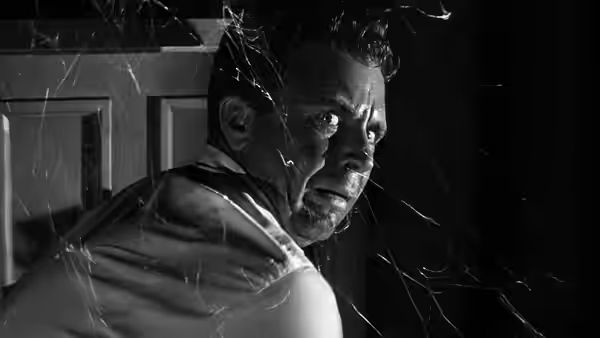
Harry J. Wild’s photography gives the film a persuasive air of shabbiness. The surroundings look inhabited, and the sordidness never feels like an excuse to arrange an attractive picture. This helps Dmytryk make even the conversations uncomfortable, since the setting gives us little reason to expect anyone to behave well. The images establish that unease without consistently taking our attention away from the performers.

Joseph Noriega’s editing has a harder job when the plotting slows down. At those points, the dialogue remains lively but a scene takes longer than it should to move us on; a 95-minute running time does not guarantee a film without slack. Roy Webb’s music supplies a useful pressure, though it is not what we remember afterwards. The voices are what we listen for, and the film is most engaging when it lets a performer control the pace.

Dmytryk uses the voiceover economically, and this is one of the film’s soundest decisions. Marlowe’s way of telling things remains part of the entertainment without making the action feel like an illustrated reading. The trouble comes when the screenplay asks a fluent explanation to carry a weak piece of plotting. We can enjoy the line and still question what it has just explained; the slower passages give us too much time to do that.

Anyone coming to noir chiefly for impenetrable shadows may find Dmytryk’s approach lighter than expected. Much of the tension comes from listening to people sizing one another up, and Powell makes those exchanges worth attending to. We would not choose it as an exercise in faultless plotting. Give it an evening when a sour joke and some untrustworthy company sound more inviting than a case that closes neatly.
Critical consensus AI synthesised

70
Positive
3
Mixed
0
Negative
1
Radio Times
★★★★★ · Tony Sloman
100

Sloman praises the film as a terrific, quintessential noir, highlighting Dmytryk’s direction and economical use of voiceover. He also singles out Dick Powell’s hard-boiled Marlowe and Claire Trevor’s femme fatale performance.

Read the full review →
Variety
31 December 1944 · Variety Staff
78*

The review finds the film smart and gripping, despite some slow stretches and plot weaknesses. It singles out the sharp suspense and the potent, convincing performances, especially Dick Powell’s.

Read the full review →
Time Out
· GA
70*

The review calls it a fine adaptation of Chandler’s novel. It singles out the film’s evocative creation of a seedy, sordid world.

Read the full review →
Empire
1 January 2000 · Patrick Humphries
30*

The review finds the film atmospheric but an inferior crime thriller that never quite clicks. It praises the witty dialogue, while faulting Dick Powell’s glib Marlowe and the film’s lack of shadow and depth.

Read the full review →

Straight answers AI written, from our review

Is Murder, My Sweet worth watching?
Murder, My Sweet is worth watching for its sharp dialogue and Dick Powell’s impertinent Marlowe, and we score it 82 out of 100. We recommend it to crime thriller viewers who enjoy suspicious company and sour jokes, with the caveat that the plotting sometimes stalls or relies on explanations that do not quite convince.
How long is Murder, My Sweet, and what is it rated?
Murder, My Sweet runs 1h 35m. It is a crime and drama film.
Where can I watch Murder, My Sweet in Spain?
Murder, My Sweet is streaming on Amazon Prime Video in Spain, and it is also available to rent from Amazon Prime Video from €2.99. Availability is checked daily; the links above go straight to each service.
How violent or frightening is Murder, My Sweet, and is it suitable for children?
Murder, My Sweet offers sordid crime, suspense and uneasy conversations, but we have no UK or US certificate recorded to anchor an age recommendation. Its shabby surroundings and untrustworthy characters create discomfort; we cannot give a firm steer on violence or suitability for children from those details alone.
How does Murder, My Sweet compare to The Third Man?
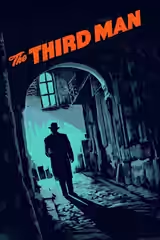
Murder, My Sweet is our choice for insolent detective talk, while we favour The Third Man for a more gripping mystery with greater concern for the harm friendship can excuse. Both offer slippery conversation and compromised loyalties, but Powell’s verbal lightness is the chief pleasure here, and the plotting is less reliable.
Is Murder, My Sweet based on a true story or a book?
Murder, My Sweet is adapted from a novel by Raymond Chandler, with a screenplay by John Paxton, rather than presented as a true story. We recommend it for the dialogue and performances without requiring familiarity with the book; our assessment does not establish how faithfully it follows Chandler’s novel.
What should I watch after Murder, My Sweet?
After Murder, My Sweet, try The Third Man (1949, Fi1m 92): For slippery conversation, compromised loyalties and a city that makes innocence look impractical. Then The Long Goodbye (1973, Fi1m 86): A different Marlowe keeps talking as the people around him stop listening.

Cast

If you liked this, try…

  1. The Third Man (1949, Fi1m 92)For slippery conversation, compromised loyalties and a city that makes innocence look impractical.

  2. Stray Dog (1949) · not on Fi1m yetAnother crime story made richer by the discomfort of its streets and inhabitants.

  3. Le Samouraï (1967) · not on Fi1m yetCriminal suspicion sustained through patient watching, spare speech and carefully controlled spaces.

  4. The Long Goodbye (1973, Fi1m 86)A different Marlowe keeps talking as the people around him stop listening.

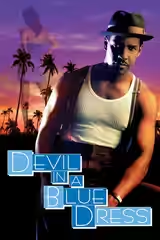
  5. Devil in a Blue Dress (1995) · not on Fi1m yetA mystery where the investigator’s wit offers only limited protection from his employers.

Murder, My Sweet (1944) review: Sharp noir with a few lulls (Spain) | Fi1m