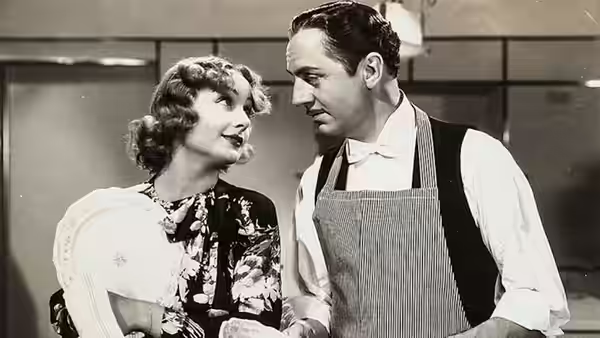
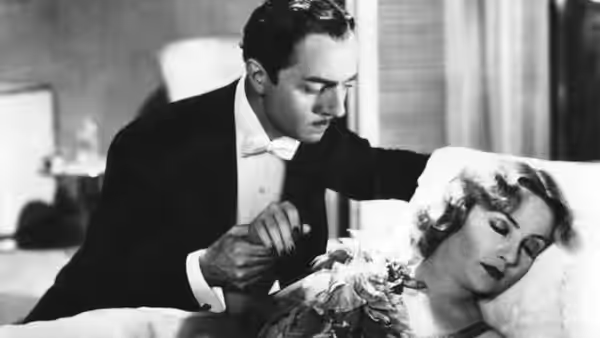
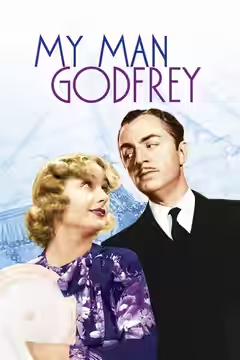
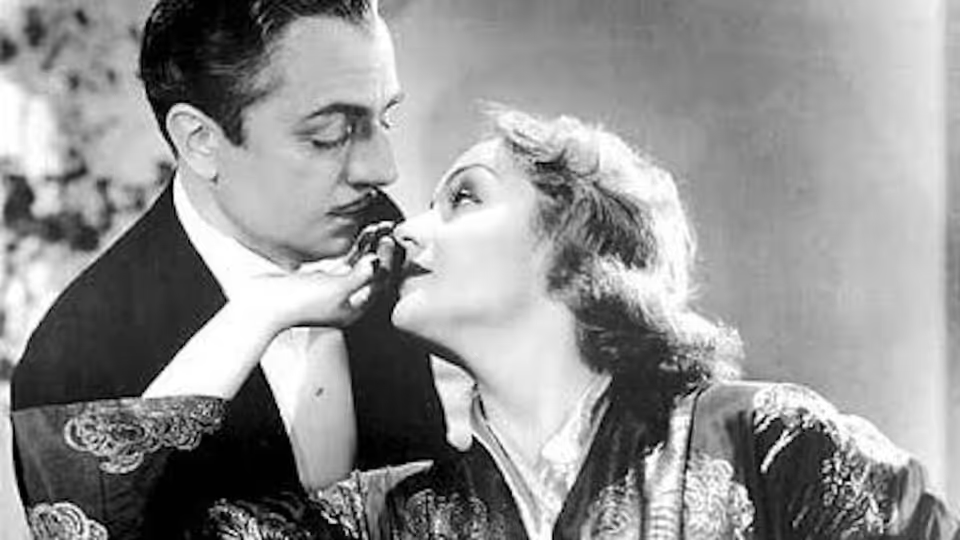
Godfrey (William Powell) and Irene Bullock (Carole Lombard) lean together for a kiss
Film review

My Man Godfrey

1936 · Directed by Gregory La Cava · 1h 35m

In a sentenceWilliam Powell makes being the only reasonable person in the house look like skilled labour

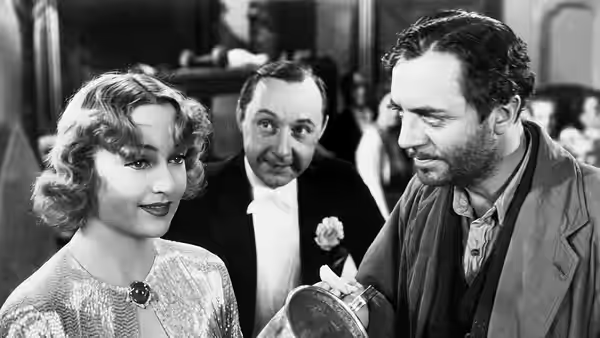
Godfrey (William Powell) works as a butler amid the demands of the Bullock family. Irene Bullock (Carole Lombard), Cornelia Bullock (Gail Patrick) and Angelica Bullock (Alice Brady) are among those requiring his attention. The job puts him in the middle of a household where money does not guarantee sensible behaviour and keeping order is difficult. Romance complicates the business of serving the family, as personal wishes interfere with his duties. Godfrey has to negotiate the Bullocks’ demands while retaining the manners expected of a man employed to look after them.

Fi1m review

William Powell and Carole Lombard make this screwball comedy worth seeking out, with Gregory La Cava keeping a demanding household funny. Its treatment of wealth is forgiving, but the performances give the farce warmth and purpose.

My Man Godfrey is a funny, generous screwball comedy, and William Powell and Carole Lombard are reason enough to see it. Gregory La Cava allows the Bullock family to be exhausting without making the film a chore. Its interest in money and status gives the farce some welcome bite. The reservation is that its affection for these people sometimes blunts its criticism of how they behave.

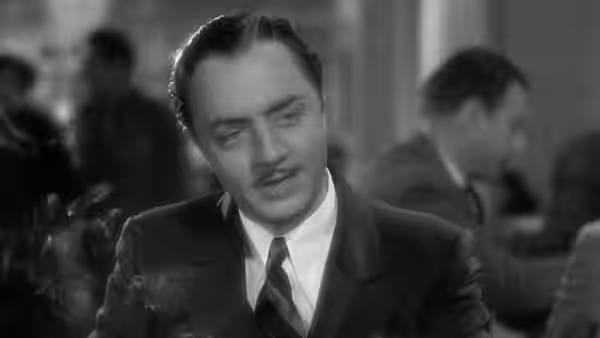
William Powell gives Godfrey a dignity that survives the farce around him. We are never asked to find a servant funny simply because he is a servant, and the performance makes us watch the people demanding his attention more closely. His restraint is funny in itself, but it also puts a useful limit on the family’s ability to dominate the film. He can hold our attention without competing at their volume.

Carole Lombard takes the riskier route with Irene Bullock, making unreasonable behaviour feel urgent and personal. We laughed at how seriously she treats Irene’s demands; the character’s complete conviction is what makes the foolishness work. There is feeling in that conviction, too, so the romantic comedy has something to draw on beyond the pleasure of watching someone disregard everyone else’s wishes. At times Irene’s insistence grows wearing, and the film is a little too ready to find her endearing.

Alice Brady is especially good as Angelica Bullock, playing absurdity with the confidence of someone who has never needed to reconsider a thought. Mischa Auer’s Carlo adds to the commotion without seeming to belong to a different comedy. Gregory La Cava gives the ensemble enough freedom for its exchanges to feel unpredictable, though the family sometimes becomes too much of a collection of comic turns. Those are the stretches when we want fewer people demanding to be funny.

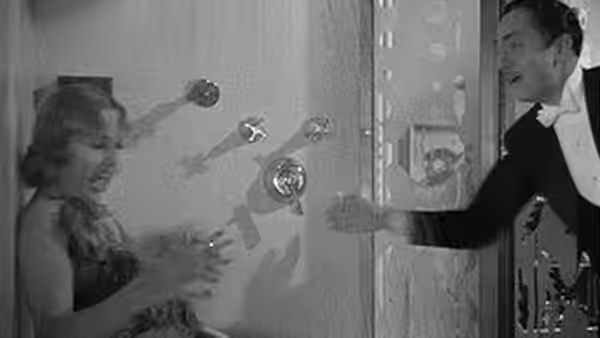
Ted Tetzlaff’s cinematography keeps the performances easy to read, and its polish suits the family’s comfortable view of itself. Travis Banton’s costume design helps make privilege visible before anyone has to explain it. Editors Ted J. Kent and Russell F. Schoengarth give the competing performances a workable rhythm, preserving the difference between Godfrey’s restraint and the family’s agitation. The pace is lively without making every exchange feel hurried. This matters in screwball comedy, where frantic cutting can be mistaken for actors actually being funny together.

The screenplay by Eric S. Hatch and Morrie Ryskind is less convincing when its social observations are treated as serious criticism. It recognises the ugliness of entitlement, but the Bullocks are so entertaining that their conduct is easily forgiven. That is a limitation worth naming, rather than pretending every joke about wealthy people amounts to a searching examination of wealth. The romance and the farce are better developed than the politics, and the pleasure of the performances makes that easy to overlook.

At 95 minutes, it is a sensible length for company this demanding. Within screwball comedy, it belongs to the warmer end of the genre, where the pleasure depends on finding something to like in people who would be a considerable nuisance in the next room. Watch it with someone who has had a difficult day being polite to unreasonable people.

Critical consensus AI synthesised

76
Positive
6
Mixed
1
Negative
0

Most critics respond warmly to My Man Godfrey, with praise clustering around its performances, sharp writing and mixture of screwball romance and social commentary. The reviews repeatedly credit La Cava’s direction with keeping the comedy lively. Carole Lombard and William Powell receive particular praise for their performances, while Variety singles out Alice Brady and Mischa Auer for their sustained comic work. The prevailing view is that the film remains funny while giving its class divisions some weight.

The reservations concern how far the farce goes and how deeply the satire cuts. Radio Times finds the family’s antics strain credibility, whereas Variety regards the absurdity as well judged. The AV Club considers the satire broad rather than incisive; Slant Magazine finds a sharper class critique. The verifiable responses occupy a fairly narrow, favourable range, though the inaccessible New York Times text prevents a reliable account of its reservations.

Radio Times
★★★★ · Robyn Karney
80

Karney regards the film as a classic comedy, though the family’s farcical antics strain credibility. She praises the work of its stars, director and screenplay, noting their Oscar nominations.

Read the full review →
Slant Magazine
27 September 2018 · ★★★★ · Jake Cole
80

Cole praises the film as a supple, cutting work of class-conscious comedy and calls it one of Hollywood’s finest. He singles out its blend of screwball romance and social critique, alongside the strong Criterion Blu-ray presentation.

Read the full review →
The AV Club
19 April 2002 · Noel Murray
80*

Murray presents the film as one of the best screwball comedies, praising its fizzy blend of romance and social commentary. He singles out La Cava’s improvisational style, while noting the film’s satire is broad rather than incisive.

Read the full review →
Variety
31 December 1935 · Variety Staff
75*

The review finds the comedy pleasantly entertaining, with a story that is delightfully absurd without going too far. It particularly praises Alice Brady’s performance and the sustained comic work by Mischa Auer.

Read the full review →
Time Out
· GB
70*

The review presents the film as a heartless screwball classic. It praises La Cava’s clinical direction and notes Morrie Ryskind’s screenplay.

Read the full review →
The New York Times
18 September 1936
65*

The article text is inaccessible, so its critical verdict cannot be verified. Its specific praise or complaint also cannot be established.

Read the full review →

Straight answers AI written, from our review

Is My Man Godfrey worth watching?
My Man Godfrey is well worth watching for its warm screwball comedy and William Powell and Carole Lombard’s performances; we score it 82 out of 100. We recommend it for the contrast between Powell’s restraint and the Bullock family’s unreasonable demands, though its affection for wealthy eccentrics softens its social criticism.
How long is My Man Godfrey, and what is it rated?
My Man Godfrey runs 1h 35m. It is a comedy film.
Where can I watch My Man Godfrey in Italy?
My Man Godfrey is not on any streaming or rental service in Italy at the moment. It is available in 7 other countries; change your country at the top of the page to see where. Availability is checked daily.
How does My Man Godfrey compare to The Lady Eve?
My Man Godfrey is the warmer choice beside The Lady Eve, which we recommend for a sharper romance built around Barbara Stanwyck’s cleverness and vulnerability. Powell’s restraint amid a demanding household gives My Man Godfrey its particular pleasure; we favour The Lady Eve for romantic complexity, with the caveat that its slapstick can grow insistent.
Is My Man Godfrey based on a true story or a book?
My Man Godfrey is based on a novel by Eric S. Hatch, rather than a true story, with a screenplay by Hatch and Morrie Ryskind. We recommend it without any preparatory reading: the performances, household farce and romance provide its pleasures without requiring familiarity with the book.
What should I watch after My Man Godfrey?
After My Man Godfrey, try The Lady Eve (1941, Fi1m 90): Another romance in which impeccable comic timing excuses some thoroughly unreasonable conduct. Then The Rules of the Game (1939, Fi1m 91): A less forgiving country house comedy about people protected by their position; and Trading Places (1983, Fi1m 80): Employment, money and class prejudice become the machinery of a much coarser farce.

Cast

Awards

Academy Awards, 1937

Nominated
Best Actor
Nominated
Best Actress
Nominated
Best Director
Nominated
Best Supporting Actor
Nominated
Best Supporting Actress
Nominated
Best Writing, Adapted Screenplay

If you liked this, try…

  1. The Lady Eve (1941, Fi1m 90)Another romance in which impeccable comic timing excuses some thoroughly unreasonable conduct.

  2. The Rules of the Game (1939, Fi1m 91)A less forgiving country house comedy about people protected by their position.

  3. Trading Places (1983, Fi1m 80)Employment, money and class prejudice become the machinery of a much coarser farce.

  4. The Servant (1963) · not on Fi1m yetFor a darker household where the balance of power refuses to stay settled.

  5. Parasite (2019, Fi1m 91)Domestic employment and class resentment, with considerably less reassurance about living together.