Michelle Williams brings feeling and uncertainty to a pleasant but shallow backstage drama. Simon Curtis provides agreeable entertainment, though the screenplay rarely looks beyond the excitement of getting close to somebody famous.
Simon Curtis’s My Week with Marilyn is a slight drama carried by Michelle Williams, and worth considering chiefly for her. She gives Marilyn Monroe enough uncertainty and feeling to suggest a more searching film than the one surrounding her. The backstage setting promises a look at how a public personality survives contact with work and other people. Instead, the screenplay by Adrian Hodges remains largely satisfied with the excitement of proximity to celebrity.
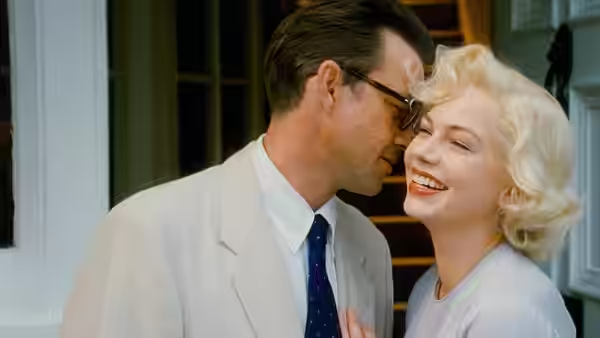
Michelle Williams is persuasive because her voice, movement and posture do not all deliver the same reassuring message. The singing has sweetness, while the physical performance allows insecurity and calculation to sit awkwardly together. We were moved by the uncertainty she lets show beneath the charm; she makes receiving all that attention seem exhausting. There is enough control in her performance to prevent vulnerability from reducing Marilyn Monroe to somebody who simply needs looking after.
Kenneth Branagh makes Sir Laurence Olivier an entertaining presence, supplying comic timing that stops the film becoming uniformly reverent. His broadness is useful, giving the audience something to enjoy beyond the fascination with Marilyn Monroe. Yet the pleasure of watching these famous figures portrayed so vividly can become a substitute for drama. Simon Curtis appears reluctant to let their less agreeable qualities make the experience uncomfortable, and the comedy tends to win out over the friction.
The difficulty lies with Colin Clark, played by Eddie Redmayne, and the weight placed on his view of Marilyn Monroe. There is a touch of wish-fulfilment in this account that Adrian Hodges does too little to question. Being close to her is treated as sufficient reason for us to care about the person doing the watching. Eddie Redmayne gives the film a gentler presence, but the screenplay cannot make his interest in her particularly revealing. We understand the attraction without learning much from it.
Ben Smithard’s cinematography and Donal Woods’s production design are agreeable enough, but we found their tidiness limiting. The backstage world feels arranged for our comfort even when Michelle Williams is making discomfort the most interesting thing on screen. The polished presentation does have a use: it helps explain the attraction of getting near these people. It is less effective at making their company feel demanding, so the surroundings and the central performance sometimes seem to belong to different accounts of the same experience.
Adam Recht’s editing keeps the 99 minutes moving comfortably, although pace cannot give the story the weight it lacks. Conrad Pope’s music also favours the agreeable mood, where a little less reassurance might have helped. Both serve the modest entertainment Simon Curtis is making. The limitation is how consistently the film makes an uneasy woman easy company for an audience, even while its leading performance suggests reasons to feel otherwise.
As a backstage drama, this offers the pleasure of watching performers interpret other performers without examining the working relationships quite hard enough. It does not need a comprehensive explanation of Marilyn Monroe to justify itself, but it does need more curiosity about the account we are being asked to accept. Michelle Williams supplies enough feeling to keep that reservation from spoiling the evening. Choose it for her, rather than for the promise of getting to know the woman she plays.