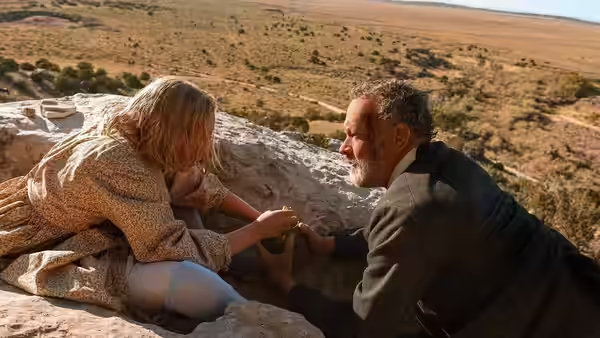
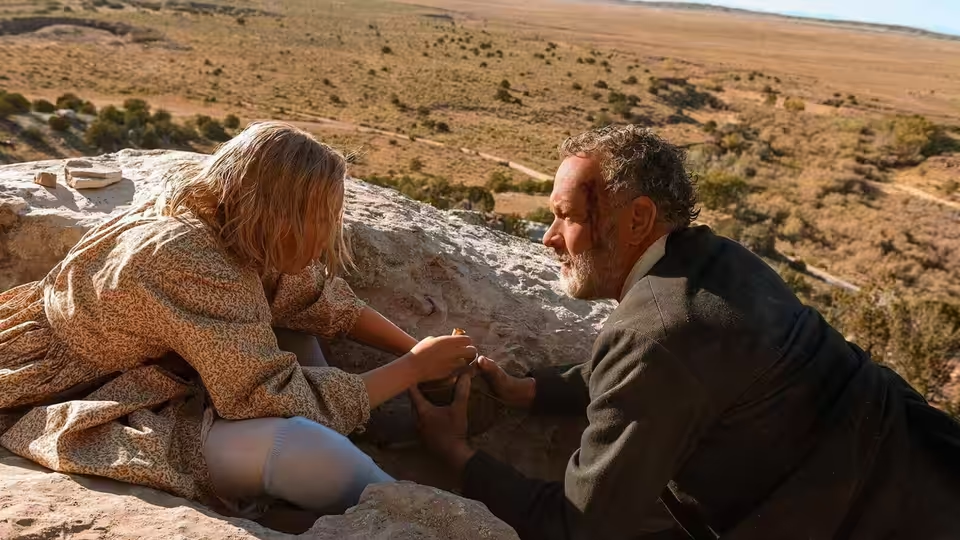
Captain Jefferson Kyle Kidd (Tom Hanks) reaches toward Johanna on a rocky hillside
Film review

News of the World

2020 · Directed by Paul Greengrass · 1h 58m

In a sentenceTom Hanks reads the newspaper to angry strangers for a dime and Texas is still not sure about him

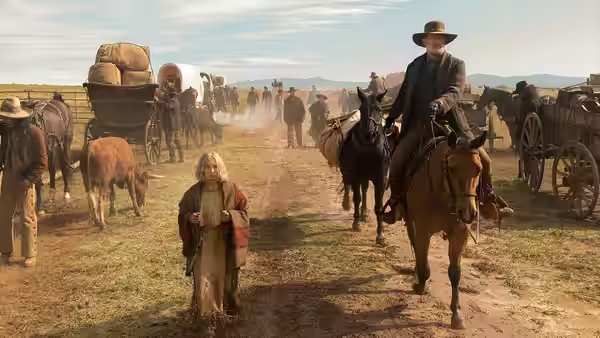
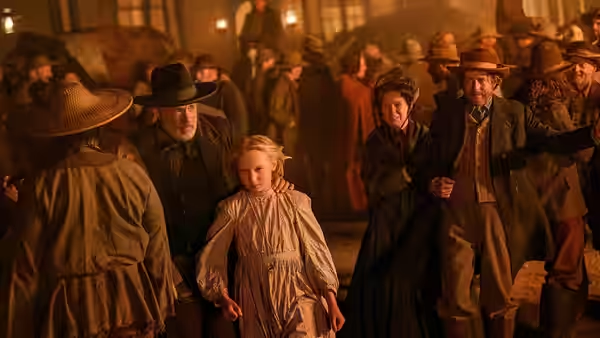
Texas, 1870. Captain Jefferson Kyle Kidd (Tom Hanks), a Confederate veteran who once ran a print shop, travels from town to town reading newspapers aloud for ten cents a head. On the road out of Wichita Falls he finds an overturned wagon, a lynched man and a girl hiding in the brush. Johanna Leonberger (Helena Zengel) was born to German settlers, raised by the Kiowa after her parents were killed, and has now lost that family too; the papers with her say she belongs to an aunt and uncle near Castroville, hundreds of miles south. The army will not take her. Kidd does, and in Dallas an ex-soldier named Almay (Michael Angelo Covino) offers to buy her, and follows when he is refused.

Plays from YouTube when you press play; nothing loads from them until then.

Fi1m review

Paul Greengrass slows down for a Western and finds a remarkable young actor in Helena Zengel. The rest is handsome and honourable and moves at a walk, and only one shootout on a ridge reminds us who is directing.

Paul Greengrass, who made his name shaking a camera through Bloody Sunday and the Bourne films, sits it on a tripod for this one. Texas, 1870. Captain Jefferson Kyle Kidd (Tom Hanks) rides from town to town reading newspapers aloud to anyone with ten cents, and on the road he finds a wagon, a body and a girl. Johanna (Helena Zengel) was born German, raised Kiowa, and has now lost both families; the papers with her say she belongs to an aunt and uncle near Castroville. Kidd tries to hand her to the army and ends up taking her himself.

Zengel is the reason to watch it. She plays Johanna without a word of English for most of the running time, speaking Kiowa and, later, a little German, and she never once asks us to like her. She eats with her hands, bolts at the sound of a wagon wheel, sings to the dead, and looks at Hanks the way a cat looks at a stranger’s hand. When she and Kidd start trading words for things, bird and horse and bread, the film finds a rhythm it never quite loses.

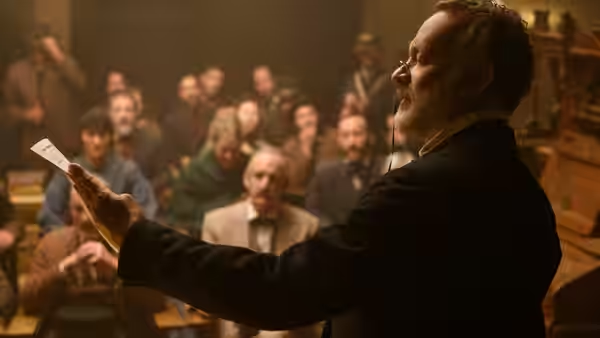
Hanks does what Hanks does, a little lower and quieter than usual. Kidd is a printer by trade with something in San Antonio he keeps not talking about, and the readings are the best of him: standing on a box, glasses on, giving a room of tired men a mine disaster in Pennsylvania and a fever outbreak down south, and knowing exactly when to pause. Between towns the script gives him less than it thinks.

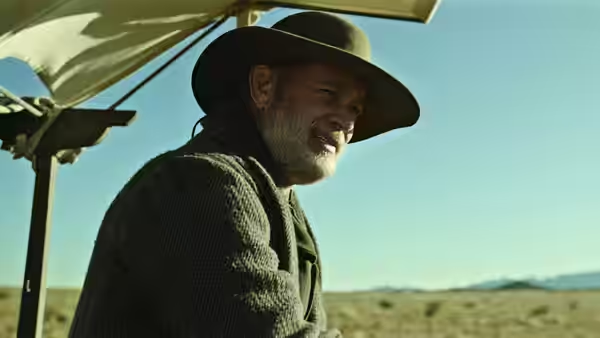
Dariusz Wolski shoots it wide and low, the grass the colour of old rope, the sky doing most of the work. He keeps the two of them small in the frame, a wagon on a hillside with weather coming. David Crank’s towns are mud and raw plank, with Union soldiers in the street five years after the surrender and nobody pleased about it. James Newton Howard’s score is strings and a sparse piano, mostly held back; it swells when the road opens out, and we could have done without the last bar of most of those swells.

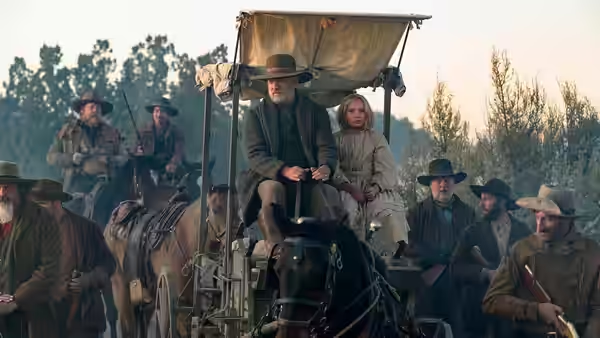
Then, on a ridge, the old Greengrass turns up. Almay (Michael Angelo Covino), the ex-soldier who tried to buy the girl in Dallas, follows them out of town with two friends, and for ten minutes the film becomes what its director does better than almost anyone: a fight in real space, where the distances matter, with a shotgun, too few shells and a child who turns out to be more use than expected. William Goldenberg cuts it fast and clean and we sat forward for the first time. We were properly gripped.

The middle hour is where it sags. There is a county run by a man named Farley (Thomas Francis Murphy) who prints his own newspaper and would like Kidd to read it, and the film’s point about who gets to tell the news is made so plainly that nobody in the audience could miss it, which is presumably the idea. There is a dust storm. We were restless, and a little annoyed at being restless in front of pictures this good.

Against the Westerns it borrows from, this is a gentle one. True Grit gave its girl a tongue and its man a bottle; The Searchers let its hero be poisonous. Kidd is neither, and Greengrass, who made United 93 without a single soft edge, has made a film in which nearly every edge is soft. And yet the last ten minutes, which we will not describe, caught us out. We had been dry-eyed for a hundred minutes and were suddenly not, and the credit belongs to Zengel’s face and to Hanks for letting it have the scene.

It runs 118 minutes and carries a 12, and there is nothing in it a twelve-year-old should not see, including one body hanging from a tree that the film is right not to cut away from. Watch it on a quiet night when you want a film to treat you decently. It will not surprise you, and it does not intend to.

Critical consensus AI synthesised

67
Positive
17
Mixed
7
Negative
3

Most critics like News of the World, though rarely with much heat. The praise clusters around Tom Hanks and Helena Zengel: his understated, decent Captain Kidd, her fierce and off-kilter Johanna, and above all the bond that grows between them, which nearly every review names as the reason to watch. The widescreen Texas landscapes come next, admired even by critics who dislike the film, and a few single out James Newton Howard’s score.

Where they part is over whether anything happens between the vistas. The mixed reviews find the story predictable, safe and a little slow, an old-fashioned Western that never surprises. The negatives go further: The Guardian finds it stolid and rarely alive as drama, Variety finds it handsome but dull, and Slant thinks its parable of a divided nation preachy and simplistic. The spread is wide, from warm raves to flat dismissals, but the middle settles on modest, comfortable approval.

Vulture
23 December 2020 · Bilge Ebiri
90*

Ebiri gives the film a strongly positive verdict, calling it hauntingly gorgeous and praising Tom Hanks’s moving performance. He also singles out the film’s expansive vistas and James Newton Howard’s sweeping score.

Read the full review →
The Hollywood Reporter
11 December 2020 · David Rooney
85*

Rooney finds the film soulful, affecting, and gently resonant, praising its intimate story of two people finding trust amid division. He singles out the nuanced performances by Tom Hanks and Helena Zengel, especially their shifting dynamic.

Read the full review →
Evening Standard
2 February 2021 · ★★★★ · Charlotte O'Sullivan
80

O’Sullivan finds the film daring and often world-class, though its attempt to find middle ground does not always succeed. She especially praises Helena Zengel’s off-kilter poise and enchanting performance.

Read the full review →
Radio Times
★★★★ · Terry Staunton
80

The review calls the film an evocative, atmospheric Western that remains faithful to genre conventions. It particularly praises the stunning photography and Tom Hanks’s reserved performance.

Read the full review →
Time Out
26 January 2021 · ★★★★ · Phil de Semlyen
80

The review calls the film an emotional, soulful western. It praises the performances of Tom Hanks and Helena Zengel.

Read the full review →
The i Paper
9 February 2021 · Geoffrey Macnab
78*

Macnab finds the film a handsome, moving western that renews familiar genre material with a contemporary perspective. He particularly praises Tom Hanks’s understated, layered performance and the convincing bond between Hanks’s character and the child.

Read the full review →

Straight answers AI written, from our review

Is News of the World worth watching?
News of the World is worth watching if you want a handsome, gentle Western that treats you decently, and we scored it 65. Helena Zengel, playing a girl raised by the Kiowa with barely a word of English, is the reason to see it, and one shootout on a ridge shows what Paul Greengrass can do. The middle hour sags, and the film will not surprise you.
How long is News of the World, and what is it rated?
News of the World runs 1h 58m. It is a drama and western film.
Where can I watch News of the World in Czechia?
News of the World is streaming on Netflix in Czechia. Availability is checked daily; the links above go straight to each service.
How does News of the World compare to True Grit?
News of the World is the gentler of the two, and True Grit is the better film. The Coens give their girl a sharp tongue and their gunman a bottle, and the result is funnier and sterner; Greengrass pairs a near-silent child with a decent man and leaves almost no hard edges. Choose True Grit for bite and News of the World for a quiet night.
Is News of the World based on a true story or a book?
News of the World is based on the novel by Paulette Jiles, not on a true story. The setting is Texas in 1870, five years after the Confederate surrender, and Captain Kidd's trade of reading newspapers aloud for ten cents a head comes from the book. You do not need to have read it; the film explains itself as it goes.
What should I watch after News of the World?
After News of the World, try True Grit (2010, Fi1m 84): The Coens’ girl-and-gunman Western, with a sharper child and a drunker man. Then The Homesman (2014, Fi1m 72): Tommy Lee Jones’s frontier road film, harder on the West and on its men.

Cast

If you liked this, try…

  1. True Grit (2010, Fi1m 84)The Coens’ girl-and-gunman Western, with a sharper child and a drunker man.

  2. The Searchers (1956) · not on Fi1m yetFord’s captive-child Western, and the one this film is politely arguing with.

  3. Paper Moon (1973) · not on Fi1m yetA con man and a small girl cross Depression Kansas; funnier and just as tender.

  4. Kikujiro (1999) · not on Fi1m yetKitano’s gruff stranger walks a boy across Japan; the same story, played for laughs.

  5. The Homesman (2014, Fi1m 72)Tommy Lee Jones’s frontier road film, harder on the West and on its men.

News of the World (2020) review: Hanks and Zengel carry a slow Western (Czechia) | Fi1m