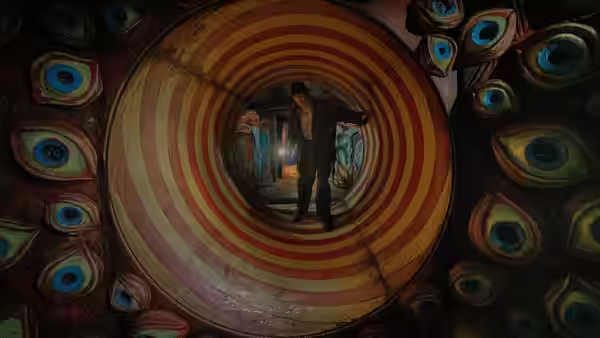
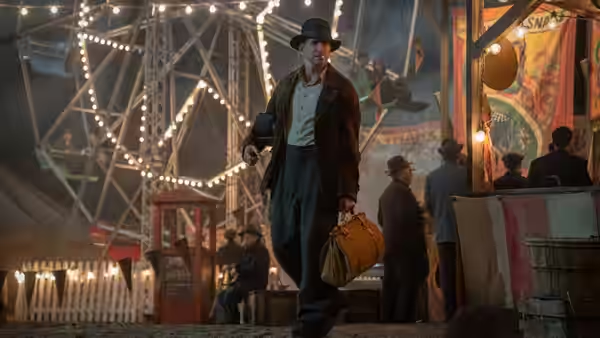
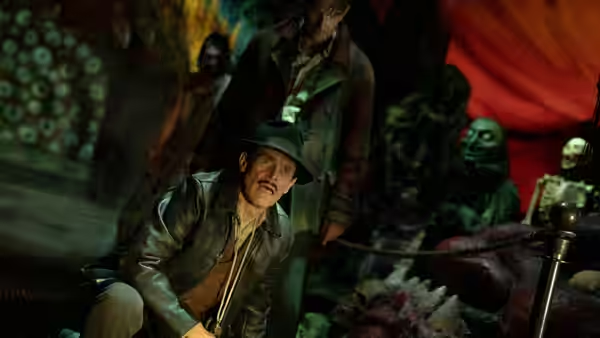
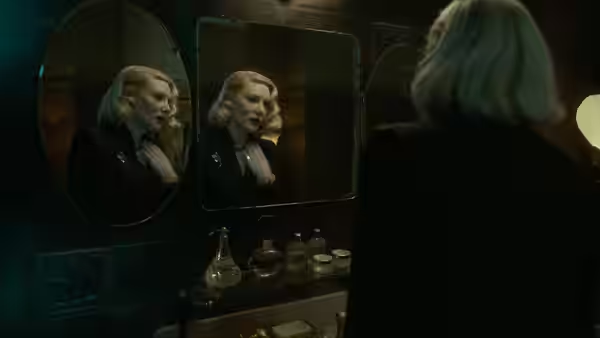
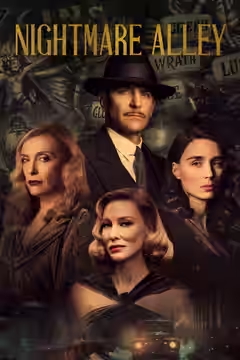
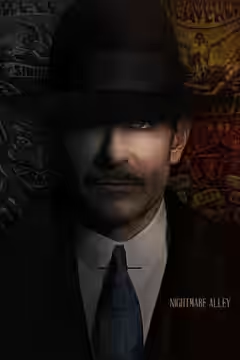
A scene from Nightmare Alley
Film review

Nightmare Alley

2021 · Directed by Guillermo del Toro · 2h 31m · MPA R

In a sentenceTwo and a half hours of immaculate mud, and Bradley Cooper’s teeth never lose their shine

A drifter, Stanton Carlisle (Bradley Cooper), burns down a house and arrives at a travelling carnival in the Depression. The owner, Clem Hoatley (Willem Dafoe), gives him a day’s work and shows him the geek, who bites the heads off live chickens. Stan learns the mentalist’s trade from Zeena the Seer (Toni Collette) and her husband Pete (David Strathairn), a drunk with a word code for reading minds, who warns him never to pretend to speak with the dead. He courts Molly Cahill (Rooney Mara), who takes electric current on stage under the eye of the strongman Bruno (Ron Perlman). Stan wants the code and a way out of the mud.

Plays from YouTube when you press play; nothing loads from them until then.

Fi1m review

Guillermo del Toro’s carnival noir is the best-looking film he has made and, for its first hour in the tents, one of his best. Then it moves to the city, slows down, and repeats itself for another ninety minutes.

Guillermo del Toro has made a film with no ghosts in it. Nightmare Alley, adapted with Kim Morgan from William Lindsay Gresham’s novel, follows a drifter called Stanton Carlisle (Bradley Cooper) into a Depression-era carnival, teaches him the mentalist’s trade, and sends him to the city to use it on people who can afford to be lied to. For its first hour, among the tents, it is close to his best work. Then it goes indoors and the air goes out of it.

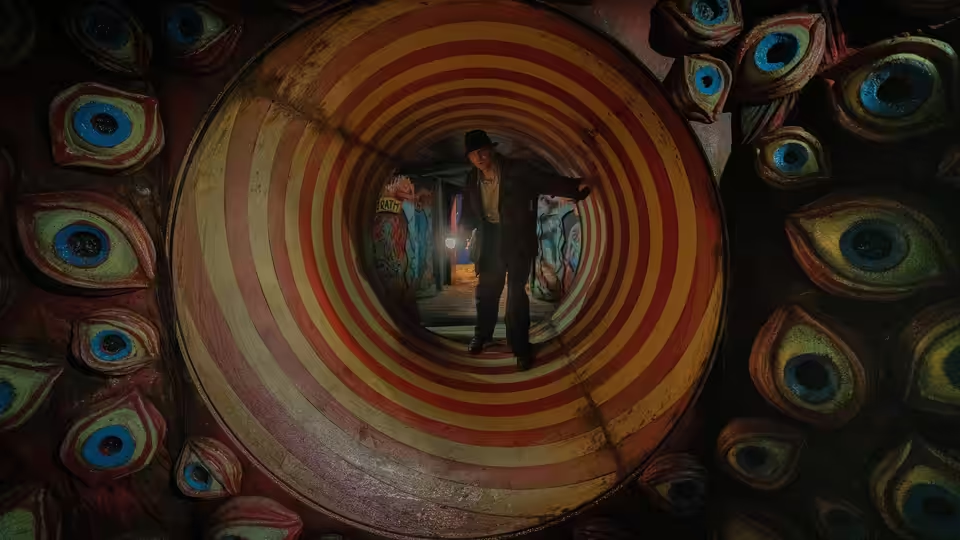
The carnival is a whole place, and Tamara Deverell built it in the mud. Dan Laustsen shoots the nights a deep blue with the lamps burning orange in them, so every face is half warm and half cold. Willem Dafoe runs the show as Clem Hoatley, and his account of how you make a geek, delivered like a man explaining how to keep a boiler going, is the most frightening speech in the film. We were repelled by the geek show, a man in a straw pit gnawing at a live chicken, and we stayed repelled, because del Toro films it plainly.

Toni Collette and David Strathairn are Zeena the Seer and her husband Pete, a ruined mentalist with a word code for reading minds. Strathairn plays Pete as a man who knows what his gift is for and drinks so he will not use it; his warning to Stan never to run a spook show is the film’s one moral. Collette is warm and sly and underused. Rooney Mara is Molly, with Ron Perlman as Bruno, the strongman who looks after her. Cam McLauchlin cuts these scenes slowly, and they can take it.

Then Stan and Molly leave for the city, and the film changes colour. Deverell’s city is green marble and snow, and Luis Sequeira puts Cooper in suits that get better as he gets worse. Cate Blanchett arrives as Dr. Lilith Ritter, a psychiatrist who sees through his act, and she is having a marvellous time. She holds her cigarette like a scalpel and delivers every line as though she has already read the last page. Richard Jenkins, as the rich and guilty Ezra Grindle, gives the second half its only real pain. But the con repeats where it ought to escalate. By the second séance we noticed we had stopped following Stan and started admiring the lamps.

The trouble is the lead. Stan is meant to fool everybody, himself first, and Cooper plays him as a man who has already been found out. In the carnival he is watchful and good. In the city he is knowing from his first line, and a man who knows has nowhere to fall from. Nathan Johnson’s score, low strings and the odd brass chord, tells us the ending is coming without hurrying towards it.

Del Toro keeps the novel’s ending, and it is the right one; the last few minutes did to us what the preceding hours had been reaching for, and we sat through the credits without moving. Whether that excuses 151 minutes of build we argued about and did not settle. Against del Toro’s record this sits with Crimson Peak (2015): the design is the star and the people are there to be dressed.

See it for the carnival, for Dafoe and Strathairn, and for Blanchett’s cigarette. It carries a 15, for a few bursts of brief, nasty violence. Do not wait for a monster; del Toro has decided, this once, that people will do.

Critical consensus AI synthesised

65
Positive
20
Mixed
1
Negative
9

Most critics come down in favour of del Toro’s noir, and the praise gathers in the same places. The production design and cinematography are admired almost everywhere, with the carnival half of the film repeatedly singled out for its grotesque detail. Bradley Cooper is widely thought to work against his usual charm, and Cate Blanchett’s femme fatale is a favourite even among reviewers who dislike the film around her.

The reservations cluster on length and polish. Many find it overlong, and a sizeable minority argue that so glossy a finish sits badly with a sleazy story; Vulture compares it to a fake dive bar and the Financial Times finds the deluxe finish pointless. The spread is wide: twenty positive reviews, nine negative, one in between, so critics tend either to fall for the world del Toro has built or to find it hollow. The New Yorker and The Times are the sharpest dissenters, finding it bloated and dull.

Los Angeles Times
16 December 2021 · Justin Chang
90*

The critic praises the film as a spectacularly grim neo-noir that treats the genre as a lavish funhouse, with Bradley Cooper’s brooding performance capturing the putrefaction of one man’s American dream. The intricately designed carnival world and Blanchett’s malevolent femme fatale are highlighted for their visual and performative richness.

Read the full review →
The Guardian
23 January 2022 · Peter Bradshaw
85*

The critic praises this neo-noir as a dazzling, deliciously damnable drama with human monsters and a bleak conclusion. Production design, cinematography and score are singled out for their evocative power.

Read the full review →
Empire
17 January 2022 · Ben Travis
80*

The review praises the enveloping atmosphere, compelling characters led by Cooper, gorgeous filmmaking, and del Toro's shift to noir while retaining his signature beastliness and detail.

Read the full review →
Little White Lies
18 January 2022 · 4/4/4 · Leila Latif
80

Del Toro delivers a deliciously dark, visually sumptuous neo-noir feast with architectural precision and lush textures, especially in the carnival and art-deco sequences. The critic praises Blanchett’s commanding turn and the pitch-black conclusion but notes some heavy-handed metaphors and an overlong runtime.

Read the full review →
Radio Times
★★★★ · Max Copeman
80

Del Toro delivers a luxurious love letter to film noir with high production values, glossy finish and a jet-black heart. Cooper subverts his charismatic image and Blanchett offers a glorious femme fatale, making this a handsome, fascinating character study despite its indulgent length.

Read the full review →
The Hollywood Reporter
2 December 2021 · Sheri Linden
80*

The critic praises del Toro's adaptation as a blood-dark jewel and luminous noir vision, highlighting the vivid worlds created, strong performances especially Cooper's, and the film's fluent direction, while noting some literal screenplay moments.

Read the full review →

Straight answers AI written, from our review

Is Nightmare Alley worth watching?
Nightmare Alley is worth watching for its first hour in the carnival, which is close to Guillermo del Toro's best work, and we scored it 66. Once it moves to the city it slows and repeats itself for another ninety minutes, so it suits patient viewers who will sit through 151 minutes for the design, for Dafoe and Strathairn, and for Cate Blanchett.
How long is Nightmare Alley, and what is it rated?
Nightmare Alley runs 2h 31m and is rated R by the MPA in the US. It is a crime and drama film.
Where can I watch Nightmare Alley in the US?
Nightmare Alley is available to rent from Apple TV from $3.99. Availability is checked daily; the links above go straight to each service.
How violent or frightening is Nightmare Alley, and is it suitable for children?
Nightmare Alley carries a UK 15 and a US R, for a few bursts of brief, nasty violence, and it is not for children. The geek show, a man in a straw pit gnawing at a live chicken, is filmed plainly and repelled us; there are no ghosts or monsters, but the cruelty is human and the tone is bleak throughout. Older teenagers with a taste for noir will manage it.
How does Nightmare Alley compare to Elmer Gantry?
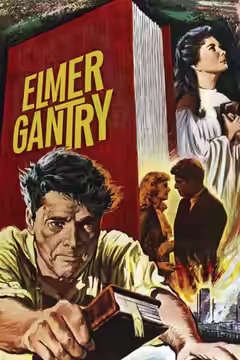
Nightmare Alley and Elmer Gantry tell the same con, one man selling people what they want to believe, but the earlier film does it louder, and Burt Lancaster's grinning salesman is the stronger lead by some distance. Del Toro's film is the better looking and the quieter, and both run too long and say things twice. Choose Elmer Gantry for the performance and Nightmare Alley for the carnival and the design.
Is Nightmare Alley based on a true story or a book?
Nightmare Alley is based on William Lindsay Gresham's novel, adapted by Guillermo del Toro with Kim Morgan; it is not a true story. Del Toro keeps the novel's ending, which we think is the right one, and the film's plainest moral, never pretend to speak with the dead, comes straight from the book's world. You need not have read it to follow the film.

Cast

Awards

Academy Awards, 2022

Nominated
Best Picture

If you liked this, try…

Nightmare Alley poster

Nightmare Alley

1947 · The first go at Gresham’s novel, with Tyrone Power at his least loved.

Freaks poster

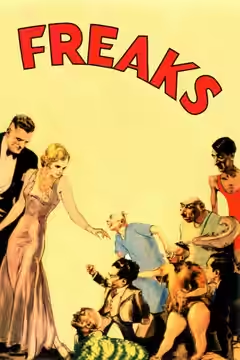
Freaks

1932 · The carnival film every other carnival film is quietly borrowing from, and still the strangest.

Elmer Gantry poster78

Elmer Gantry

1960 · Burt Lancaster sells salvation to people who want to be sold it; the same con, louder.

The Grifters poster84

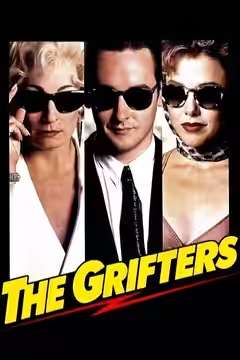
The Grifters

1990 · Three con artists, one family, no design budget to hide behind; Anjelica Huston is terrifying.

Santa Sangre poster

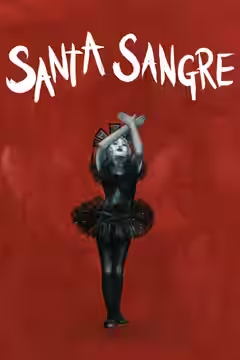
Santa Sangre

1989 · Jodorowsky’s circus of the damaged, if you found del Toro’s tents too tidy.