Dougal Wilson’s third Paddington film is kind, brisk and handsomely made, and Olivia Colman’s singing Reverend Mother is worth the ticket on her own. It is also the first of the three that plays like a sequel.
Three films in, Paddington leaves Windsor Gardens. A letter arrives from the Reverend Mother (Olivia Colman), who runs the Home for Retired Bears in Peru: Aunt Lucy is not herself. The Browns book flights, and by the time they reach the Home, Aunt Lucy has gone into the jungle. The rest is a river, a boat, a captain called Hunter Cabot (Antonio Banderas) and a search. Dougal Wilson directs, the first of the three not made by Paul King, from a script by Jon Foster, James Lamont and Mark Burton. It is kind and quick, and it is the first Paddington film that feels like a sequel.
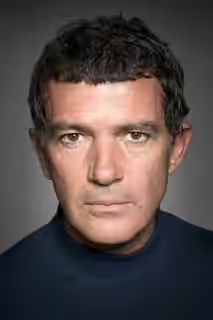
Colman is the reason to go. Her Reverend Mother greets the Browns with a guitar and a song about the pleasures of the Home, smiling so hard and for so long that the smile becomes the joke. We laughed out loud at Paddington’s passport photograph, a small, perfectly timed piece of slapstick, and after that we laughed mostly at Colman. Banderas plays Cabot as a riverboat captain with gold on his mind, and he throws himself at the moustache and the accent. Carla Tous, as his daughter Gina, is the one adult on the boat who is paying attention.
Erik Wilson photographs London in the warm reds and yellows the series has always used, and Peru in a green so bright it looks polished. The Home for Retired Bears, designed by Andy Kelly, is the best set in the film, a stack of painted balconies and hammocks on a mountainside where elderly bears take tea. Charlotte Walter puts the Browns in explorer khaki that never gets properly dirty. Dario Marianelli’s score adds pipes and brass to his usual bounce and tells us when to feel something. Úna Ní Dhonghaíle cuts it to 106 minutes and does not let a scene outstay itself.
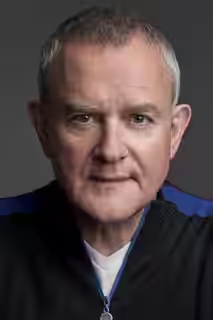
The trouble is that the Browns have less to do than before, so the script hands each of them a small thread. Henry (Hugh Bonneville) has been told by his new boss (Hayley Atwell) that he is too cautious, and spends the film learning to take risks. Mary (Emily Mortimer) worries that Judy (Madeleine Harris) is about to leave home and that Jonathan (Samuel Joslin) has stopped talking to her. These are decent ideas; the script announces each, then pays each off, and none of it surprised us. Once the boat sets off, the film becomes a run of set pieces, a rope bridge, a ruin, a ledge, each well built, none frightening. Peru itself is scenery.
The earlier films got at us sideways, when the bear was simply being polite to someone who had not earned it. This one has a theme, whether home is where you come from or where you are loved, and it is said aloud in the first act and then said again more than once before the end. The first time, we were touched, because Whishaw’s voice can make almost anything sound like it is being said for the first time. By the third, we had stopped feeling anything and were nodding along.
Paul King’s two films, in 2014 and 2017, were built out of small mechanical jokes that paid off twenty minutes later, and villains, Nicole Kidman’s taxidermist and Hugh Grant’s actor, who were allowed to be properly nasty. Wilson’s film has one such villain in Colman and keeps her offscreen for long stretches, and its jokes arrive, land and leave. It is careful in the way of something that has been approved rather than dreamed up.
Take the children, who will want to move into the Home for Retired Bears. Adults get Colman, a passport photograph and a bear who remains the politest creature in British cinema, and will spend the rest of the time thinking fondly about the film before this one. It carries a PG and never comes near troubling it.