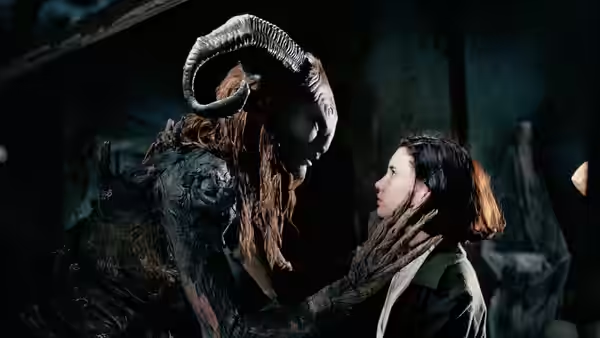
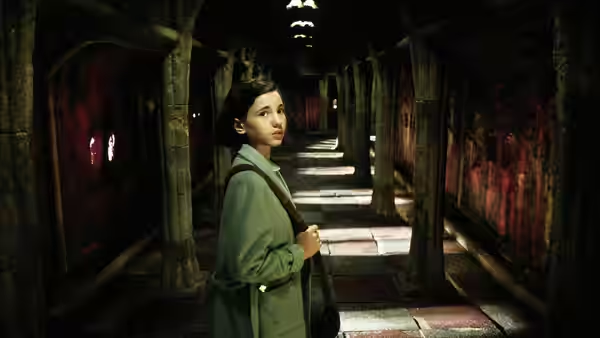
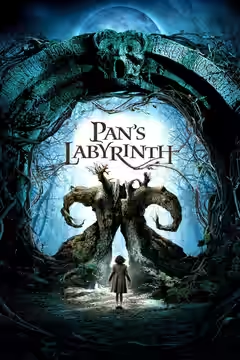
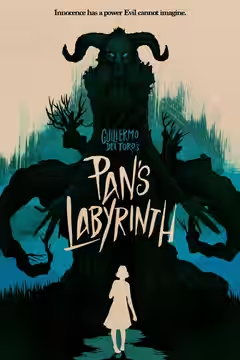
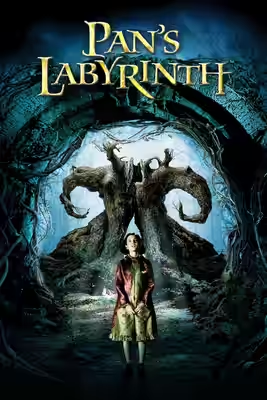
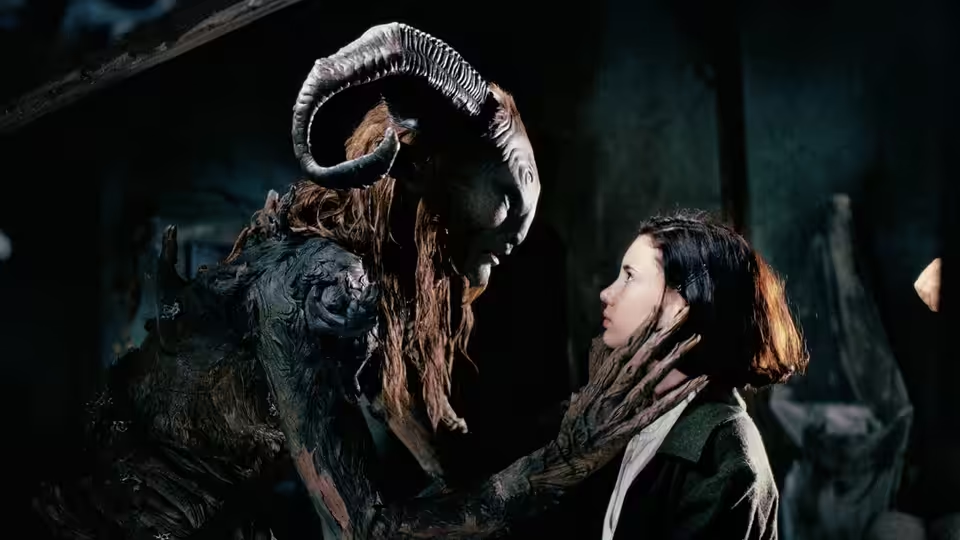
Fauno (Doug Jones) touching Ofelia's (Ivana Baquero) face in a dark chamber
Film review

Pan's Labyrinth

2006 · Directed by Guillermo del Toro · 1h 58m

In a sentenceA children’s story with a 15 certificate, and the certificate is right

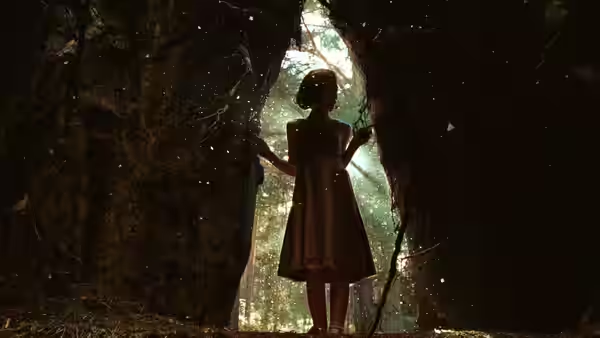
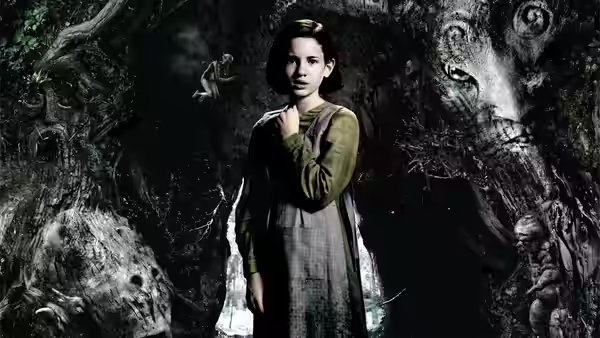
Spain, 1944. The Civil War is over and Franco has won, but fighters still hide in the northern woods. Ofelia (Ivana Baquero) is brought to an old mill with her mother Carmen (Ariadna Gil), pregnant and unwell. The mill is the garrison of Capitán Vidal (Sergi López), Carmen’s new husband, who wants his son born where he is and the partisans dead. On her first night a stick insect leads Ofelia into a stone labyrinth behind the mill, where a faun (Doug Jones) tells her she is the lost princess of an underground kingdom and must complete three tasks before the moon is full. The first sends her into a dying fig tree after a toad. Above ground, the housekeeper Mercedes (Maribel Verdú) watches the captain.

Plays from YouTube when you press play; nothing loads from them until then.

Fi1m review

Guillermo del Toro puts a fairy tale inside the aftermath of the Spanish Civil War, and the two halves feed each other more often than they fight. The world above ground is thinner than the one below it. We recommend it warmly, and not to children.

Guillermo del Toro has made a fairy tale set in Spain in 1944, five years after the Civil War ended and the wrong side won. A girl finds a faun in a labyrinth; a captain hunts partisans in the woods above her. It is the most complete film del Toro has made, and we recommend it with two cautions: the mill is less alive than the labyrinth, and the certificate means what it says.

Capitán Vidal (Sergi López) has set up his garrison in an old mill, and his new wife Carmen (Ariadna Gil), pregnant and ill, is brought there with her daughter Ofelia (Ivana Baquero). López plays Vidal as a man who has arranged his life to leave no gap for feeling. He shaves with a straight razor and speaks to the people he is about to hurt in the voice he uses to order dinner. He questions a farmer and his son about a rabbit, and what he then does with a wine bottle made us look away. We do not look away often. Guillermo Navarro shoots the mill in blue-grey, rain on the stone, lamplight that never reaches the walls.

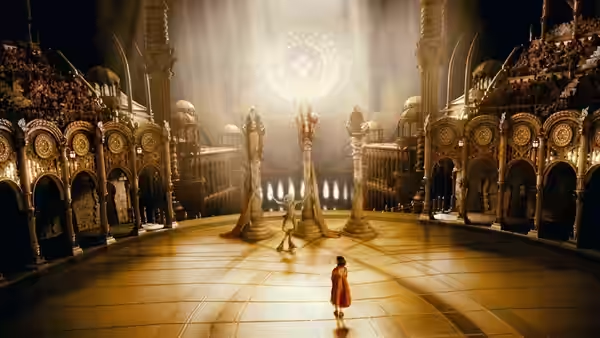
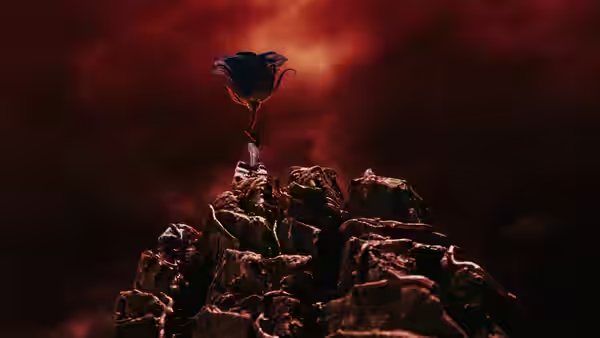
Below it, another palette. Eugenio Caballero’s labyrinth is a ring of mossed stone with a stair down its centre, and the places it leads to are amber and red. The Faun (Doug Jones) creaks when he moves, and has bark for skin and eyes set too wide to read. Javier Navarrete’s score is built on a lullaby that Mercedes (Maribel Verdú) hums without words, and it returns under both worlds until you stop knowing which it belongs to. Del Toro and his editor Bernat Vilaplana cross between them by sliding the camera behind a tree trunk or a pillar, so there is hardly a cut between the captain and the creatures.

One sequence we will describe only as far as its door. Ofelia draws a doorway in chalk and steps into a long dining hall, a table laid with fruit and meat, and at its head a thing with sagging skin, no eyes in its face and its hands folded on its plate. Paintings on the walls show what it eats. Nothing moves for a long time. We were frightened in the way a picture book frightens a child, by a thing that has not yet woken up, and we have not been frightened like that by a film since.

The weaknesses are all above ground. Carmen is a sickbed and a warning, and Gil is given little to play beyond pain and disappointment. The partisans in the hills, among them Mercedes’s brother Pedro (Roger Casamajor), are a cause rather than people. Some critics found the mill duller than the labyrinth and the join between them forced, and we half agree: the war scenes are made with less invention than the fantasy. But we think del Toro means the real world to look poorer than the story, and Vidal’s cruelty needs no design to land.

Verdú plays Mercedes as a woman who has worked out exactly how much she can risk and does not flinch when the sum changes. Baquero carries the film without the tricks child actors are taught: she listens, she is stubborn, and when told she is a princess she looks not delighted but unsure whether to believe it. Lala Huete puts her in a dark green dress with a white collar for the captain’s dinner, and she ruins it in the mud of the fig tree within the hour.

Set against del Toro’s films, this is where the pieces fit. Cronos (1993) had the creatures and The Devil’s Backbone (2001) had the war and the children; Hellboy (2004) had the budget and not much else. Here the monsters and the history need each other, and at 118 minutes there is no fat on it.

Watch it with the lights off and the sound up, and do not let anyone under fifteen talk you round, however much the trailer looks like a story for them. The last ten minutes moved us more than we expected, and we knew what was coming.

Critical consensus AI synthesised

81
Positive
8
Mixed
2
Negative
0

The reviews are warm, and most are more than warm. Critics agree that del Toro has set a fairy tale down in the Spain of 1944 and made both halves darker for the contact. The praise clusters on the fantasy: the creature designs, the detail of the world beneath the labyrinth, the look of the film as a whole. Sergi López’s captain is singled out, and several critics note that the monsters below are there to echo the brutality above rather than to decorate it.

The reservations are about the join. The Guardian finds the political, overground half far less alive than the dreamscape beneath it, and misses any real narrative drive. Slant goes further, calling the split between reality and fantasy almost pathological and the characters thin. Time Out, writing years later, admires the design but finds the storytelling disjointed. The spread is moderate: nobody dislikes it, but the two mixed notices come from serious quarters and share the same complaint.

Empire
27 October 2006 · Kim Newman
90*

Del Toro has delivered his masterpiece to date, a companion piece to The Devil's Backbone that entwines fairy-tale fantasy with war-movie horror to startling effect.

Read the full review →
The Hollywood Reporter
27 May 2006 · festival review · Ray Bennett
90*

The critic praises del Toro’s engrossing fable that weaves a young girl's fantastical tasks with the brutal reality of Franco's Spain, highlighting the mesmerizing visuals and strong performances, especially Sergi López as the villainous captain.

Read the full review →
Total Film
24 November 2006
90*

A dark and majestic piece of fantasy that dissects the horror of fascism under the guise of a fairy-tale flick; it will likely stand as one of the year's best films.

Read the full review →
Time Out
9 April 2020 · ★★★★
80

The critic describes the film as an unusual, adult take on a familiar fairy-tale archetype, unsuitable for children due to its graphic violence and lessons about the limits of fantasy against repression. Del Toro excels as a filmmaker with grotesque, detailed fantasy designs and cinematic references, though the story form and execution feel somewhat disjointed.

Read the full review →
Slant Magazine
6 September 2006 · Ed Gonzalez
60*

The review notes the film's clean split between reality and fantasy as almost pathological, criticizing insufficient dramatization of relationships and cardboard characters, but praises the wondrous fantasy sequences and spiritual center.

Read the full review →
The Guardian
24 November 2006 · Peter Bradshaw
60*

The critic finds the film's political dimension less successful than its fantasy elements, with asymmetric energies between the historical surface world and the energetic subterranean dreamscape. He praises the extraordinary monster designs and visual images but notes a lack of overall narrative drive.

Read the full review →

Straight answers AI written, from our review

Is Pan's Labyrinth worth watching?
Pan's Labyrinth is worth watching for adults who can take a fairy tale with real cruelty in it, and we scored it 87. The labyrinth is more alive than the mill above it, and the war scenes are made with less invention than the fantasy, but the two halves need each other and the last ten minutes moved us more than we expected.
How long is Pan's Labyrinth, and what is it rated?
Pan's Labyrinth runs 1h 58m. It is a fantasy and drama film.
Where can I watch Pan's Labyrinth in Poland?
Pan's Labyrinth is not on any streaming or rental service in Poland at the moment. It is available in 5 other countries; change your country at the top of the page to see where. Availability is checked daily.
How violent or frightening is Pan's Labyrinth, and is it suitable for children?
Pan's Labyrinth carries a 15 certificate and it is right: this is not a film for children, however much the trailer looks like one. Capitán Vidal's violence is brief, plain and hard to watch, and one interrogation made us look away. The creature in the dining hall frightened us as a picture book frightens a child, which is to say thoroughly.
How does Pan's Labyrinth compare to The Spirit of the Beehive?
Pan's Labyrinth is the louder and more violent of the two, with a faun, a labyrinth and a captain hunting partisans; The Spirit of the Beehive gives its child only Frankenstein and silence. Erice's film is quieter, slower and holds us at more of a distance, while del Toro's is the fuller piece of work. Watch Erice if you want stillness, del Toro if you want the monsters.
What should I watch after Pan's Labyrinth?
After Pan's Labyrinth, try The Spirit of the Beehive (1973, Fi1m 87): A child in Franco’s Spain meets a monster of her own; quieter, and just as sad. Then Spirited Away (2001, Fi1m 92): A girl bargains her way through a spirit world where every meal has a price; and The Night of the Hunter (1955, Fi1m 91): Two children flee a preacher with a knife; a fairy tale told by moonlight.

Cast

Awards

Academy Awards, 2007

Nominated
Best International Feature Film
Nominated
Best Original Score
Nominated
Best Writing, Original Screenplay
Won
Best Cinematography
Won
Best Makeup and Hairstyling
Won
Best Production Design

Hugo Awards, 2007

Won
Best Dramatic Presentation, Long Form

Ignotus Award for Best Audiovisual Production, 2007

Won
Ignotus Award for Best Audiovisual Production

International Submission to the Academy Awards, 2007

Nominated
International Submission to the Academy Awards

Saturn Awards, 2007

Won
Best International Film

Central Ohio Film Critics Association Award for Best Foreign Language Film, 2006

Won
Central Ohio Film Critics Association Award for Best Foreign Language Film

If you liked this, try…

  1. The Devil's Backbone (2001) · not reviewed yetDel Toro’s earlier Civil War ghost story; the same war, the same care, fewer creatures.

  2. The Spirit of the Beehive (1973, Fi1m 87)A child in Franco’s Spain meets a monster of her own; quieter, and just as sad.

  3. Tigers Are Not Afraid (2017) · not reviewed yetMexican children orphaned by the cartels, with ghosts and wishes; del Toro’s method, sharper teeth.

  4. Spirited Away (2001, Fi1m 92)A girl bargains her way through a spirit world where every meal has a price.

  5. The Night of the Hunter (1955, Fi1m 91)Two children flee a preacher with a knife; a fairy tale told by moonlight.

Free account

Know what to watch tonight

Two lists that know where things are streaming, collections you can share, your own score beside ours, and Discover that remembers what you have seen.

  • Want to see, sorted by what is streaming now
  • Seen, with your score out of ten
  • No adverts, ever