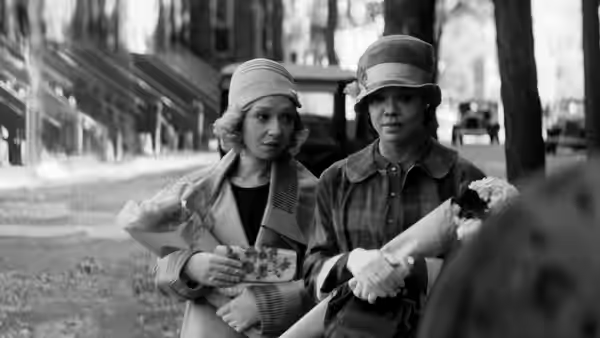
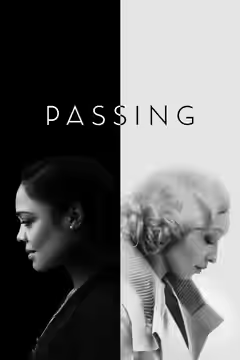
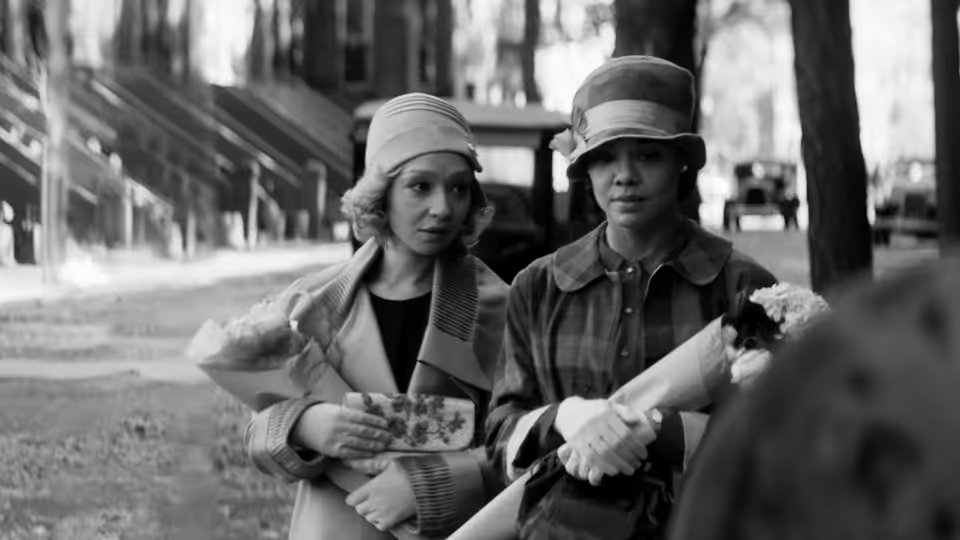
Clare Kendry (Ruth Negga) and Irene Redfield (Tessa Thompson) walk together along a city sidewalk
Film review

Passing

2021 · Directed by Rebecca Hall · 1h 38m

In a sentenceTessa Thompson and Ruth Negga make the pauses in a conversation feel like the dangerous part

In Harlem, Irene Redfield (Tessa Thompson) is caught between envy and longing as she regards Clare Kendry (Ruth Negga). Irene’s world also includes Brian Redfield (André Holland) and John Bellew (Alexander Skarsgård), but her attention keeps returning to Clare. She tries to understand the other woman while contending with fears and insecurities of her own. Conversations leave important feelings unspoken, and the attention the women give one another complicates any simple explanation of their relationship. Questions of racial identity sit alongside questions of desire, with Irene’s perceptions shaping what can be understood about either woman.

Plays from YouTube when you press play; nothing loads from them until then.

Fi1m review

Rebecca Hall’s Passing is an unsettling drama carried by Tessa Thompson and Ruth Negga, whose silences deserve close attention. Its careful manners sometimes dampen the tension, but we recommend it for the uneasy intimacy between its leads.

Rebecca Hall’s Passing is an absorbing drama, even when its restraint becomes excessive. Working from a novel by Nella Larsen, Rebecca Hall puts Irene Redfield’s fascination with Clare Kendry at the centre of a story about racial identity and desire. Much depends on our willingness to study Irene as closely as she studies Clare. Tessa Thompson and Ruth Negga make that an invitation worth accepting.

Tessa Thompson plays Irene with a composure that never looks comfortable. The effort of keeping her feelings contained is always there, and her attention to Clare leaves us wondering how much she understands about herself. We felt uneasy during the silences between them, because Irene’s scrutiny seems too intense to be harmless. Tessa Thompson makes that discomfort precise without reducing it to a single emotion. Envy, attraction and fear can all occupy the same look.

Ruth Negga gives Clare enough allure to make that attention understandable, without making her simply an object for Irene to study. There is a person here whose wants matter, even when we cannot confidently name them. Their chemistry gives the conversations a charge that the dialogue does not always manage on its own. The performances allow us to entertain several explanations for an exchange, and neither actor appears to be waiting for the screenplay to settle the matter.

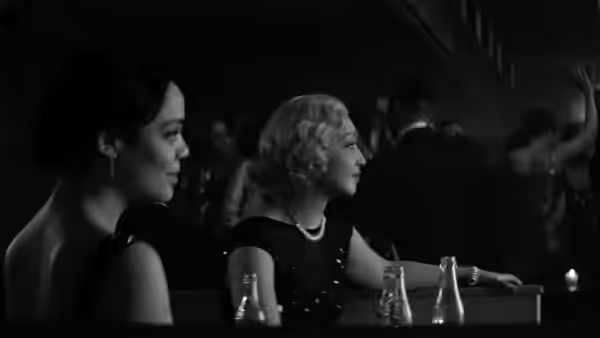
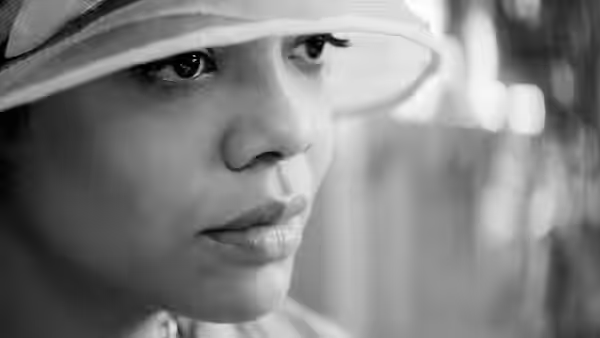
Eduard Grau’s black-and-white cinematography keeps the women compelling to look at without making them easy to read. The delicacy of the greys suits the performances, while the enclosed feel of the images makes such close attention uncomfortable. Nora Mendis’s production design contributes to that controlled atmosphere, though its refinement can occasionally make the people seem too carefully placed. We are most interested when an expression threatens to upset the composure of the picture.

Sabine Hoffmann’s editing gives the performances time to register, and the patient pace usually earns its keep. We can follow a change in feeling without having a line of dialogue explain it immediately. Dev Hynes’s music leaves less of an impression than the faces, which feels the right proportion for this film. At 98 minutes, Passing has room to pause; the trouble comes when a pause seems to repeat what the previous one has already told us.

Some of Rebecca Hall’s dialogue is too decorous for the feelings underneath it. Conversations occasionally lose their urgency, and the later passages feel hurried after so much measured attention to the women. That unevenness matters because Irene’s doubts need time to become ours, and a rush through them makes the uncertainty harder to share. The film is right not to explain every motive, but it sometimes leaves us sorting out the storytelling when we ought to be watching the people.

As a literary adaptation, this works best when it lets the actors suggest feelings that a longer explanation could make too tidy. Its limitations did not keep us at a distance from Irene and Clare, and their encounters stayed with us afterwards. We recommend it for those performances, with the caveat that its quietness occasionally becomes stiffness. Choose an evening when the conversation on the sofa can wait until afterwards.

Critical consensus AI synthesised

76
Positive
17
Mixed
6
Negative
1

Most critics respond warmly to Passing, with praise clustering around Tessa Thompson and Ruth Negga’s performances and Rebecca Hall’s restrained direction. The leads’ chemistry, charged silences and careful expressions give the film’s treatment of racial identity, desire and envy much of its force. The black-and-white cinematography also draws consistent approval, often alongside Hall’s patient visual storytelling. For many reviewers, that restraint allows complicated feelings to emerge without spelling them out.

The spread is wide, however, and the chief disagreement concerns how much the film’s reserve costs it emotionally. Some otherwise favourable reviews find the later stretches rushed or unfocused, while mixed assessments describe stiffness, chilliness and repetitive conflicts. Total Film admires the central chemistry but argues that the adaptation sidesteps the novel’s complex ideas. Sight and Sound offers the sharpest dissent, praising the acting, especially Negga, but finding the film stilted and emotionally flattened.

Time Out
1 February 2021 · ★★★★★ · Dave Calhoun
100

Calhoun calls the film a stunning investigation of race, sexuality and identity. He praises its treatment of these themes in Jazz Age Harlem.

Read the full review →
IndieWire
30 January 2021 · A- · Kate Erbland
90

Erbland finds Hall’s adaptation beautiful, bruising, and compelling, praising it as a formidable debut. She especially singles out Thompson and Negga’s performances, with Thompson’s restrained intensity building to a searing effect.

Read the full review →
The New Yorker
9 November 2021 · Richard Brody
90*

Brody praises the film as an emotionally resonant and stylistically refined adaptation. He singles out Hall’s visual approach and Tessa Thompson’s expressive performance, especially the way the film makes Irene’s gaze central.

Read the full review →
Variety
31 January 2021 · Critic's Pick · Jessica Kiang
86*

Kiang praises the film as an intimate, intelligent and compassionate directorial debut, finding its subtle story of envy and longing compelling. She especially singles out the performances of Tessa Thompson and Ruth Negga, along with the luminous black-and-white cinematography.

Read the full review →
Los Angeles Times
26 October 2021 · Justin Chang
85*

Chang finds the film a beautifully crafted, transfixing adaptation with subtle emotional and racial complexities. He especially praises Rebecca Hall’s visual direction and the precise performances of Tessa Thompson and Ruth Negga.

Read the full review →
The Hollywood Reporter
31 January 2021 · festival review · David Rooney
85*

The critic finds the film thoughtful, provocative, and emotionally resonant. He singles out Tessa Thompson and Ruth Negga’s exquisite performances as its pulsing emotional center.

Read the full review →

Straight answers AI written, from our review

Is Passing worth watching?
Passing is worth watching for its unsettling intimacy and Tessa Thompson and Ruth Negga’s performances; we score it 80 out of 100. We recommend it to viewers who enjoy patient, performance-led drama, with the caveat that its restrained conversations sometimes become stiff and its later passages feel hurried.
How long is Passing, and what is it rated?
Passing runs 1h 38m. It is a drama film.
Where can I watch Passing in Spain?
Passing is streaming on Netflix in Spain. Availability is checked daily; the links above go straight to each service.
How violent or frightening is Passing, and is it suitable for children?
Passing has a UK 12A certificate, meaning children under 12 need an accompanying adult at the cinema, and its uneasy drama is better suited to teenagers and adults. We find the tension in Irene’s intense scrutiny of Clare and the feelings their conversations leave unspoken; the certificate alone does not establish how much violence or frightening material it contains.
How does Passing compare to Imitation of Life?
Passing is quieter and more restrained than Imitation of Life, another drama about racial passing that allows its feelings to spill over. We find Passing’s central pairing more consistently compelling, though its restraint can become stiffness; Imitation of Life offers more overt emotion, with Juanita Moore and Susan Kohner giving it a force that Lana Turner’s thinner storyline lacks.
Is Passing based on a true story or a book?
Passing is adapted from a novel by Nella Larsen, rather than presented as a true story. We recommend it without requiring familiarity with the book: Thompson and Negga make racial identity, desire and uncertainty compelling through their performances, and the adaptation works best when it lets them suggest feelings rather than explain them.
What should I watch after Passing?
After Passing, try Imitation of Life (1959, Fi1m 86): Another account of racial passing, with feelings allowed to spill over. Then Brief Encounter (1945, Fi1m 90): For another drama where manners make unspoken desire harder to bear; and Persona (1966, Fi1m 89): Two women, close scrutiny, and performances that make certainty increasingly difficult.

Cast

If you liked this, try…

  1. Imitation of Life (1959, Fi1m 86)Another account of racial passing, with feelings allowed to spill over.

  2. Brief Encounter (1945, Fi1m 90)For another drama where manners make unspoken desire harder to bear.

  3. Persona (1966, Fi1m 89)Two women, close scrutiny, and performances that make certainty increasingly difficult.

  4. Far from Heaven (2002, Fi1m 87)For the racial tensions and forbidden desires beneath carefully maintained appearances.

  5. The Handmaiden (2016, Fi1m 85)A more expansive treatment of desire, class and the risks of misreading.