Spielberg’s adaptation of Ernest Cline’s novel is built with extraordinary skill and runs on other people’s inventions. The virtual races and raids are as good as anything he has staged in years; the human beings in front of them barely register.
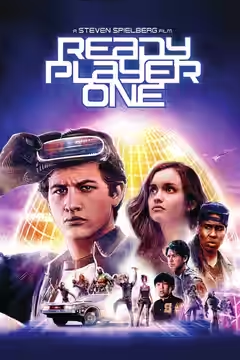
Steven Spielberg has adapted Ernest Cline’s novel about a treasure hunt inside a video game, and he has made two films with it. The one set inside the OASIS, the virtual world where most of humanity spends its days in 2045, is as fast and as cleverly staged as anything he has directed in years. The one set outside it, in a Columbus, Ohio slum of stacked trailers, is thin and hurried, and its people never quite convince. The first film keeps interrupting itself to tell us to log off and go outside, which is an odd message for 140 minutes of spectacle to carry.
The race is the best of it. The first of Halliday’s three challenges sends every avatar in the game hurtling through a virtual New York in cars borrowed from forty years of films and cartoons, while the road folds up ahead of them and King Kong waits near the finish. Janusz Kamiński’s camera goes wherever it likes, under the wheels and through the windscreens, and Michael Kahn and Sarah Broshar cut it so that we always know where Parzival is and what he is about to hit. We grinned through the whole of it.
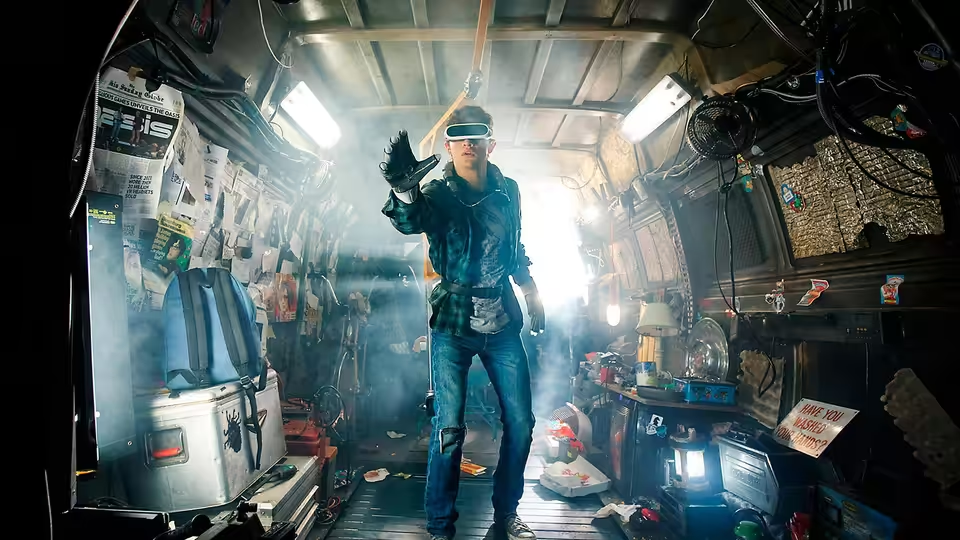
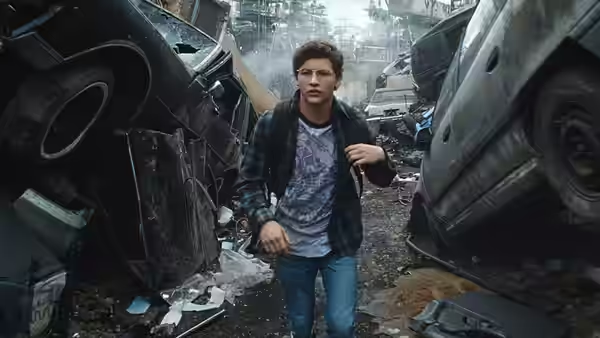
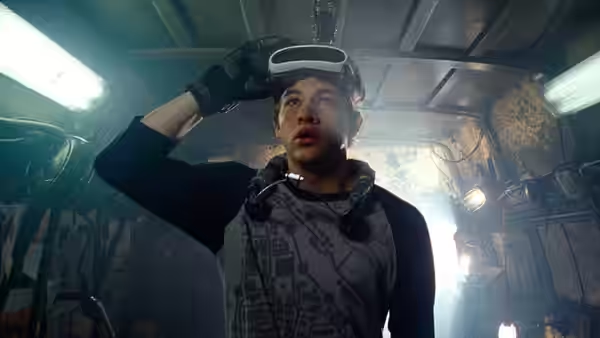
Adam Stockhausen builds the real Columbus as rust and scaffolding, a leaning trailer on every level and a dish on every trailer, and IOI’s headquarters as the kind of glass box where nobody has a plant. Kasia Walicka Maimone puts the players in scuffed haptic suits and visors that make them look faintly silly, which is honest of her. Alan Silvestri’s score brings in the brass at every gate and every key, and it is well played and never once surprised us.
The other stretch worth the ticket takes the hunt into the corridors of The Shining, rebuilt room by room so that Wade’s friends can wander Kubrick’s hotel while the one who has never seen the film keeps opening the wrong doors. It is witty about horror in a way the rest of the picture is never witty about anything. It is the only time a reference is used to make a joke.
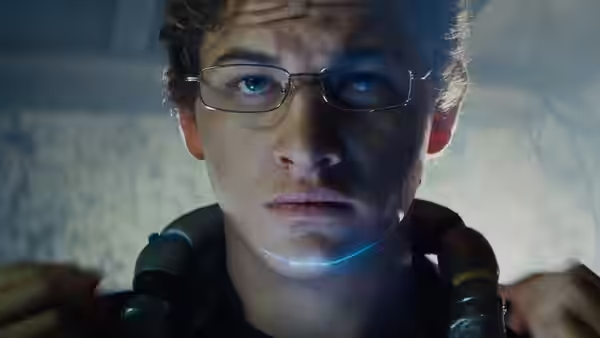
The people are the trouble. Tye Sheridan is pleasant and mostly blank as Wade, and the script by Zak Penn and Cline gives him a voiceover to explain his feelings because the face is not going to. Olivia Cooke is sharper as Samantha than the film lets her be as Art3mis, and Lena Waithe’s Aech is the friend you would want at your side in any raid. Ben Mendelsohn plays Sorrento as a middle manager who has skimmed a pamphlet on villainy, and he is the funniest thing outside the game. Mark Rylance’s Halliday, glimpsed in old recordings and mumbling at his shoes, is the only person in the film who seems to have an inner life. Simon Pegg turns up as Halliday’s old partner and is given little to do.
Then there are the references, hundreds of them, the Iron Giant and the DeLorean and a Chucky doll, arriving so fast that recognising them becomes the film’s idea of pleasure. Nothing in the OASIS is new. Its treasure is other people’s property, and the film’s affection for it never turns into a thought about it. Somewhere in the last forty minutes we noticed we were tired, and that the sight of a thousand borrowed characters charging across a field was not thrilling us at all. It looked like an inventory. That is a strange feeling to have at a Spielberg film, and we did not enjoy it.
He used to do this with one thing. E.T. the Extra-Terrestrial (1982) has a boy and a creature in a cupboard. Jurassic Park (1993) makes us wait an hour for the dinosaur and then shows us a glass of water trembling on a dashboard. Here the wonder is meant to come from quantity, and nobody has ever wept at a quantity.
See it large if you can, for the race and the hotel, and do not expect to remember anyone’s name afterwards. At home the final battle becomes a smear and the quiet scenes get quieter, which does them no favours. It runs 140 minutes and carries a 12A.