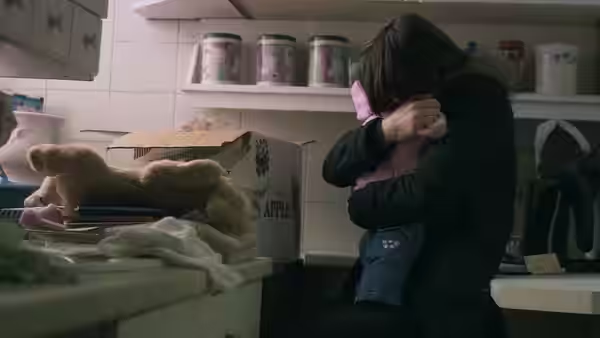
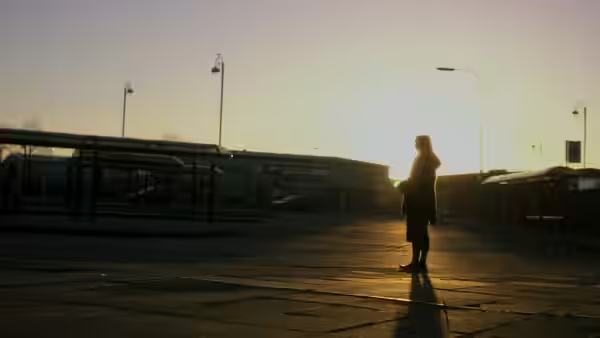
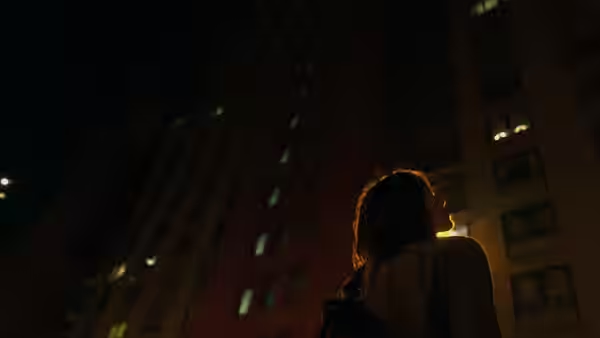
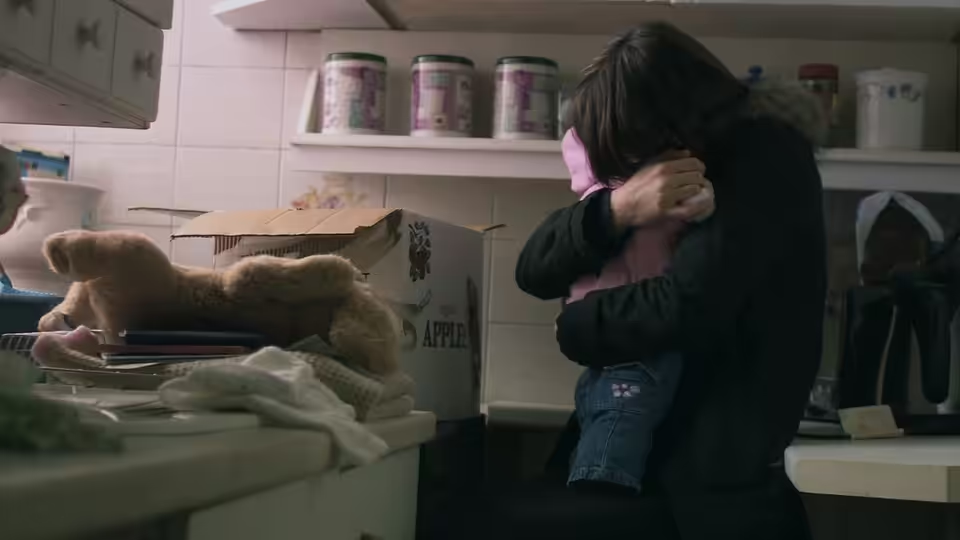
A woman embraces a child beside a counter piled with toys and household goods
Film review

Red Road

2006 · Directed by Andrea Arnold · 1h 53m

In a sentenceThe night shift in a Glasgow CCTV room, where the most dangerous thing on the wall of screens is the woman watching them

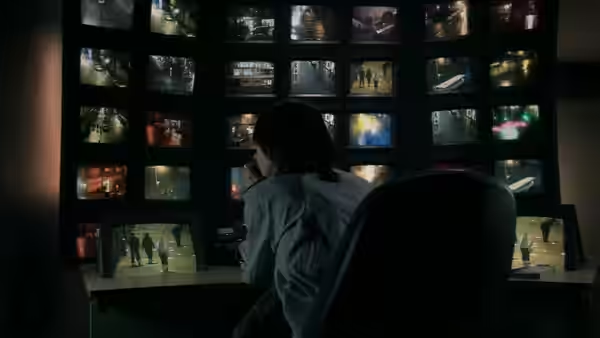
Glasgow, now. Jackie (Kate Dickie) works nights in a CCTV control room, watching a wall of monitors trained on the streets around the Red Road flats. She knows her regulars: a man walking an old dog, a cleaner who dances with her mop when she thinks nobody is looking. She lives alone and keeps to herself. Then one night a man appears on her screens whom she recognises: Clyde Henderson (Tony Curran), recently out of prison and lodging in the towers with Stevie (Martin Compston) and his girlfriend April (Natalie Press). Jackie begins to follow him, first on her monitors and then on foot, and for a long time the film does not say why.

Plays from YouTube when you press play; nothing loads from them until then.

Fi1m review

Andrea Arnold’s first feature is a tight, watchful thriller built on Kate Dickie’s face and Robbie Ryan’s camera, and for ninety minutes we could not look away. The reason it eventually gives for all that watching is weaker than the watching itself.

Andrea Arnold’s first feature is about a woman who watches, and it is nearly as good as its idea. Jackie (Kate Dickie) spends her nights in front of a wall of CCTV monitors covering a patch of Glasgow that includes the Red Road flats, and the film spends its first hour making us watch with her. Arnold wrote it with Lone Scherfig and Anders Thomas Jensen credited alongside her, and what she has made is a close, tense thriller that holds its nerve for ninety minutes and loses some of it in the last twenty. We recommend it, with that caveat and one more about the certificate.

Dickie carries the film and does it mostly with her eyes. For long stretches she has no lines, only a face lit by monitors, and Arnold trusts her to tell us when something on the screens has changed. Jackie is kind to her regulars, zooming in to check on a man walking an old dog, smiling at a cleaner who dances with her mop, and then Clyde Henderson (Tony Curran) walks into frame and the kindness goes out of her. Dickie does not play grief or rage. She plays a woman who has decided something and will not say what, and when she leaves the control room to follow him on foot the film gets more frightening because we know less than she does.

Robbie Ryan shoots it close and handheld in the grey light Glasgow offers in winter, and he lets the monitor footage look like monitor footage: grainy, faintly green, Clyde’s face breaking into squares when Jackie zooms too far. The towers are photographed from the ground so they seem to lean over the street. Nicolas Chaudeurge cuts between the control room and the pavement so that we are often unsure whether we are seeing a thing happen or a recording of it, which is the point. Helen Scott gives Jackie a flat with nothing out of place and Clyde a mattress on the floor and a kettle. Carole Fraser keeps Jackie in a dark work fleece with her hair scraped back, and Glenn Gregory’s music is so sparse that most of what we hear is the city.

Curran is good enough that we understood why Jackie cannot stop looking at him and why she would rather not. His Clyde is loud, free with drink, quick to put a hand on a shoulder, and plainly capable of harm, and the film does not say which of those is the act. Martin Compston’s Stevie and Natalie Press’s April, the young couple he lodges with, are sketched in a few strokes but true ones; Press makes April’s chatter sound like someone trying to be liked. The night Jackie follows Clyde into a party in the flats had us properly tense. The camera stays on her back in a crowded hallway, nobody there knows who she is, and we found we were not breathing evenly, and were slightly cross with ourselves, because Arnold had done it with a corridor, a crowd and a woman who will not turn round.

What does not quite work is the answer. Arnold withholds Jackie’s reason for most of the running time, and when it arrives it comes in a scene of explanation, the kind of scene the film had until then been too careful to need. It is not a bad reason, and Dickie plays the telling as well as she plays the silence, but it is smaller than what we had been imagining, and the final stretch that follows is neater than anything before it. There is also an encounter in the second half that earns the 18 certificate on its own. We think it is honest and we think both actors are brave in it; we also know people who will not want it in the living room on a weeknight, and they should be told.

Arnold went on to make Fish Tank (2009), and that film’s restless girl and this film’s still woman are from the same hand: a camera that stays too close, a refusal to explain anyone until it has to. Red Road is the colder of the two and the more controlled. Watch it with the lights off. It runs 113 minutes and we did not look at the clock until the explanation arrived.

Critical consensus AI synthesised

70
Positive
10
Mixed
4
Negative
0

Most critics admire Red Road, and ten of the fourteen reviews recommend it. The praise lands first on Kate Dickie’s lead performance, described repeatedly as restrained, self-contained and haunted, with Tony Curran’s Clyde noted as a convincingly feral counterpart. Nearly as often the reviews single out Robbie Ryan’s cinematography and Andrea Arnold’s surveillance-like framing, which make a grim corner of Glasgow feel both menacing and compassionate. Several call it a slow burn that stays suspenseful, and an assured debut.

The reservations gather almost entirely around the final act. Reviewers who like the film still find the late reveal implausible, the resolution less convincing than the realism before it, and the pacing stretched. The spread runs from fifty to the mid-eighties, with no outright pans. The sharpest dissent comes from Slant Magazine, which argues that the naturalistic style sits badly with a manipulative revenge plot, and Variety, which calls the ending overwrought.

Total Film
27 October 2006 · ★★★★ · Total Film
80

The review calls the film a controlled, humane, compellingly suspenseful debut. It praises the performances and Robbie Ryan’s cinematography for making the bleak setting feel menacing yet compassionate.

Read the full review →
IndieWire
10 April 2007 · Michael Rowin
76*

Rowin finds the film convincing and powerful, despite a clear trajectory and some flaws. He especially praises the suspenseful build and the palpable attraction and disgust between Kate Dickie and Tony Curran.

Read the full review →
Empire
1 August 2006 · Anna Smith
75*

Smith finds Red Road an intriguing, slow-burning thriller with a moving, thought-provoking conclusion, though its resolution is less believable than the gritty realism. She particularly praises Kate Dickie’s expressive performance and the film’s vivid portrayal of female sexuality and strength.

Read the full review →
The New York Times
13 April 2007 · A.O. Scott
75*

Scott finds the film compelling and praises Arnold as a talented, risk-taking filmmaker, though he says the story falters toward the end. He singles out Kate Dickie’s restrained, intensely haunted performance and Arnold’s expressive use of surveillance-like framing and sound.

Read the full review →
The AV Club
13 April 2007 · B- · Noel Murray
70

Murray finds the film mesmerizing and promising, but says its structure falters when the backstory is explained and its delays grow tiresome. He praises its grainy look and Arnold’s close-up-heavy style for supporting the story’s obsession with surveillance.

Read the full review →
The Guardian
23 February 2007 · Rob Mackie
70*

Mackie finds the film impressive overall, despite a disappointing resolution. He praises Kate Dickie’s self-contained lead performance and Arnold’s transition to feature filmmaking.

Read the full review →

Straight answers AI written, from our review

Is Red Road worth watching?
Red Road is worth watching for anyone who likes a slow, close thriller that trusts an actor's face over dialogue, and we scored it 74. Kate Dickie and Robbie Ryan's handheld camera hold the first ninety minutes tight; the explanation that arrives in the last twenty is smaller than what we had been imagining. Watch it with the lights off.
How long is Red Road, and what is it rated?
Red Road runs 1h 53m. It is a drama and thriller film.
Where can I watch Red Road in Ecuador?
Red Road is not on any streaming or rental service in Ecuador at the moment. It is available in 8 other countries; change your country at the top of the page to see where. Availability is checked daily.
How violent or frightening is Red Road, and is it suitable for children?
Red Road carries an 18 certificate in the UK and is not suitable for children. There is little in the way of conventional violence or shocks; the fear comes from a woman following a man she will not explain through the Glasgow flats, and one encounter in the second half earns the certificate on its own. Anyone who does not want explicit sex in the living room should know it is there.
How does Red Road compare to The Conversation?
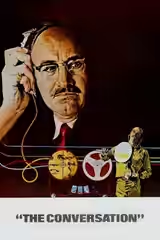
Red Road and The Conversation are both thrillers about a lonely professional watcher who sees or hears the one thing they should not have, and the earlier film is the tighter of the two. Coppola's film keeps its grip to the end, where Andrea Arnold's loses some nerve once it starts explaining. Red Road is the colder, more physically intimate film; The Conversation is the surer piece of plotting.
What should I watch after Red Road?
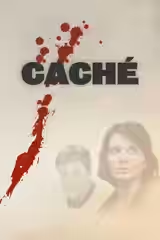
After Red Road, try The Conversation (1974, Fi1m 92): Gene Hackman listens for a living and hears the one thing he should not have. Then Caché (2005, Fi1m 88): Haneke’s videotapes on the doorstep; surveillance as a guilty conscience that will not be explained; and Ratcatcher (1999, Fi1m 88): Lynne Ramsay’s Glasgow, seen by a boy during the bin strike, tender and unsparing.

Cast

If you liked this, try…

  1. The Conversation (1974, Fi1m 92)Gene Hackman listens for a living and hears the one thing he should not have.

  2. Caché (2005, Fi1m 88)Haneke’s videotapes on the doorstep; surveillance as a guilty conscience that will not be explained.

  3. Ratcatcher (1999, Fi1m 88)Lynne Ramsay’s Glasgow, seen by a boy during the bin strike, tender and unsparing.

  4. Fish Tank (2009, Fi1m 85)Arnold’s next, with Michael Fassbender charming his way into an Essex flat he should leave.

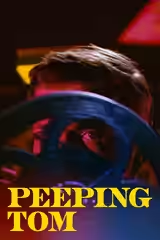
  5. Peeping Tom (1960) · not on Fi1m yetMichael Powell’s camera-wielding killer; the film that first asked what watching does to the watcher.