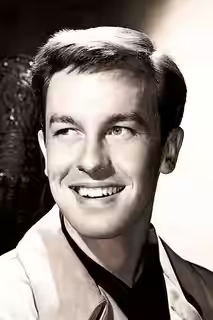
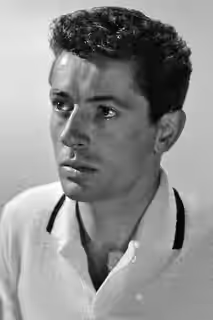
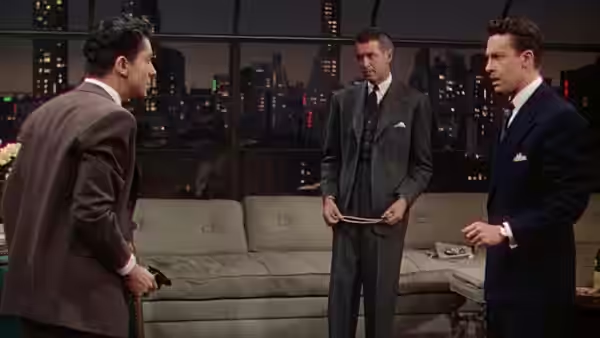
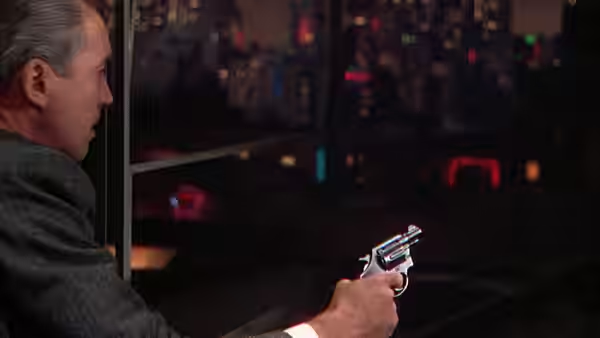
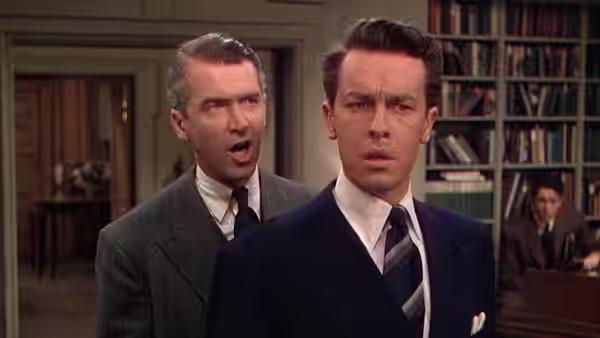
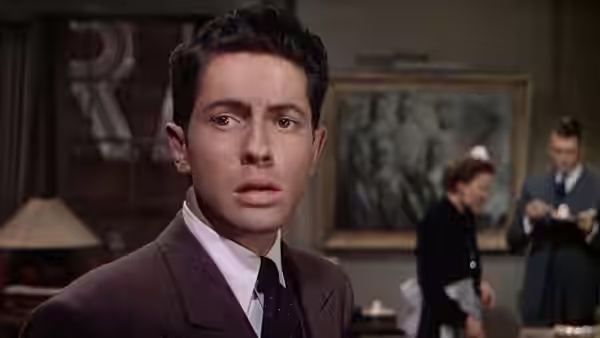
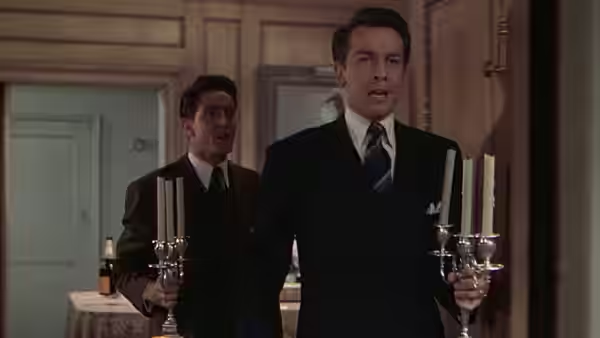
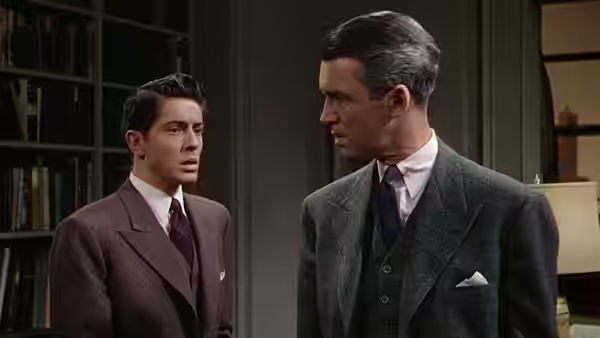
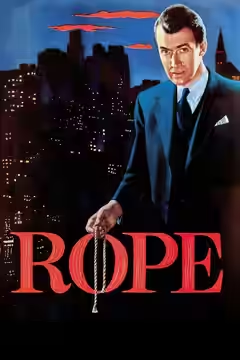
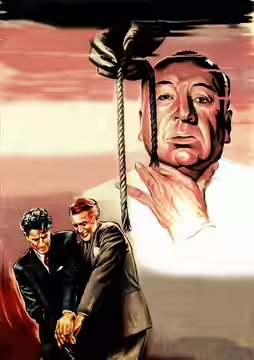
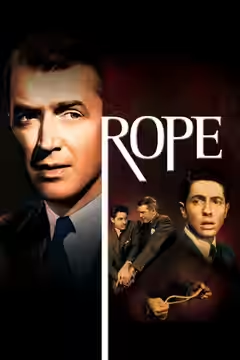
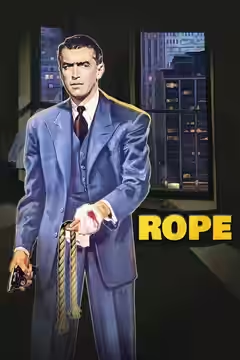
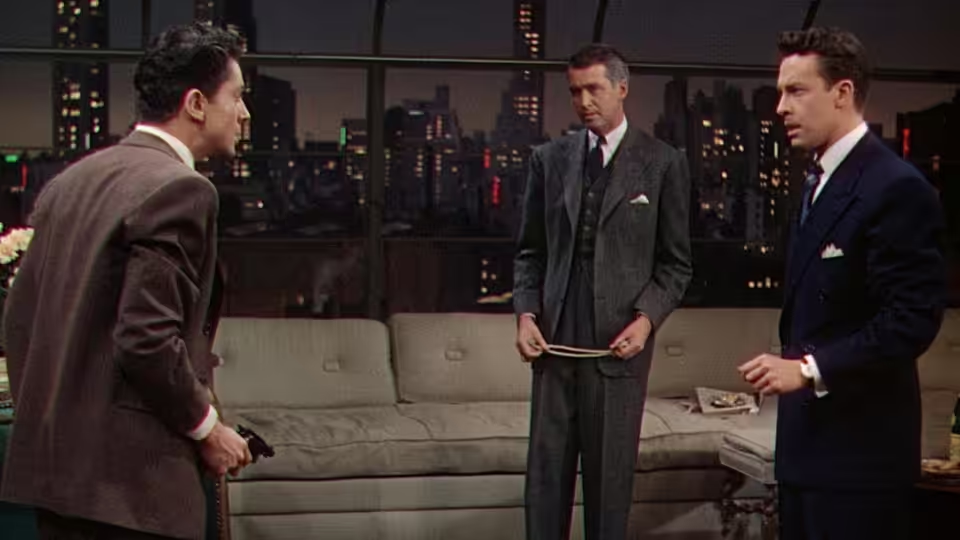
Brandon Shaw (John Dall), Phillip Morgan (Farley Granger), and Rupert Cadell (James Stewart) gather in the apartment living room
Film review

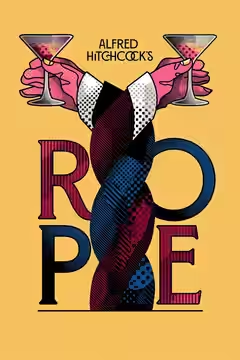
Rope

1948 · Directed by Alfred Hitchcock · 1h 21m

In a sentenceNothing spoils a dinner party quite like a host who needs everyone to notice how clever he is

In a Manhattan flat, Brandon Shaw (John Dall) and Phillip Morgan (Farley Granger) strangle David Kentley (Dick Hogan) and hide his body in a chest. Brandon wants to prove that they can commit murder without being caught, and arranges a dinner party with the chest serving as the buffet table. Among the guests are David’s father, Mr. Henry Kentley (Cedric Hardwicke), his fiancée, Janet Walker (Joan Chandler), and the killers’ former teacher, Rupert Cadell (James Stewart). As the guests arrive, Brandon enjoys testing how much he can get away with. Phillip struggles to keep his anxiety from showing.

Plays from YouTube when you press play; nothing loads from them until then.

Fi1m review

Alfred Hitchcock’s Rope is a tense, unsettling thriller with a camera experiment that sometimes gets in its way. John Dall and Farley Granger keep the people worth watching when the long takes threaten to distract us.

Alfred Hitchcock lets us see the murder before the guests arrive, which dispenses with the usual business of suspects. We know what Brandon Shaw and Phillip Morgan have done; the interest lies in how they behave while entertaining people who do not. Rope is a good thriller, particularly when its hosts disagree about how much danger they can bear. Its determination to make the evening appear continuous is ingenious, though not always helpful.

John Dall plays Brandon with a pleasure in his own cleverness that makes his hospitality unpleasant well before it becomes risky. Farley Granger gives Phillip a nervousness that Brandon seems to regard as bad manners. The chest containing David Kentley becomes a buffet table, and guests are invited to eat from it. We felt queasy at that piece of hosting: the practical preparations make the cruelty worse, because Brandon has thought about how to enjoy it.

William V. Skall and Joseph A. Valentine keep the camera mobile, allowing us to watch one exchange develop into another without the relief of a cut. The long takes give Dall and Granger time to make their different responses uncomfortable. They also give us time to admire how the camera gets from one position to the next. That is the difficulty: we occasionally stop worrying about discovery and start wondering where the camera will go.

William H. Ziegler’s editing works to preserve that apparent continuity, but the effort can become conspicuous. The sustained takes teach us to look for the joins, so the trick sometimes creates precisely the distraction it needs to avoid. A conventional cut could occasionally show us a reaction more directly. The actors do not always benefit from having to sustain a scene for quite so long.

The chest is more useful to the suspense than some of that movement. Having food laid over a body gives even an ordinary social action an unpleasant implication, without anyone needing to explain it. Arthur Laurents’s screenplay supplies plenty of explanation nonetheless, especially when the conversation turns to intellectual superiority. The performances make the idea of these men believing themselves exceptional unpleasant enough; the talk sometimes gives their opinions more attention than they deserve.

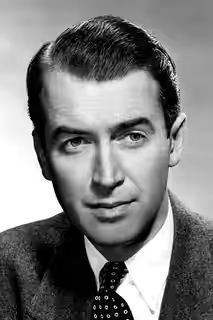
James Stewart, as Rupert Cadell, helps by making intelligence look like the habit of paying attention. His dry delivery gives the conversation some needed ease, and we believe in his capacity to unsettle Brandon. The performance keeps some amusement in a film whose cleverness can otherwise become airless. We could have used more of that ease from the writing, which too often sounds arranged for an audience rather than spoken between people.

The pleasure of a confined thriller is being able to follow each small change in who knows what, and Rope mostly gives us that pleasure. Its concentration on the hosts makes the threat of an ordinary question sufficient to hold our attention. At 81 minutes, it stops before the experiment becomes exhausting. It is worth an evening for Dall and Granger, though we would not blame anyone for occasionally wishing Hitchcock would just cut.
Critical consensus AI synthesised

64
Positive
2
Mixed
5
Negative
1

The reviews lean towards a mixed assessment of Rope, with praise clustering around Hitchcock’s camera movement, long takes and staging. Even the less enthusiastic accounts find the technique worth discussing, though they disagree about how much it contributes to the drama. James Stewart’s performance draws praise from both Variety and Eye for Film, while Variety also commends John Dall and Farley Granger. No performance attracts the same reservations as the film’s experimental approach.

The central divide is over whether that approach sustains moral tension or becomes a distraction. Slant Magazine finds that the camera keeps the ethical consequences of violence in view; Empire regards the experiment as ragged and distracting. Variety offers the sharpest rejection, finding the subject less entertaining than the technique deserves. The spread is wide, but the evidence has limits: three of the eight entries lack accessible verdicts, so the apparent balance needs treating with care.

Slant Magazine
19 June 2006 · ★★★½/4 · Fernando F. Croce
88

Croce finds the film morally complex and sees its treatment of violence and repression as more than a simple exercise in shock. He praises how the mobile camera and long takes keep the ethical consequences in view.

Read the full review →
The New Yorker
4 September 1948 · John McCarten
64*

The issue lists “Rope” among the films reviewed in “The Current Cinema,” but the review’s verdict is not visible. The accessible page provides no praise or criticism to single out.

Read the full review →
The New York Times
27 August 1948
64*

The page identifies this as a review, but its text is inaccessible. The available material does not reveal the critic’s verdict or specific praise.

Read the full review →
Time Out
· GA
64*

The accessible metadata characterizes the film as one of Hitchcock’s more experimental works. The critic’s overall verdict and specific praise or complaints are not available in the page text.

Read the full review →
Empire
1 January 2000 · David Parkinson
60*

The critic sees the film as a ragged, distracting experiment, though one worth watching for Hitchcock collectors. He singles out its hints of the perversity that would characterize Hitchcock’s later films.

Read the full review →
Radio Times
★★★ · Robyn Karney
60

Karney finds the film more cerebral experiment than suspenseful Hitchcock entertainment. The continuous long takes are singled out as its most interesting feature today.

Read the full review →

Straight answers AI written, from our review

Is Rope worth watching?
Rope is worth watching for its tense dinner-party suspense and John Dall and Farley Granger’s contrasting performances as the murderous hosts; we score it 76 out of 100. It suits viewers who enjoy confined, talk-driven thrillers, though the conspicuous long takes sometimes distract from the danger and the dialogue can sound overarranged.
How long is Rope, and what is it rated?
Rope runs 1h 21m. It is a thriller and crime film.
Where can I watch Rope in South Korea?
Rope is not on any streaming or rental service in South Korea at the moment. Availability is checked daily.
How violent or frightening is Rope, and is it suitable for children?
Rope has a UK PG certificate, but its opening strangulation and dinner party served from a chest containing the victim’s body make it an unsettling choice for children. We find the hosts’ calculated cruelty more disturbing than the camera experiment: the suspense centres on possible discovery, so the PG label should not be mistaken for a promise of gentle entertainment.

Cast

If you liked this, try…

  1. Le Corbeau (1943) · not on Fi1m yetFor another community whose civil conversation conceals an appetite for cruelty.

  2. Compulsion (1959) · not on Fi1m yetAnother study of educated arrogance, with less interest in the camera’s manoeuvres.

  3. The Servant (1963) · not on Fi1m yetFor a confined household where control keeps changing hands beneath the politeness.

  4. Cure (1997) · not on Fi1m yetFor patient unease and a still nastier examination of responsibility for murder.

  5. The Invitation (2015) · not on Fi1m yetA dinner party that makes accepting a drink feel like a mistake.