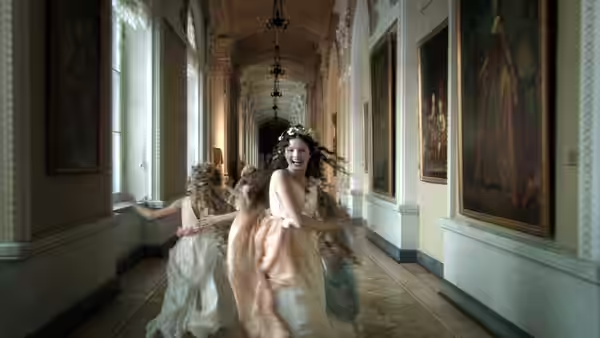
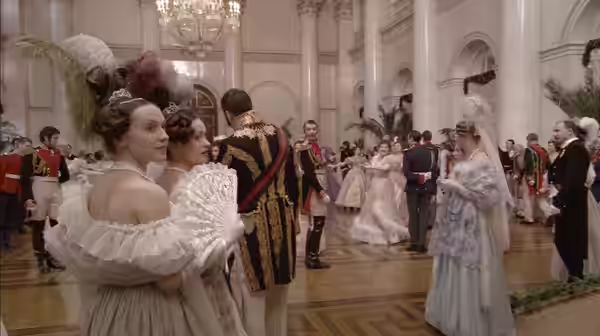
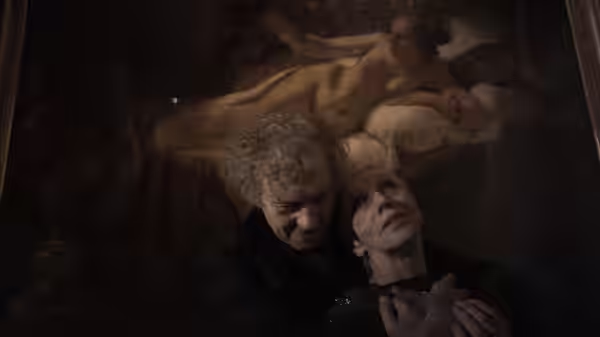
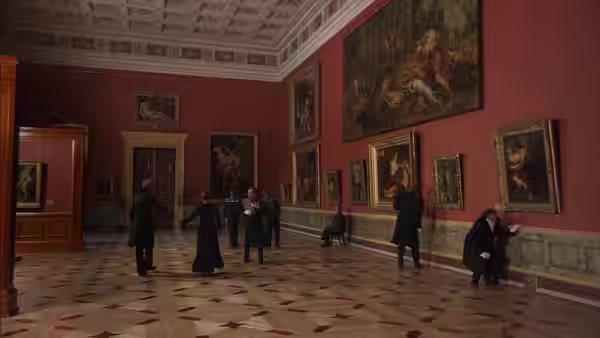
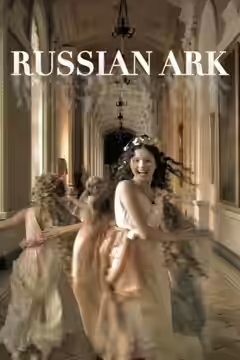
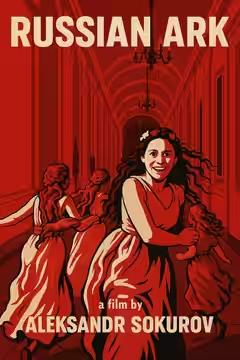
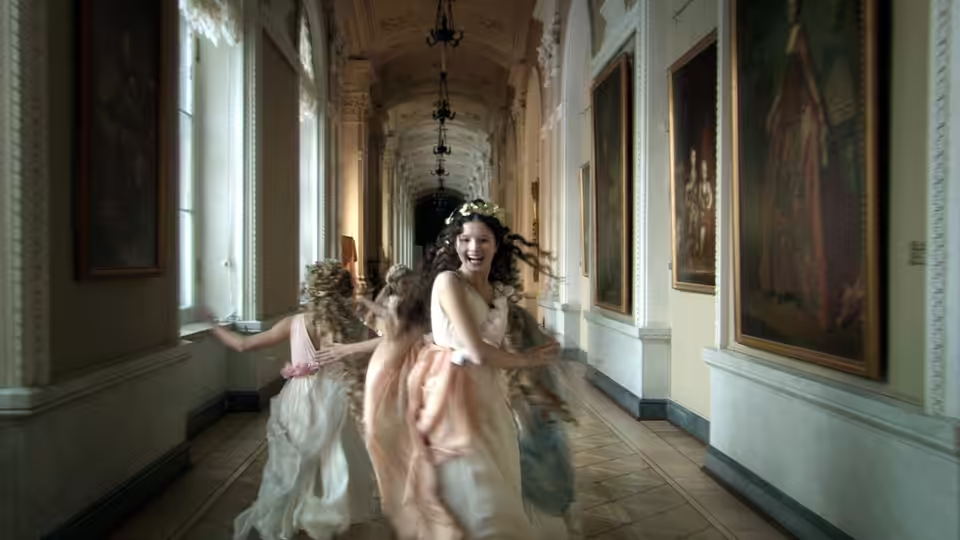
Young dancers in pastel dresses twirl through a gallery lined with paintings
Film review

Russian Ark

2002 · Directed by Alexander Sokurov · 1h 39m

In a sentenceA museum visit where the past refuses to wait politely in its own room

Inside the Hermitage, a continuous journey through Russian history brings Marquis de Custine (Sergey Dreyden) into rooms occupied by figures from different periods. Among them are Peter the Great (Maksim Sergeyev) and Catherine The Great (Mariya Kuznetsova). The visit moves through the imperial past without settling into a chronological account, while an offscreen voice comments on what passes before the camera. Across a route taking in 33 rooms and three centuries, the building provides the one constant. Doorways lead to further encounters, but no change of shot to mark where one period ends and another begins.

Plays from YouTube when you press play; nothing loads from them until then.

Fi1m review

Alexander Sokurov’s continuous journey through the Hermitage is absorbing, sometimes moving and occasionally hard work. Its camera gives history a physical closeness that the solemn commentary too often interrupts.

Russian Ark is worth the patience it asks for, though it occasionally asks rather a lot. Alexander Sokurov takes a continuous journey through the Hermitage and makes the simple business of entering another room feel uncertain. Russian history does not arrive in a helpful sequence, and the camera cannot cut away to explain where we have landed. The pleasure comes from looking, listening and accepting that some of the references will pass us by. Anyone expecting a history lesson with clear dates will have a long evening.

That single take matters because it changes how we attend to people. Tilman Büttner keeps moving among figures and through rooms, allowing us to notice how a space fills and how one person draws attention from another. The choreography is elaborate, but the movement rarely feels like an instruction to admire the organisation. We felt unexpectedly sad watching people pass out of view as the camera continued through the rooms. The unbroken movement gives us time to notice them, then carries us away before we feel quite finished looking.

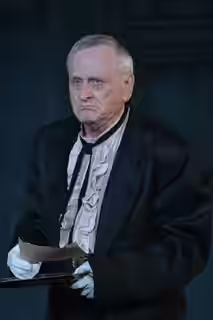
Sergey Dreyden, as Marquis de Custine, gives the film a welcome human focus. His presence helps prevent it from becoming a procession of handsome interiors, although the central performance can become as insistent as the commentary. We do not need every feeling about the past supplied for us. At its least persuasive, the offscreen melancholy sounds prescribed, and we would rather be allowed to listen and look. The film is more affecting when it stops telling us how sorrowful it is.

The Hermitage itself is crucial: these rooms give the historical encounters a shared place even when the period changes. Maria Grishanova, Tamara Seferyan and Lidiya Kryukova’s costumes help us read the people within that space without turning each arrival into an explanation. Sergei Yevtushenko’s music belongs comfortably to the film’s deliberate pace, although it cannot make every passage equally involving. There is enough to look at that the eye often stays occupied when our interest in the conversation begins to wander.

The editing credits belong to Betina Kuntzsch, Sergey Ivanov and Stefan Ciupek, but the usual remedy for a slow scene is unavailable within the continuous shot. A change of pace has to come from movement, a fresh encounter or a shift in our attention. That makes the slack stretches noticeable, and knowing about the technical difficulty does not shorten them. Still, we would not exchange this accumulating sense of time for a brisk collection of historical highlights.

The presence of Catherine The Great (Mariya Kuznetsova) and Peter the Great (Maksim Sergeyev) does not turn this into a conventional account of rulers and their decisions. Alexander Sokurov is more interested in being near the past than in explaining it. That choice will frustrate anyone who wants events connected and motives examined. It also lets us spend time looking at people who would otherwise be hurried through as illustrations of a date.

Its 99 minutes require a kind of concentration that a longer, busier film might never ask of us. We recommend it to anyone who enjoys looking closely and does not require every question answered. Save it for an evening when nobody is likely to ask what is happening.
Critical consensus AI synthesised

79
Positive
10
Mixed
2
Negative
1

Most critics respond warmly to Russian Ark, with praise centred on the choreography and camera movement of its continuous journey through the Hermitage. The single take is widely admired for more than its technical difficulty: the reviews describe it as a way of making Russian history feel vivid, elusive and sometimes sorrowful. Several critics find the film absorbing even when its historical references remain hard to follow, and its atmosphere earns almost as much praise as its camerawork.

The spread is wide, however, from enthusiastic approval to outright frustration. Reservations cluster around thin drama, slow passages and a solemnity that can keep viewers at a distance. For some, those limitations scarcely diminish the achievement; for others, they make it difficult to engage. Eye for Film offers the clearest dissent, finding the film slow and frustrating despite admiring its visuals and choreography, and also criticising the central performance and subtitling.

Radio Times
★★★★★ · David Parkinson
100

Parkinson calls the film audacious and breathtaking, and says its historical and cultural sweep will thrill film lovers. He especially praises the choreography of the single-take Steadicam journey through the Hermitage.

Read the full review →
Slant Magazine
1 September 2013 · ★★★★/4 · Jesse Cataldo
100

Cataldo finds the film’s disorienting approach to history inimitable and compelling. He especially praises how its continuous shot and carefully choreographed movement make the past feel vivid yet unknowable.

Read the full review →
Empire
1 January 2000 · David Parkinson
90*

The critic calls the film an exceptional cinematic achievement, though acknowledging its intellectual, dramatic and technical shortcomings. He particularly praises the balletic camera movement and the sumptuous recreation of Russia’s imperial and Soviet past.

Read the full review →
IndieWire
12 December 2002 · festival review · David Sterritt and Mikita Brottman
90*

The critics hail the film as a formally ambitious, triumphant achievement. They single out its dazzling single-shot spectacle and evocative exploration of Russian history.

Read the full review →
Los Angeles Times
10 January 2003 · Kenneth Turan
90*

Turan praises the film as a beautiful, soulful achievement whose technical feat serves its artistry. He especially admires the final ballroom sequence, which makes the past feel vividly present.

Read the full review →
Variety
21 May 2002 · festival review · Deborah Young
85*

Young finds the film a dazzling, technically remarkable journey through Russian culture, likely to broaden Sokurov’s audience. She especially praises the single-take camera work for creating a magical visual style.

Read the full review →

Straight answers AI written, from our review

Is Russian Ark worth watching?
Russian Ark is worth watching for patient viewers who enjoy looking closely rather than following a conventional plot; we score it 78 out of 100. Its continuous journey through the Hermitage makes the past feel close and sometimes unexpectedly moving, though the solemn commentary and slack stretches can test our concentration.
How long is Russian Ark, and what is it rated?
Russian Ark runs 1h 39m. It is a drama and fantasy film.
Where can I watch Russian Ark in Greece?
Russian Ark is not on any streaming or rental service in Greece at the moment. It is available in 10 other countries; change your country at the top of the page to see where. Availability is checked daily.
How does Russian Ark compare to Last Year at Marienbad?
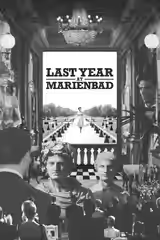
Russian Ark offers a warmer encounter with the past than Last Year at Marienbad, whose grand rooms contain a colder, more exact puzzle about memory. We find Russian Ark more affecting when it lets us look without commentary; Last Year at Marienbad is the stronger choice for intricate construction, though both demand patience and a willingness to get lost.
What should I watch after Russian Ark?
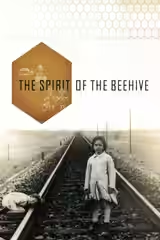
After Russian Ark, try Last Year at Marienbad (1961, Fi1m 82): For grand rooms, uncertain memories and another demanding pleasure in getting lost. Then The Spirit of the Beehive (1973, Fi1m 87): For a quieter encounter with history, seen through a child’s watchful eyes; and A Ghost Story (2017, Fi1m 84): For patient watching and an intimate sense of lives passing through rooms.

Cast

Awards

Nika Award for Best Costume Design, 2004

Won
Nika Award for Best Costume Design

European Film Award for Best Cinematographer, 2002

Nominated
European Film Award for Best Cinematographer

European Film Award for Best Director, 2002

Nominated
European Film Award for Best Director

If you liked this, try…

  1. The Colour of Pomegranates (1969) · not on Fi1m yetFor history told through costumes, rooms and images that resist easy explanation.

  2. Last Year at Marienbad (1961, Fi1m 82)For grand rooms, uncertain memories and another demanding pleasure in getting lost.

  3. The Spirit of the Beehive (1973, Fi1m 87)For a quieter encounter with history, seen through a child’s watchful eyes.

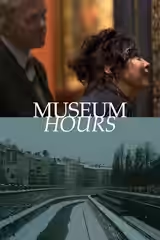
  4. Museum Hours (2012) · not on Fi1m yetFor another patient encounter with art, where looking becomes the main event.

  5. A Ghost Story (2017, Fi1m 84)For patient watching and an intimate sense of lives passing through rooms.