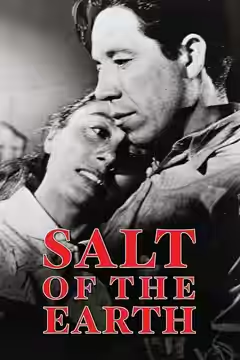
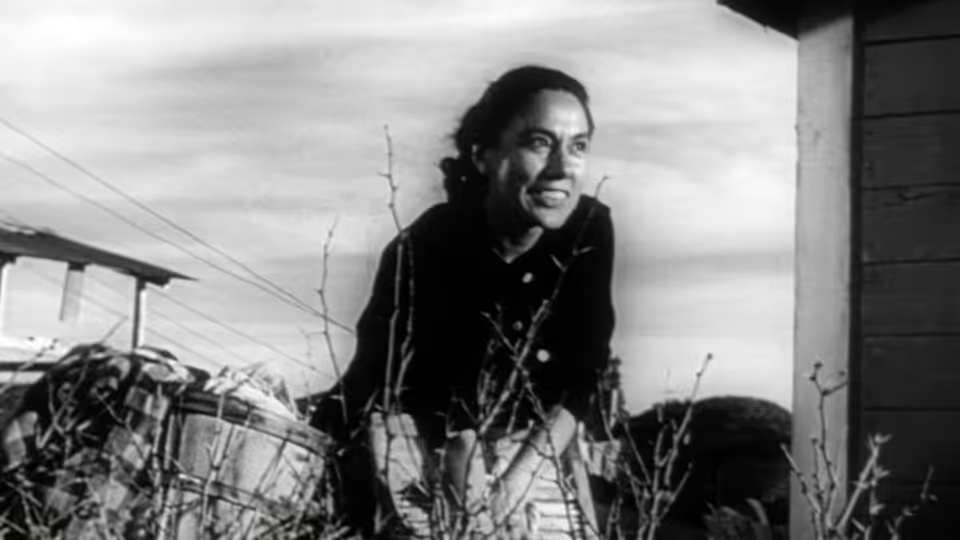
Esperanza Quintero (Rosaura Revueltas) smiles while tending plants outside a building
Film review

Salt of the Earth

1954 · Directed by Herbert J. Biberman · 1h 34m

In a sentenceRosaura Revueltas does more with a look than the speeches manage with a paragraph

Esperanza Quintero (Rosaura Revueltas) and Ramon Quintero (Juan Chacón) are at the centre of a drama about American working people. The Sheriff (Will Geer) is among the figures of authority, while Frank Barnes (Clinton Jencks), Ruth Barnes (Virginia Jencks) and Teresa Vidal (Henrietta Williams) also feature. Labour rights, racism, immigration and women’s rights shape the concerns of the film. Its attention extends beyond the workplace to the question of whose needs count within a community. Herbert J. Biberman directs, with a screenplay by Michael Wilson.

Fi1m review

Herbert J. Biberman’s labour drama can be blunt and uneven, but Rosaura Revueltas gives it feeling. It takes women’s rights seriously, even when its speeches do too much of the work.

Herbert J. Biberman’s Salt of the Earth is a good, sometimes stiff political drama that takes working people seriously. It wants us to care about labour rights, racism and women’s rights, and does not pretend to be neutral about any of them. We need not demand neutrality from it. We can, however, ask that its characters have enough room to be people, and the film is uneven on that score.

Rosaura Revueltas, as Esperanza Quintero, gives it that room. We were moved by her restraint, by the impression of anger held back because expressing it has a cost. She makes the demand for respect feel personal, without making it small. Juan Chacón’s Ramon Quintero is less flexible, and the difference between the two performances can make the acting feel uneven. Her patient attention keeps drawing us back to the person behind the political point.

Michael Wilson’s writing is strongest in giving women’s rights a place alongside the concerns of organised labour. That choice prevents the film from treating working people as though they all want precisely the same things. There is something properly uncomfortable about a demand for equality that also has to be taken seriously within one’s own community. The script is less persuasive when it spells out what its sympathies have already made clear. Some of the speeches leave the actors little to discover.

The cinematography by Leonard Stark and Stanley Meredith helps keep this directness from becoming merely dutiful. Its starkness makes the people worth attending to without flattering them, and the lack of visual fuss suits the subject. There is pleasure in a film that does not seem embarrassed by ordinary faces. But plain presentation cannot solve every problem in the writing: when a passage becomes instructional, an unadorned image does not make it less so.

The editing by Ed Spiegel and Joan Laird sometimes lets that emphasis become heavy. A point can feel settled before the film is ready to move on, and those extra beats interrupt the momentum. That matters when a drama needs collective action to feel alive. The stiffness is intermittent, but noticeable beside the lead performance’s quiet assurance. At 94 minutes, this is hardly a test of endurance, although shortness alone does not make every passage brisk.

Sol Kaplan’s score adds earnestness where the film scarcely needs more of it. The music’s insistence can narrow our response, telling us how seriously to take material that has already earned serious attention. Will Geer, playing the Sheriff, gives authority a recognisable human face. His presence helps, although the writing leaves little uncertainty about how we should regard that authority, and the performance has limited room to complicate our response.

Within political drama, its sustained attention to women’s rights is a substantial virtue. The bluntness is a limitation, especially when the writing begins to sound settled on everyone’s behalf, but it does not cancel the conviction or the feeling. There is enough here to reward an interest in how films represent working people, without needing to excuse every rough passage as evidence of sincerity. Go for the people, and allow for the speeches.

Critical consensus AI synthesised

3 of 6
Positive
1
Mixed
1
Negative
1
Radio Times
★★★★★ · John Gammon
100

Gammon regards the film as an extraordinary act of defiance against McCarthyism. He praises its wide-ranging treatment of labor, racism, immigration and women's rights.

Read the full review →
The New York Times
15 March 1954
64*

The page is inaccessible, so its critical verdict cannot be verified. No specific praise or criticism is available in the supplied text.

Read the full review →
Variety
31 December 1953 · Variety Staff
40*

The review praises the film’s dramatic force but ultimately considers it propaganda better suited to union halls than theatres. It singles out Rosaura Revueltas’s performance and the film’s stark, realistic direction for praise.

Read the full review →

Straight answers AI written, from our review

Is Salt of the Earth worth watching?
Salt of the Earth is worth watching for its attention to working people and women’s rights, and we score it 76 out of 100. Rosaura Revueltas gives the politics personal feeling through her restrained performance, though we find the speeches blunt and the pacing occasionally heavy; it suits an interest in political drama rather than a need for brisk entertainment.
How long is Salt of the Earth, and what is it rated?
Salt of the Earth runs 1h 34m. It is a drama and history film.
Where can I watch Salt of the Earth in Lithuania?
Salt of the Earth is not on any streaming or rental service in Lithuania at the moment. It is available in 8 other countries; change your country at the top of the page to see where. Availability is checked daily.
How does Salt of the Earth compare to Norma Rae?
Salt of the Earth gives women’s rights sustained attention alongside organised labour, while Norma Rae is the stronger choice for forceful workplace drama led by a woman’s resolve. We find the speeches and uneven acting harder to overlook in Biberman’s film; Sally Field’s unvarnished performance and John A. Alonzo’s factory-floor photography make the bluntness of Norma Rae matter less.
What should I watch after Salt of the Earth?
After Salt of the Earth, try Norma Rae (1979, Fi1m 82): Another workplace struggle in which a woman’s resolve refuses to remain private. Then Two Days, One Night (2014, Fi1m 88): Workplace solidarity tested through individual conversations, with no comforting guarantees; and Pride (2014, Fi1m 82): Collective action with more jokes, and a clear eye for internal prejudice.

Cast

If you liked this, try…

  1. Norma Rae (1979, Fi1m 82)Another workplace struggle in which a woman’s resolve refuses to remain private.

  2. The Organizer (1963) · not on Fi1m yetA labour dispute with room for hunger, confusion and inconvenient human behaviour.

  3. Two Days, One Night (2014, Fi1m 88)Workplace solidarity tested through individual conversations, with no comforting guarantees.

  4. Pride (2014, Fi1m 82)Collective action with more jokes, and a clear eye for internal prejudice.

  5. The Second Mother (2015) · not on Fi1m yetDomestic work exposes the limits of a household’s professed affection and equality.