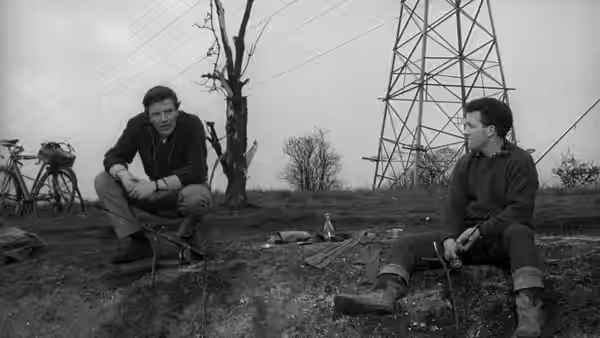
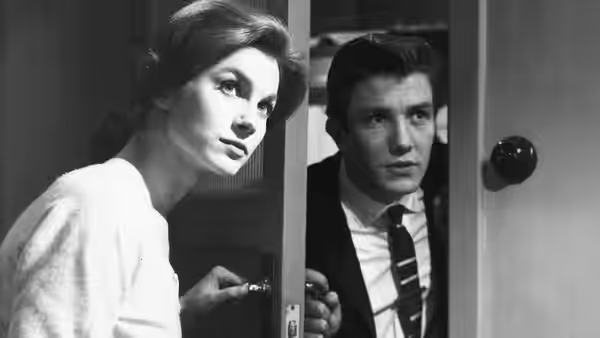
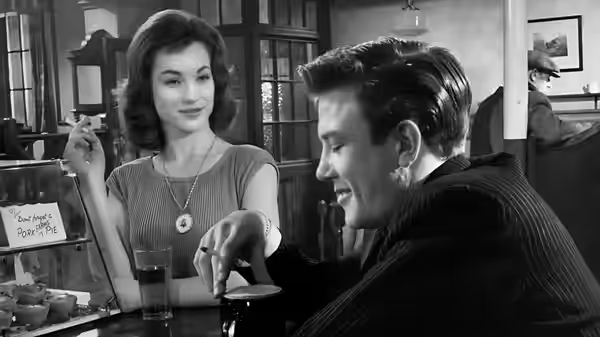
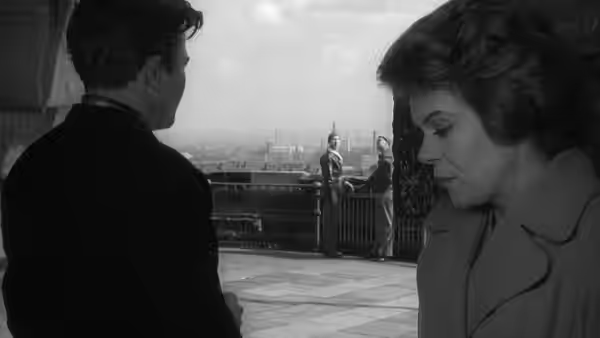
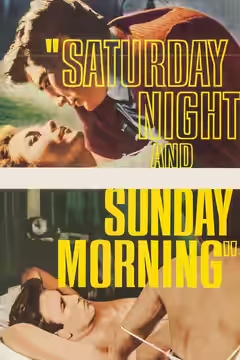
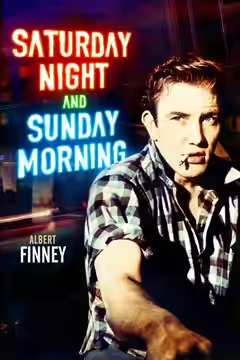
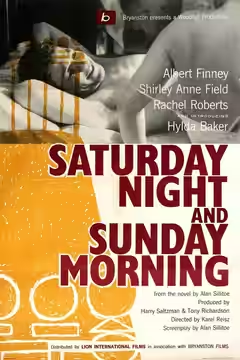
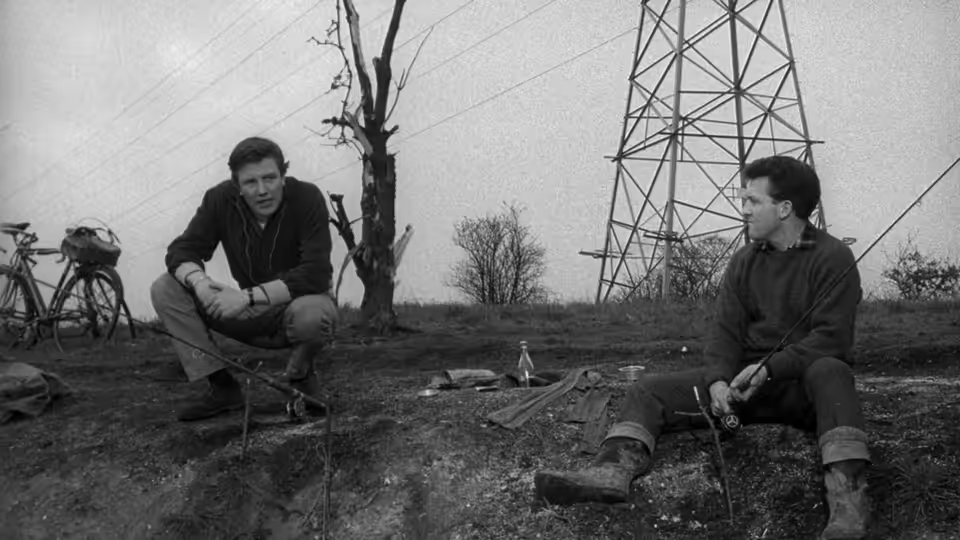
Arthur Seaton and a friend sit beside railway tracks beneath power lines
Film review

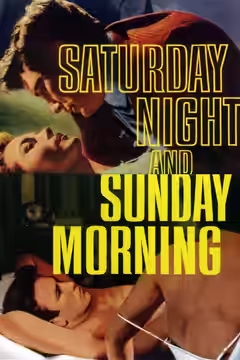
Saturday Night and Sunday Morning

1960 · Directed by Karel Reisz · 1h 30m

In a sentenceAlbert Finney makes a man we would avoid in the pub worth spending ninety minutes with

Arthur Seaton (Albert Finney) is the defiant central figure in an industrial-town drama. Suspicious of the life around him, he combines rebellion with a sense that little will change. Doreen (Shirley Anne Field) and Brenda (Rachel Roberts) also feature in his story, alongside Aunt Ada (Hylda Baker), Bert (Norman Rossington) and Jack (Bryan Pringle). Karel Reisz directs Alan Sillitoe’s adaptation of his own novel, bringing together drama and romance. The film follows Arthur against the town’s industrial surroundings and domestic interiors over a running time of 90 minutes.

Fi1m review

Albert Finney gives Karel Reisz’s drama a stubborn, uncomfortable energy. We recommend it for the performance and the assured direction, with one reservation: Arthur Seaton sometimes makes everyone else seem secondary.

Saturday Night and Sunday Morning is worth seeing for Albert Finney, and Karel Reisz gives him the space he needs. The performance makes Arthur Seaton’s cynicism engaging without making it especially admirable. There is pleasure in spending time with someone this difficult, even when his certainty about himself begins to wear. Alan Sillitoe’s screenplay, adapted from his own novel, gives the actor plenty to resist and remarkably little need to ingratiate himself with us.

The important thing about Albert Finney is that the belligerence never quite conceals the resignation. His Arthur Seaton can seem pleased with himself and already disappointed in what life has to offer, without either feeling cancelling the other. We found ourselves warming to him against our better judgement, because the weariness showing through the swagger makes his confidence seem less secure. That does not excuse him. It does make watching him more interesting than simply agreeing that he is trouble.

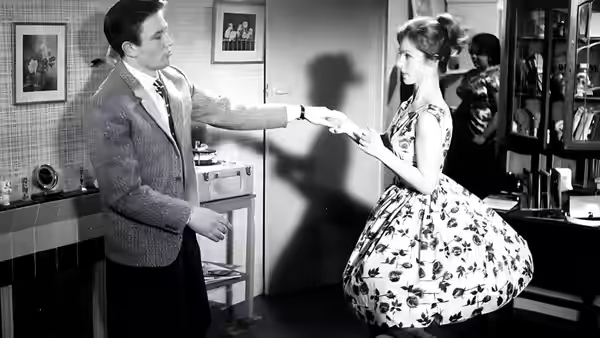
Freddie Francis’s cinematography helps by making the industrial-town surroundings feel substantial without turning them into an illustrated complaint. The people seem to belong in these interiors; the rooms never demand admiration separately from the performances. Karel Reisz’s direction has a similar patience with the place, allowing its ordinary appearance to carry weight. This matters because a more insistent treatment could make Arthur Seaton seem merely the inevitable product of his surroundings, and Albert Finney gives us someone considerably more awkward than that.

Seth Holt’s editing keeps the film compact without making the performances feel hurried. At 90 minutes, there is room for an attitude to become irritating, revealing or unexpectedly funny before the film moves on. John Dankworth’s music adds a useful restlessness, giving the drama movement without asking us to treat every grievance as a tragedy. Neither contribution calls much attention to itself, but both help prevent the film from settling into a solemn examination of its central character.

The reservation is how thoroughly that central character commands our attention. Shirley Anne Field, as Doreen, and Rachel Roberts, as Brenda, bring a seriousness that deserves more consideration than Arthur Seaton’s force of personality always allows. Their performances register, but we sometimes want the film to stay interested in them independently of its interest in him. This is partly the cost of casting Albert Finney: even his less attractive qualities are compelling. It is also a limitation that Karel Reisz does not entirely overcome.

Against the familiar habits of social drama, the film’s refusal to make its central figure exemplary remains a considerable strength. We are allowed to find him funny, selfish and tiring without being handed a different explanation for each response. Alan Sillitoe occasionally presses the defiance harder than necessary; once we understand the distrust, further insistence adds less. The performance is more persuasive when it lets uncertainty appear without underlining it.

There is enough assurance here to carry that imbalance, though it remains an imbalance. The film asks for an appetite for difficult company rather than a readiness to applaud rebellion on principle. Its pleasures depend on watching closely, especially when confidence begins to look like effort. Watch it for Albert Finney, and give Rachel Roberts and Shirley Anne Field your attention when he threatens to monopolise it.

Critical consensus AI synthesised

78
Positive
4
Mixed
3
Negative
0

Most critics respond favourably to Saturday Night and Sunday Morning, with praise clustering around Albert Finney’s performance as Arthur Seaton. The reviews credit him with making Arthur’s cynicism, laddishness and resignation vivid and credible, giving familiar material much of its force. The script also earns praise, while the strongest notices place the film among the leading examples of British kitchen-sink drama.

The recorded scores range from enthusiastic to mixed, with none classed as negative, though the available text gives limited grounds for explaining every reservation. Variety finds the film absorbing but not especially likeable, while praising Reisz’s documentary-informed direction for the convincing industrial-town atmosphere of its locations and interiors. Two other reviews lack accessible verdicts, so their reservations cannot be established: the clearest documented qualification concerns the film’s appeal rather than the credibility of its setting.

Radio Times
★★★★★ · David Parkinson
100

Parkinson praises the film as a classic drama and highlights Albert Finney’s astonishing performance. He singles out Finney’s ability to convey Arthur Seaton’s cynicism, laddishness and resignation.

Read the full review →
Empire
1 January 2000 · David Parkinson
90*

Parkinson regards the film as one of the finest entries in the British kitchen-sink tradition. He especially praises Albert Finney’s electrifying performance and the strength of the script.

Read the full review →
The Guardian
29 November 1960 · Guardian staff reporter
82*

The critic finds the film triumphantly overcomes familiar themes and becomes a genuine work of film art. They single out Albert Finney’s vivid, credible performance as the chief reason for its success.

Read the full review →
Time Out
· TM
78*

The available metadata identifies this as a review and describes the film as a major British New Wave box-office success. It singles out the hero’s defiant watchword as part of the film’s appeal.

Read the full review →
Variety
31 December 1959 · Variety Staff
65*

The review finds the film good and absorbing, though not very likeable. It praises Reisz’s documentary-informed direction for giving the locations and interiors an authentic industrial-town atmosphere.

Read the full review →
Film Comment
· Max Nelson
64*

The available text does not reveal the critic’s verdict. It also provides no specific praise or complaint about the film.

Read the full review →

Straight answers AI written, from our review

Is Saturday Night and Sunday Morning worth watching?
Saturday Night and Sunday Morning is worth watching for Albert Finney’s compelling performance and Karel Reisz’s assured direction; we score it 82 out of 100. We recommend it to anyone who enjoys drama about difficult people, with one reservation: Arthur Seaton commands so much attention that the women around him sometimes seem secondary.
How long is Saturday Night and Sunday Morning, and what is it rated?
Saturday Night and Sunday Morning runs 1h 30m. It is a drama and romance film.
Where can I watch Saturday Night and Sunday Morning in Malaysia?
Saturday Night and Sunday Morning is available to rent from Apple TV from RM 9.90. Availability is checked daily; the links above go straight to each service.
How does Saturday Night and Sunday Morning compare to The Last Picture Show?
Saturday Night and Sunday Morning is more tightly concentrated on one difficult personality than The Last Picture Show, whose small-town frustrations receive more generous attention across its characters. We favour the latter for sympathy towards people left waiting, while the former is the stronger choice for a commanding central performance, though Finney sometimes overshadows his fellow actors.
Is Saturday Night and Sunday Morning based on a true story or a book?
Saturday Night and Sunday Morning is adapted from Alan Sillitoe’s novel, with Sillitoe himself writing the screenplay, rather than presented as a true story. We recommend it without requiring familiarity with the book: Arthur Seaton’s mixture of defiance and resignation is compelling on screen, though we make no claim about how closely the adaptation follows the novel.

Cast

If you liked this, try…

  1. A Kind of Loving (1962) · not on Fi1m yetAnother unsentimental account of desire, responsibility and the limits of youthful confidence.

  2. I vitelloni (1953) · not on Fi1m yetYoung men postpone adulthood, with consequences their charm cannot indefinitely keep away.

  3. Wanda (1970) · not on Fi1m yetFor a woman’s less swaggering passage through work, disappointment and uncertain freedom.

  4. Rosetta (1999) · not on Fi1m yetA harsher, more urgent working-class drama, fiercely attentive to its difficult lead.

  5. The Last Picture Show (1971, Fi1m 89)Small-town frustration and sexual disappointment, with generous attention to people left waiting.