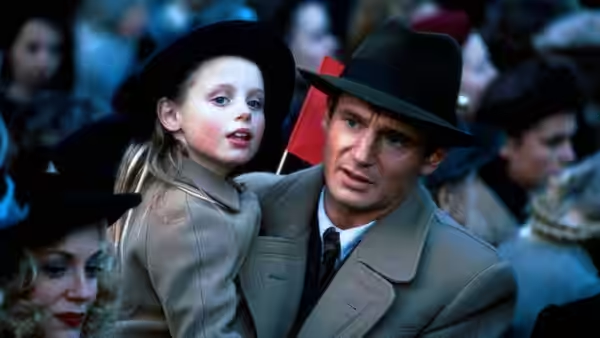
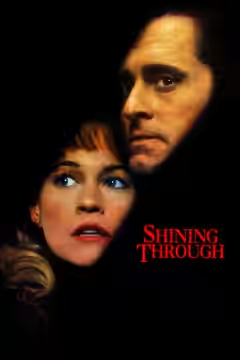
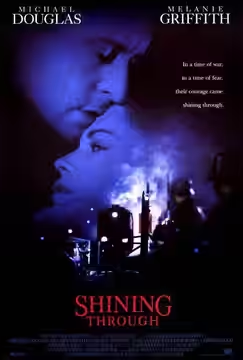
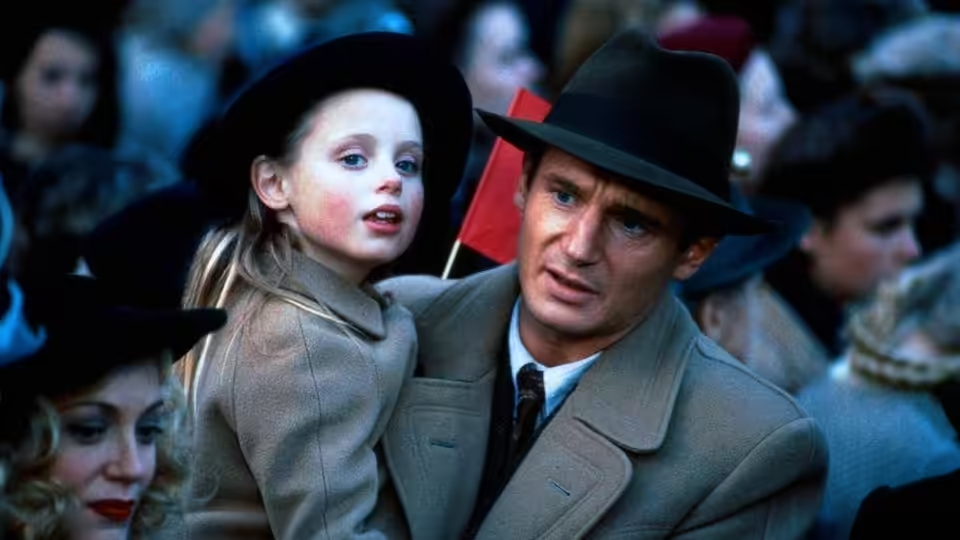
Ed Leland (Michael Douglas) carries a young girl through a crowded street
Film review

Shining Through

1992 · Directed by David Seltzer · 2h 12m

In a sentenceMelanie Griffith goes undercover in Nazi Berlin armed with fluent German and a long memory for war films

New York, 1940. Linda Voss (Melanie Griffith), a half-Jewish secretary from Queens who speaks German and has seen every war film, takes a job at a law firm as assistant to Ed Leland (Michael Douglas). He is secretive and often away, and she works out before he tells her that the law is a cover and he is a spy. They fall into an affair. When America enters the war, Leland leaves for Washington and Linda insists she can be of use behind the lines, because she knows the language and nobody else is volunteering. The plan: a post as a cook in a Nazi household in Berlin, a contact known as Sunflower (John Gielgud) and then the home of Franze-Otto Dietrich (Liam Neeson), an official with children.

Fi1m review

David Seltzer’s wartime romance is handsomely built and hard to believe at every turn. Melanie Griffith is asked to carry it and cannot; Douglas and Neeson do what they can. Watchable, often silly, and not quite a recommendation.

David Seltzer has adapted Susan Isaacs’s novel into the sort of picture Hollywood made in the 1940s: a secretary falls for her boss, discovers he is a spy and follows him into the war. Those films were quick, cheap and did not ask to be believed. This one runs 132 minutes and plays its story straight, so we are asked from the first minute to take what follows as history. That is where the trouble starts.

Griffith plays Linda Voss, half-Jewish, from Queens, fluent in German and in the war films she has seen several times each. It is a part written for someone who can be both innocent and quick. Griffith manages the innocence. The quickness does not come, and the script keeps asking for it: she talks her way past guards, lies to a house full of Nazis and bluffs in a kitchen, and she does it all in the small, breathy voice that suited her in Working Girl, which makes every danger sound like an anecdote told later over a drink. Her narration runs over much of the film and does the same. Most critics have said her Linda belongs to the wrong decade, and they are right, though it was Seltzer who wrote her the lines.

Douglas plays Ed Leland as a man who disapproves of everything, including falling in love. He is better in New York, where the disapproval has an office to work in, than in Berlin, where it has nowhere to go. Neeson has the most interesting part. His Franze-Otto Dietrich is a Nazi official who takes Linda into his home to look after his children, and he is courteous to her and gentle with them, and we found ourselves liking him and then disliking ourselves for it. It is the one place the film does what a spy story should, which is make us unsure where to put our sympathy. Joely Richardson’s Margrete Von Eberstein is sharp and watchable in a role that is mostly plot. John Gielgud, as Sunflower, behaves as if he were in a better film, which is reasonable.

It is handsome, and the people responsible should be named. Anthony Pratt’s Berlin is high ceilings, dark panelling and polished floors, a rich man’s city, and the film spends long enough in Dietrich’s house that we came to know its corridors. Marit Allen dresses Griffith in tailored wool and small hats, and the clothes do more to put her in the period than the dialogue does. Jan de Bont shoots New York warm and lamplit and Berlin colder and greyer, so the change of country is on the screen before anybody mentions it. Michael Kamen’s strings swell wherever the film wants us to feel something, and in several places where we did not.

What does not work is the story, and that is a large thing not to work. Seltzer sends a woman with no training into the capital of the Reich on the strength of her German and her nerve, and then has her survive on luck. Each time she is nearly caught, something turns up that lets her go on, and by the third or fourth time we had stopped holding our breath and started counting. Craig McKay cuts the suspense sequences cleanly, but an editor can only do so much when we know how a scene will end from the way it begins. The second half takes turns we will not describe, except to say that the last half-hour spends whatever plausibility was left on a finish out of a Saturday serial, and plays it straight.

Most critics landed close to where we have, split between those who found it an entertaining two hours of contrivance and those who found the contrivance too much. We are nearer the second group, with some affection for the first hour, when it is still a New York office romance with a secret in it and the cast have something to play. The 15 certificate and the 132 minutes are both accurate. Watch it at home with someone who will laugh at the right moments, which are not always the ones the film intended, and stop paying close attention once it leaves for Berlin.

Critical consensus AI synthesised

49
Positive
1
Mixed
3
Negative
3

The reviews lean mixed to negative, and most critics agree on what the problem is: a wartime melodrama with a spy plot they call far-fetched, contrived or outright ludicrous. Where the praise clusters, it is on Melanie Griffith, whom several reviewers find engaging enough to carry the audience through the implausibilities, at least for a stretch, with Michael Douglas credited alongside her for giving his all in a role that suits him. Only Empire comes out properly in favour, finding the film entertaining in spite of its clichés.

The spread is wide. The harsher notices find the melodrama overly sentimental and the intrigue predictable, with the film’s excesses wearing out their welcome well before the end. Griffith divides them too: Radio Times calls her miscast and uncomfortable in a period role, and Variety says her character feels too modern for the setting, even while finding her occasionally appealing. Two of the reviews could not be read in full, so the picture rests largely on five.

Empire
1 January 2000 · William Thomas
70*

The critic finds the film entertaining despite its contrivances and clichéd plot. They praise Griffith and Douglas for giving their all in roles suited to them.

Read the full review →
RogerEbert.com
64*

The page could not be accessed, so the critic’s verdict cannot be established. No praise or complaint can be verified from the available text.

Read the full review →
The New York Times
31 January 1992 · Janet Maslin
64*

The page is inaccessible, so the critic’s verdict cannot be verified. The available text does not identify any specific praise or complaint.

Read the full review →
Los Angeles Times
31 January 1992 · Kenneth Turan
55*

Turan finds the film entertaining for a while despite its far-fetched plot, though its excesses eventually wear out their welcome. He especially praises Melanie Griffith’s engaging performance and ability to carry the audience.

Read the full review →
Radio Times
★★ · Joanna Berry
40

Berry finds the melodrama implausible and spoiled by ludicrous plot turns. She particularly criticizes Melanie Griffith’s miscasting and discomfort in the period role.

Read the full review →
Time Out
· NF
30*

The critic characterizes the film as a lavish but ludicrous WWII melodrama. The description singles out Griffith’s plucky, half-Jewish New York secretary as its central figure.

Read the full review →

Straight answers AI written, from our review

Is Shining Through worth watching?
Shining Through is not quite worth watching, and we scored it 47: a handsomely built wartime romance that is hard to believe at every turn. The first hour, a New York office romance with a secret in it, has some charm, and Liam Neeson is good. Once Melanie Griffith reaches Berlin, the story runs on luck and we stopped holding our breath.
How long is Shining Through, and what is it rated?
Shining Through runs 2h 12m. It is a drama and romance film.
Where can I watch Shining Through in Ukraine?
Shining Through is available to rent from Apple TV from ₴3.99. Availability is checked daily; the links above go straight to each service.
How violent or frightening is Shining Through, and is it suitable for children?
Shining Through carries a 15 certificate in the UK and an R in the US, and it is a wartime spy story with an affair at its centre rather than a frightening one. The suspense sequences are cleanly cut but rarely tense, so the squeamish have little to fear. It is not for children, and most teenagers would find it slow.
How does Shining Through compare to Notorious?
Shining Through is the longer and weaker of the two: the same bargain as Notorious, a woman sent into the enemy's household, made at twice the length and never believed. Hitchcock's film is exceptionally tense and Ingrid Bergman gives its suffering weight, where Griffith makes every danger sound like an anecdote. Watch Notorious first; watch Shining Through only if you want to see the comparison.
Is Shining Through based on a true story or a book?
Shining Through is based on Susan Isaacs's novel of the same name, not on a true story, though the film plays its fiction straight as if it were history. David Seltzer adapted and directed it. Knowing the book is not needed; the plot is simple enough to follow, and its contrivances are the film's problem rather than the novel's.
What should I watch after Shining Through?
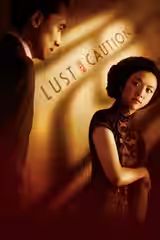
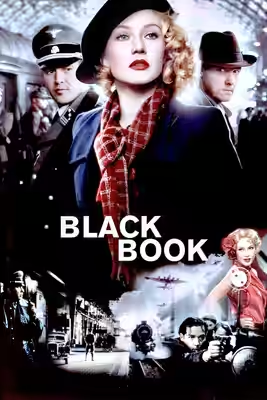
After Shining Through, try Notorious (1946, Fi1m 92): The same bargain, a woman sent into the enemy’s bed, made at half the length and believed. Then Black Book (2006, Fi1m 80): Verhoeven’s Dutch resistance thriller takes the undercover-in-a-Nazi-household idea and does not flinch; and Lust, Caution (2007, Fi1m 76): Ang Lee’s wartime Shanghai, where seduction is the mission and the mission goes wrong slowly.

Cast

Awards

Golden Raspberry Award for Worst Picture, 1993

Won
Golden Raspberry Award for Worst Picture

If you liked this, try…

  1. Notorious (1946, Fi1m 92)The same bargain, a woman sent into the enemy’s bed, made at half the length and believed.

  2. Black Book (2006, Fi1m 80)Verhoeven’s Dutch resistance thriller takes the undercover-in-a-Nazi-household idea and does not flinch.

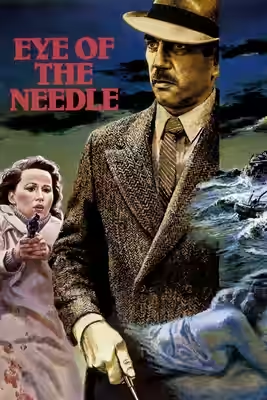
  3. Eye of the Needle (1981) · not reviewed yetDonald Sutherland as a German agent stranded on a Scottish island; patient, nasty and plausible.

  4. Charlotte Gray (2001) · not reviewed yetCate Blanchett goes into occupied France for love and finds the war does not care.

  5. Lust, Caution (2007, Fi1m 76)Ang Lee’s wartime Shanghai, where seduction is the mission and the mission goes wrong slowly.

Free account

Know what to watch tonight

Two lists that know where things are streaming, collections you can share, your own score beside ours, and Discover that remembers what you have seen.

  • Want to see, sorted by what is streaming now
  • Seen, with your score out of ten
  • No adverts, ever