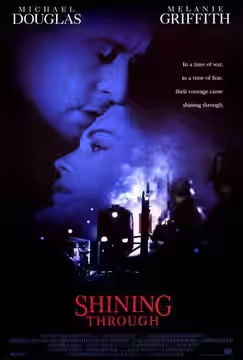
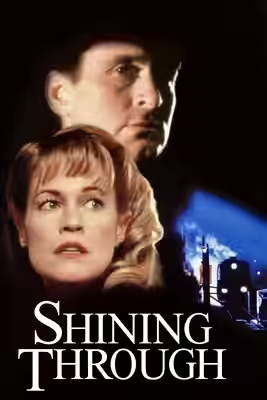
David Seltzer’s wartime romance is handsomely built and hard to believe at every turn. Melanie Griffith is asked to carry it and cannot; Douglas and Neeson do what they can. Watchable, often silly, and not quite a recommendation.
David Seltzer has adapted Susan Isaacs’s novel into the sort of picture Hollywood made in the 1940s: a secretary falls for her boss, discovers he is a spy and follows him into the war. Those films were quick, cheap and did not ask to be believed. This one runs 132 minutes and plays its story straight, so we are asked from the first minute to take what follows as history. That is where the trouble starts.
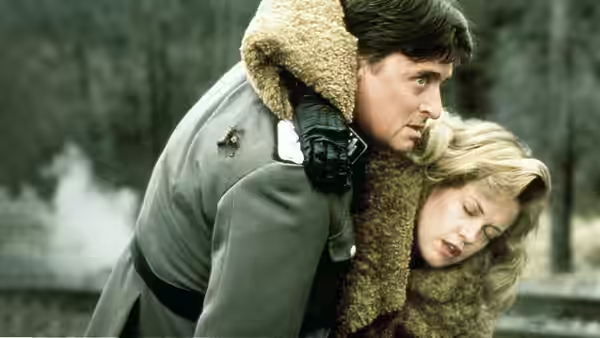
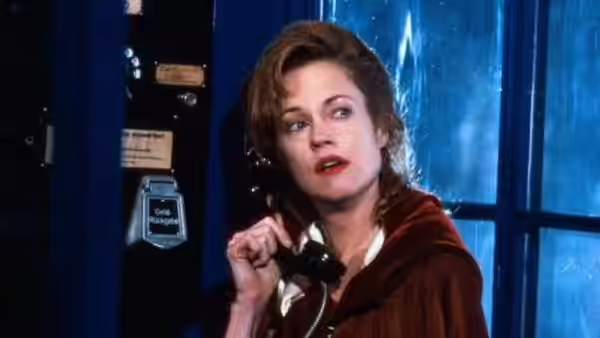
Griffith plays Linda Voss, half-Jewish, from Queens, fluent in German and in the war films she has seen several times each. It is a part written for someone who can be both innocent and quick. Griffith manages the innocence. The quickness does not come, and the script keeps asking for it: she talks her way past guards, lies to a house full of Nazis and bluffs in a kitchen, and she does it all in the small, breathy voice that suited her in Working Girl, which makes every danger sound like an anecdote told later over a drink. Her narration runs over much of the film and does the same. Most critics have said her Linda belongs to the wrong decade, and they are right, though it was Seltzer who wrote her the lines.
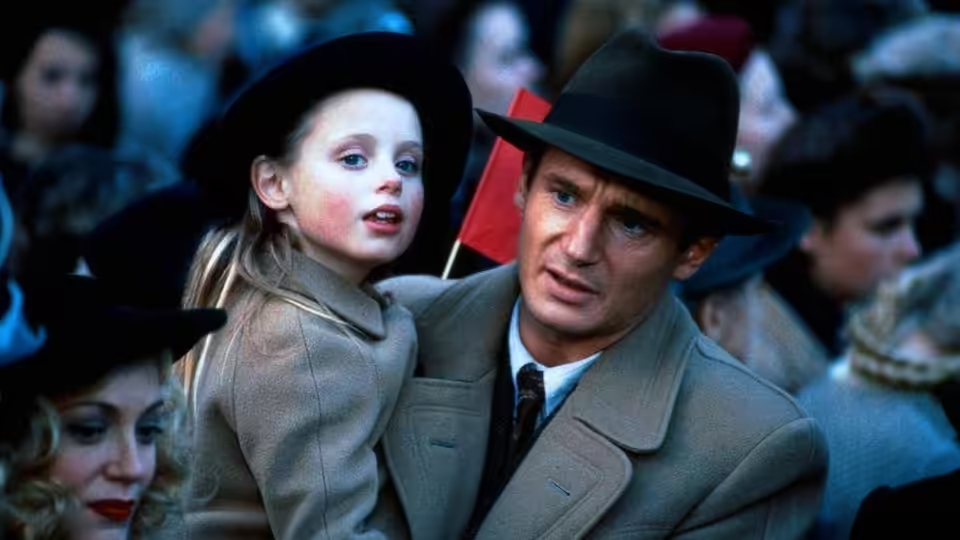
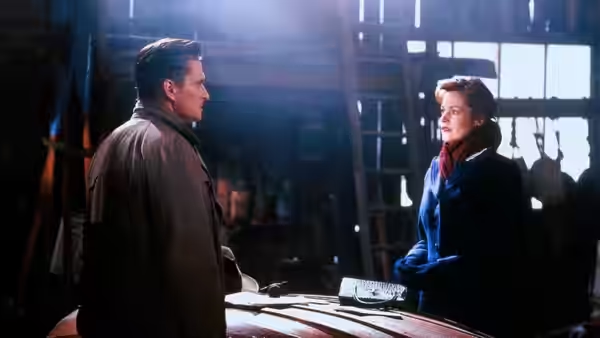
Douglas plays Ed Leland as a man who disapproves of everything, including falling in love. He is better in New York, where the disapproval has an office to work in, than in Berlin, where it has nowhere to go. Neeson has the most interesting part. His Franze-Otto Dietrich is a Nazi official who takes Linda into his home to look after his children, and he is courteous to her and gentle with them, and we found ourselves liking him and then disliking ourselves for it. It is the one place the film does what a spy story should, which is make us unsure where to put our sympathy. Joely Richardson’s Margrete Von Eberstein is sharp and watchable in a role that is mostly plot. John Gielgud, as Sunflower, behaves as if he were in a better film, which is reasonable.
It is handsome, and the people responsible should be named. Anthony Pratt’s Berlin is high ceilings, dark panelling and polished floors, a rich man’s city, and the film spends long enough in Dietrich’s house that we came to know its corridors. Marit Allen dresses Griffith in tailored wool and small hats, and the clothes do more to put her in the period than the dialogue does. Jan de Bont shoots New York warm and lamplit and Berlin colder and greyer, so the change of country is on the screen before anybody mentions it. Michael Kamen’s strings swell wherever the film wants us to feel something, and in several places where we did not.
What does not work is the story, and that is a large thing not to work. Seltzer sends a woman with no training into the capital of the Reich on the strength of her German and her nerve, and then has her survive on luck. Each time she is nearly caught, something turns up that lets her go on, and by the third or fourth time we had stopped holding our breath and started counting. Craig McKay cuts the suspense sequences cleanly, but an editor can only do so much when we know how a scene will end from the way it begins. The second half takes turns we will not describe, except to say that the last half-hour spends whatever plausibility was left on a finish out of a Saturday serial, and plays it straight.
Most critics landed close to where we have, split between those who found it an entertaining two hours of contrivance and those who found the contrivance too much. We are nearer the second group, with some affection for the first hour, when it is still a New York office romance with a secret in it and the cast have something to play. The 15 certificate and the 132 minutes are both accurate. Watch it at home with someone who will laugh at the right moments, which are not always the ones the film intended, and stop paying close attention once it leaves for Berlin.